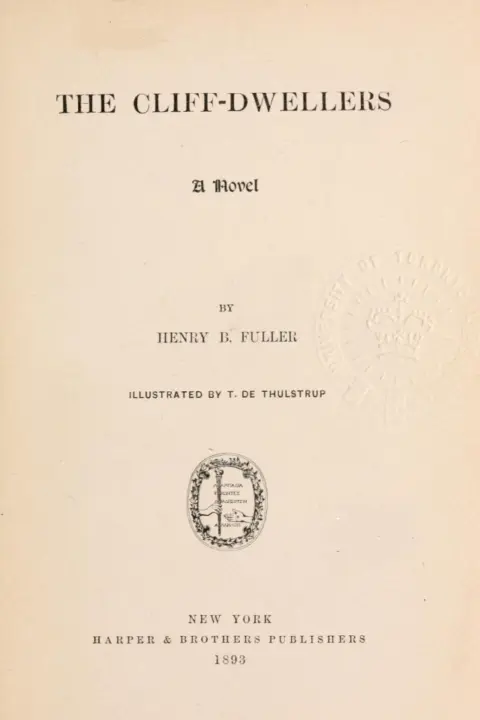
The Cliff-Dwellers: A Novel
Henry Blake Fuller
THE CLASSIC COLLECTION · 1895
"With the Procession" by Henry Blake Fuller is a novel believed to have been written in the late 19th century. The story revolves around the Marshall family, particularly focusing on the dynamics between its members and their interactions with the changing society around them, marked by the return of their son, Truesdale Marshall, after an extended period abroad. The opening of the novel introduces us to the elderly Mr. David Marshall, whose illness invokes surprising reactions from his family, who view his frailty as a crack in the once-impenetrable reliability they attributed to him. As the narrative progresses, it shifts to the bustling city life outside, illustrating the rising tensions between the family's established status and the modernizing world. Truesdale's return home, after years in Europe, sets the stage for family dramas, shifting social positions, and aspirations for relevance amidst a rapidly changing Chicago, where old values appear to clash with new realities. His sisters, Jane and Rosy, and their mother, Eliza, are fleshed out through their observations and responses to the city and to their brother’s newfound ‘elegance’ and experiences abroad, hinting at themes of social mobility and familial loyalty that will unfold throughout the narrative.
Introduction adapted from the source catalogue; source summaries may be automatically generated.
Free to read · English · 86,633 words · No account needed
MAKE TIME FOR A GOOD BOOK
On by default. Untick to stop anonymous reading totals. Each page counts after 10 seconds in view. How this works.
Anonymous counting is on unless you have switched it off.
"Oh! with some girl friends, then? Not much better--that way."
"I'm not going with any girl friends"--this accompanied by a perceptible palpitation of delight. She looked at Mrs. Bates with eyes that seemed to say, "Please go on; don't stop right there."
"Oh, then, that kind, good brother, perhaps," suggested Mrs. Bates--going
on.
"No, not that kind, good brother." Jane's face was fairly beaming.
"Some other kind, good young man, then."
"Yes," responded Jane, with a challenging light on her countenance; "some other kind, good young man."
"Ah! And when does your lecture end?"
"At nine."
"Before the other thing begins. Of course the lecture is much too instructive to lose, and then there's the fascination of a mile or two in a dirty street-car; but couldn't you look in on us between ten and half-past? The box is small, but I have a great fondness for those kind, good young men. Couldn't you induce one of them--any one at all, of course--to bring you, if he knew there was a place waiting for you both?"
"The gentleman who is going to escort me," began Jane, rising suddenly to a very formal tone, "is--well, in fact, he--he doesn't go out very much," she proceeded, lapsing back into her former manner. "He's kind of quiet and retiring. I don't believe he'd ever go to anything like this."
"Not when he's got a good place offered him--and a nice girl to take, with a brand-new dress of just the right sort to go in? I should want a beau of mine to have a little more spunk than that."
"How can you talk that way?" whimpered Jane, quite quivering with pleasure. "I can't sit here and listen to anything like that. What right"--with a feint of maiden indignation--"what right have you to say that Mr. Br--that anybody is--is my--"
"Beau," supplied Mrs. Bates, serenely. "Beau--that's what I said. Old-fashioned word, I know; but I can't think of a better one."
"You're just dreadful; you are," stammered Jane, trying to withdraw as best she might from too pronounced an attitude of protest. She fingered the length of ravelled bordering that drooped from the hair-cloth cushion of her chair and ran an eye, pretendedly speculative, up and down the pink and green stripes of Mrs. Bates's wall-paper.
"I'm pretty sure he wouldn't go--the gentleman who is to escort me to the lecture," she said, with another return to her vain paraphrase. "He's earnest. He's serious. Besides, he hasn't got a dress-coat."
"Hasn't got a dress-coat?"
"He doesn't approve of them. He thinks they're ugly and foolish and--and not right. He believes that society is--well, not exactly wrong, but--"
Your reading position is saved on this browser. Take it to another device with a library code. Reading pages adapt to text, rather than matching a printed edition.
Henry Blake Fuller
Henry Blake Fuller
Henry Blake Fuller
Henry Blake Fuller
BEHIND THE BOOK
This eBook is for the use of anyone anywhere in the United States and most other parts of the world at no cost and with almost no restrictions whatsoever. You may copy it, give it away or re-use it under the terms of the Project Gutenberg License included with this eBook or online at www.gutenberg.org. If you are not located in the United States, you will have to check the laws of the country where you are located before using this eBook. Read the source licence.
The original source file, including credits and licence, is retained by this library. Request an original-format copy at no charge. Please include the book title and Project Gutenberg identifier #8891.
KEEP YOUR CURIOSITY GOING
Coulson Kernahan

Maurice Baring
Frances Wright
Cécile Tormay

Frederic Jesup Stimson

W. H. P. (William Henry Pope) Jarvis