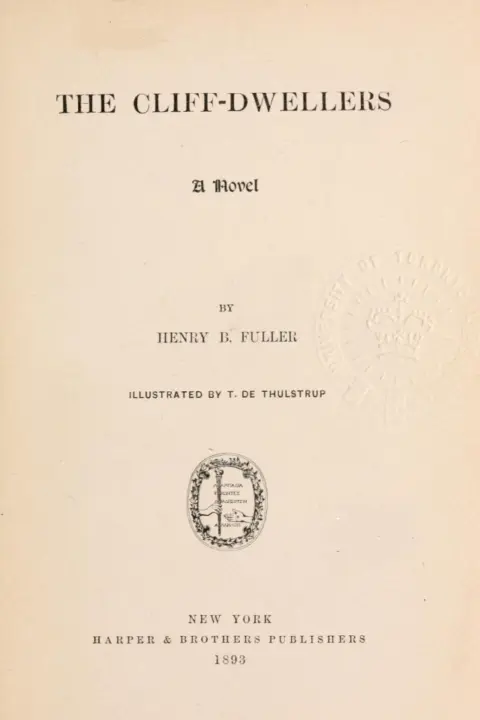
The Cliff-Dwellers: A Novel
Henry Blake Fuller
THE CLASSIC COLLECTION · 1895
"With the Procession" by Henry Blake Fuller is a novel believed to have been written in the late 19th century. The story revolves around the Marshall family, particularly focusing on the dynamics between its members and their interactions with the changing society around them, marked by the return of their son, Truesdale Marshall, after an extended period abroad. The opening of the novel introduces us to the elderly Mr. David Marshall, whose illness invokes surprising reactions from his family, who view his frailty as a crack in the once-impenetrable reliability they attributed to him. As the narrative progresses, it shifts to the bustling city life outside, illustrating the rising tensions between the family's established status and the modernizing world. Truesdale's return home, after years in Europe, sets the stage for family dramas, shifting social positions, and aspirations for relevance amidst a rapidly changing Chicago, where old values appear to clash with new realities. His sisters, Jane and Rosy, and their mother, Eliza, are fleshed out through their observations and responses to the city and to their brother’s newfound ‘elegance’ and experiences abroad, hinting at themes of social mobility and familial loyalty that will unfold throughout the narrative.
Introduction adapted from the source catalogue; source summaries may be automatically generated.
Free to read · English · 86,633 words · No account needed
MAKE TIME FOR A GOOD BOOK
On by default. Untick to stop anonymous reading totals. Each page counts after 10 seconds in view. How this works.
Anonymous counting is on unless you have switched it off.
It was. Truesdale was escorting Gladys--Gladys McKenna, as her complete name had finally come to him. He had laughed on first hearing it. "There's a chaud-froid for you, sure enough!"
Gladys wore a flame-colored gown, and her eyes, curiously fringed with black above and beneath, had an outré and dishevelled appearance that lingered in the memory as wax-works do. She kept a strong clutch on his arm, and galloped alongside him with a persistent camaraderie which conveyed no hint of cessation.
"Why insist so strongly on a quadrille d'honneur?" he was asking her. "Wasn't a march good enough?"
"We always look for a quadrille at one of the best functions--at home."
"But why draw lines? You don't object if people meet for pleasure on
terms free and equal?"
"Oh, of course if you have no celebrities here--no great figures--"
"Not one--not till you came. We are all plain people here. If any of us forget our plainness there are plenty who are glad enough to remind us of it."
"Are you plain, too?"
"The plainest of the lot."
"You don't seem so; you look awfully ornamental, with that ribbon and all." The "all" meant the wave in his hair, the lustre of his eyes, the upward flaunt of his mustache which hid in no degree the white, firm evenness of his teeth, the freshness of a second gardenia--even the sheen of his shapely shoes.
"The ribbon--you like it? Sorry I'm wearing only one. How would you have liked a second running the opposite way? Or a third pinned on behind?"
"Oh, you!--How about all these other young men; are they anybody?"
"What other young men?"
"The ones with these criss-cross red ribbons."
"Oh! Well, some few of them have what you might call position, and some are working for it, and some are not thinking anything about it; and some, after having served their purpose, will be dropped soon enough, I promise you."
"And you yourself--are you in, or out, or not thinking about it, or-"
"I?" returned Truesdale, carelessly. "I'm just a passer-by; I'm on my way
to Japan."
"Oh no; not Japan!" said the girl, quickly.
"Japan, I assure you," he smiled.
She caught herself. "To escape my uncle, then?"
"Why that, in Heaven's name?"
"You have offended him."
"Dear me! How?"
"By what you said at the house the other night. About the costumes, you
know."
"Nonsense. How could that have reached him?"
"Those things do get around. Do you know what he's going to do? He's going to cut your comb. My aunt--she cried like anything."
Your reading position is saved on this browser. Take it to another device with a library code. Reading pages adapt to text, rather than matching a printed edition.
Henry Blake Fuller
Henry Blake Fuller
Henry Blake Fuller
Henry Blake Fuller
BEHIND THE BOOK
This eBook is for the use of anyone anywhere in the United States and most other parts of the world at no cost and with almost no restrictions whatsoever. You may copy it, give it away or re-use it under the terms of the Project Gutenberg License included with this eBook or online at www.gutenberg.org. If you are not located in the United States, you will have to check the laws of the country where you are located before using this eBook. Read the source licence.
The original source file, including credits and licence, is retained by this library. Request an original-format copy at no charge. Please include the book title and Project Gutenberg identifier #8891.
KEEP YOUR CURIOSITY GOING
Coulson Kernahan

Maurice Baring
Frances Wright
Cécile Tormay

Frederic Jesup Stimson

W. H. P. (William Henry Pope) Jarvis