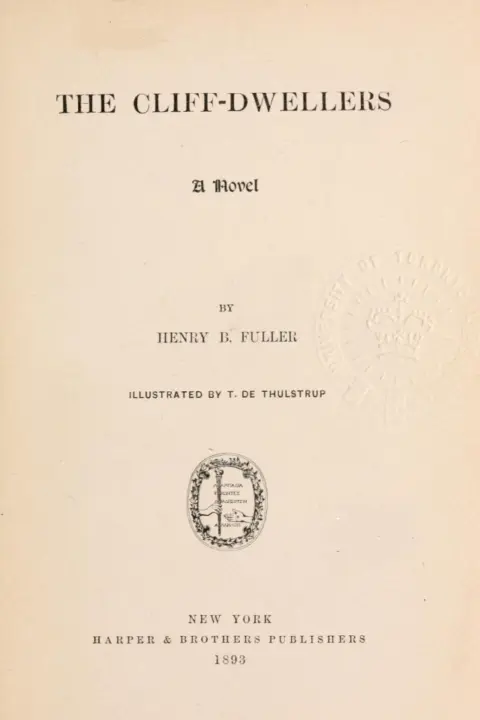
The Cliff-Dwellers: A Novel
Henry Blake Fuller
THE CLASSIC COLLECTION · 1895
"With the Procession" by Henry Blake Fuller is a novel believed to have been written in the late 19th century. The story revolves around the Marshall family, particularly focusing on the dynamics between its members and their interactions with the changing society around them, marked by the return of their son, Truesdale Marshall, after an extended period abroad. The opening of the novel introduces us to the elderly Mr. David Marshall, whose illness invokes surprising reactions from his family, who view his frailty as a crack in the once-impenetrable reliability they attributed to him. As the narrative progresses, it shifts to the bustling city life outside, illustrating the rising tensions between the family's established status and the modernizing world. Truesdale's return home, after years in Europe, sets the stage for family dramas, shifting social positions, and aspirations for relevance amidst a rapidly changing Chicago, where old values appear to clash with new realities. His sisters, Jane and Rosy, and their mother, Eliza, are fleshed out through their observations and responses to the city and to their brother’s newfound ‘elegance’ and experiences abroad, hinting at themes of social mobility and familial loyalty that will unfold throughout the narrative.
Introduction adapted from the source catalogue; source summaries may be automatically generated.
Free to read · English · 86,633 words · No account needed
MAKE TIME FOR A GOOD BOOK
On by default. Untick to stop anonymous reading totals. Each page counts after 10 seconds in view. How this works.
Anonymous counting is on unless you have switched it off.
"Well, I don't know," said Jane, filling up the breach in the first fashion that presented itself. "If pa had the same gift of language that you have, I should feel surer." She picked out her puffs, and then leaned back negligently with her hands crossed. She was too thoroughly grounded by this time to be discomposed by any youth seven or eight years her junior.
The youth shifted his feet.
"I saw you with my sister a minute ago," continued Jane. She knew, without looking round to see, that Mrs. Bates was smiling in the anxious, would-be-helpful way of parents who have put their offspring at a disadvantage.
"Yes--oh yes," the young man responded, with precipitation. "We had a
very nice polka, indeed."
"Well," said Jane to herself, "I can talk about polkas and lots of other things." And she did. She held and entertained the young man for a full ten minutes. She found, after all, that he was in no degree constrained or backward, and she made him do himself justice.
"Well, my dear," said Mrs. Bates, as he withdrew, "you made my Billy
quite brilliant. I don't know when I have heard so much real
conversation!"
"That's all right," responded Jane; "I was young myself once. I haven't
forgotten that."
"Only you mustn't fascinate him," protested the elder woman, with a burlesque of maternal anxiety. "I want somebody else to do that." She gave Jane a smile full of meaning.
"Aha!" thought Jane, and wondered if she were to see a certain little romance resumed after the lapse of so many lumbering years.
"But she didn't seem to mind Paston any. Well, why should she?" concluded
Jane.
Presently Truesdale came along and asked his sister to waltz. "All right," she said; "just for a minute; but not out in the middle--yet." She wished to test herself first.
"You're awfully good to me, Dicky," she whispered, as he led her back.
"Cut it," said Truesdale; "I'm proud of you."
Jane got back to her lofty perch. "I'll do it once more--if anybody
asks me; yes, I will."
In another ten minutes she was on the floor again. "Quite happy, I'm sure," she had said to Bingham.
"Only I'm no great dancer," this big and bearded bachelor had warned her.
"Neither am I," declared Jane. "I can just totter around and that's about all." She arose quickly, shook out her plumage, took his arm, and in less than a minute was waltzing again. "Lucky it is a waltz," she thought; "I don't want to be trying too many novelties."
Your reading position is saved on this browser. Take it to another device with a library code. Reading pages adapt to text, rather than matching a printed edition.
Henry Blake Fuller
Henry Blake Fuller
Henry Blake Fuller
Henry Blake Fuller
BEHIND THE BOOK
This eBook is for the use of anyone anywhere in the United States and most other parts of the world at no cost and with almost no restrictions whatsoever. You may copy it, give it away or re-use it under the terms of the Project Gutenberg License included with this eBook or online at www.gutenberg.org. If you are not located in the United States, you will have to check the laws of the country where you are located before using this eBook. Read the source licence.
The original source file, including credits and licence, is retained by this library. Request an original-format copy at no charge. Please include the book title and Project Gutenberg identifier #8891.
KEEP YOUR CURIOSITY GOING
Coulson Kernahan

Maurice Baring
Frances Wright
Cécile Tormay

Frederic Jesup Stimson

W. H. P. (William Henry Pope) Jarvis