THE CLASSIC COLLECTION✦An outlaw’s diary: the CommuneCLASSIC FREE BOOKS
An outlaw’s diary: the Commune
Cécile Tormay
THE CLASSIC COLLECTION · 1916
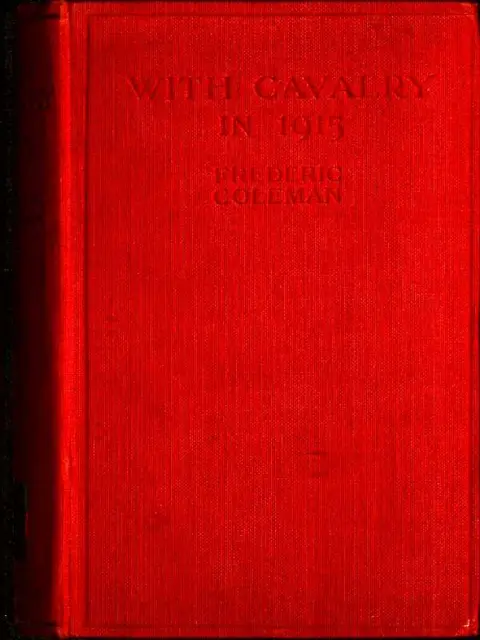
"With Cavalry in 1915" by Frederic Coleman is a historical account written during the early 20th century. It provides a detailed chronicle of the British cavalry's experiences during World War I, specifically focusing on the events surrounding the Second Battle of Ypres. The narrative explores the hardships of trench warfare, the valor of soldiers, and the dynamic between British and German forces during this critical period. The opening of the book introduces the author, who is one of the few remaining members of the original Royal Automobile Club Corps attached to the 1st Cavalry Division. He describes the dismal conditions in Flanders, his interactions with fellow officers, and the routines of military life during the winter of 1915. Coleman reflects on the extraordinary resilience and discipline of the British troops amidst the wet and muddy landscape, detailing various encounters along the front lines, including a poignant account of a temporary Christmas truce between opposing soldiers. His depiction captures the grim realities of war while hinting at the camaraderie and humor that could still thrive in such dire circumstances.
Introduction adapted from the source catalogue; source summaries may be automatically generated.
Free to read · English · 61,794 words · No account needed
MAKE TIME FOR A GOOD BOOK
On by default. Untick to stop anonymous reading totals. Each page counts after 10 seconds in view. How this works.
Anonymous counting is on unless you have switched it off.
Tell the nation that this hate is not un-German, that it is not poison for our people. Write in letters of fire the name of our bitterest enemy. You guardians of the truth, feed this sacred hate!
You German fathers, lead your children up to the high hills of our homeland, at the feet of our dear country bathed in sunshine. Your women and children shall starve: bestial, devilish conception. England wills it! Surely all that is in you rises against such infamy!
Listen to the ceaseless song of the German forest, behold the fruitful fields like rolling seas, then will your love for this wondrous land find the right words, "Hate, unquenchable Hate! Germany, Germany above all!"
Let it be inculcated in your children, and it will grow like a landslide, irresistible, from generation to generation.
You fathers, proclaim it aloud over the billowing fields, that the toiling peasant below may hear you, that the birds of the forest may fly away with the message: into the land that echoes from German cliffs send it reverberating like the clanging of bells from tower to tower throughout the country side:
"Hate, Hate, the accursed English, Hate!"
You masters, carry the flame to your workshops. Axe and hammer will fall the heavier when arms are nerved by this Hate.
You peasants, guard this flame, fan it anew in the hearts of your toilers that the hand may rest heavy on the plough that throws up the soil of our homeland.
What CARTHAGE was to ROME, ENGLAND is to GERMANY.
For ROME as for us it is a question of "to be or not to be."
May our people find a faithful mentor like Cato.
HIS CETERUM CENSEO, CARTHAGINEM ESSE DELENDAM for us means
Some people laud the "thoroughness" of the German Army.
I wonder if they laud the "thoroughness" of its hate.
The Army under Sir John French was assuming considerable proportions early in April. In addition to the 1st, 2nd, 3rd, 4th, 5th, 6th, 7th, and 8th Divisions, the 27th and 28th, the Canadian Division and the Divisions of the Indian Corps, as well as the 1st, 2nd and 3rd Cavalry Divisions and the Indian Cavalry Division, were well seasoned. The North Midland, 2nd London and South Midland Territorial Divisions were "out," and fast gaining experience and a good reputation with it, while the Northumberland Territorial Division was on the way.
G.H.Q. information summaries in the early days of April said laconically, "Nothing to report on the British front," and were generally fairly correct.
Your reading position is saved on this browser. Take it to another device with a library code. Reading pages adapt to text, rather than matching a printed edition.
BEHIND THE BOOK
This eBook is for the use of anyone anywhere in the United States and most other parts of the world at no cost and with almost no restrictions whatsoever. You may copy it, give it away or re-use it under the terms of the Project Gutenberg License included with this eBook or online at www.gutenberg.org. If you are not located in the United States, you will have to check the laws of the country where you are located before using this eBook. Read the source licence.
The original source file, including credits and licence, is retained by this library. Request an original-format copy at no charge. Please include the book title and Project Gutenberg identifier #51285.
KEEP YOUR CURIOSITY GOING
Cécile Tormay

Moritz Busch
John L. Ransom
Frances Wright
Cécile Tormay

Mabel Potter Daggett