THE CLASSIC COLLECTION✦An outlaw’s diary: the CommuneCLASSIC FREE BOOKS
An outlaw’s diary: the Commune
Cécile Tormay
THE CLASSIC COLLECTION · 1916
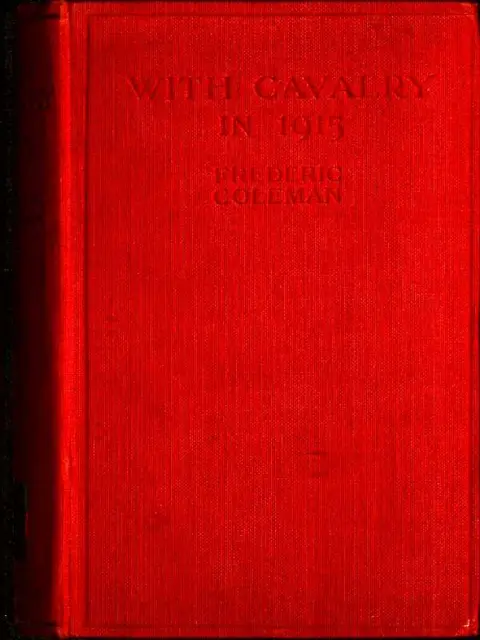
"With Cavalry in 1915" by Frederic Coleman is a historical account written during the early 20th century. It provides a detailed chronicle of the British cavalry's experiences during World War I, specifically focusing on the events surrounding the Second Battle of Ypres. The narrative explores the hardships of trench warfare, the valor of soldiers, and the dynamic between British and German forces during this critical period. The opening of the book introduces the author, who is one of the few remaining members of the original Royal Automobile Club Corps attached to the 1st Cavalry Division. He describes the dismal conditions in Flanders, his interactions with fellow officers, and the routines of military life during the winter of 1915. Coleman reflects on the extraordinary resilience and discipline of the British troops amidst the wet and muddy landscape, detailing various encounters along the front lines, including a poignant account of a temporary Christmas truce between opposing soldiers. His depiction captures the grim realities of war while hinting at the camaraderie and humor that could still thrive in such dire circumstances.
Introduction adapted from the source catalogue; source summaries may be automatically generated.
Free to read · English · 61,794 words · No account needed
MAKE TIME FOR A GOOD BOOK
On by default. Untick to stop anonymous reading totals. Each page counts after 10 seconds in view. How this works.
Anonymous counting is on unless you have switched it off.
"At last," he murmured. "Now I must count off the five minutes to the
second."
A squadron of the Queen's Bays was ready to rush into the enemy's
trench. Ten of them, the forward storming party, were waiting in a
saphead.
One, two, three, four, and at last, five.
Boom!
The whole earth seemed thrown skyward. The shock was terrific. Nearly one thousand pounds of blasting powder had tossed fifty yards of German trench, not two hundred feet in front of our line, high in air.
The great smash came as a complete surprise to the Huns, but, alas! an equal surprise to French and British.
The explosion which the British sapper, in his tunnel dug-out, had mistaken for the discharge of the French mine, had been a huge German minenwerfer, or trench-bomb, thrown by a trench-howitzer.
The French mine, inexplicably delayed, had not been fired.
For a moment confusion reigned. Three men of the half-score Queen's Bays in the storming party were hurt. One suffered a broken arm, and the others, hurled aside by the unexpected explosion of our own mine, were badly bruised and strained.
In an instant, however, every man in the line realised what had occurred, and the Bays went forward with a yell, occupying about fifty yards of German first-line trench and the gaping crater left by the mine.
Fortifying the captured position and installing therein a couple of machine-guns, they met the enemy's counter-attacks staunchly.
For three hours and a half they kept the ground won, but at last were bombed out. The Huns threw hundreds of grenades among them, while our poor supply of trench-bombs ran out in but a few minutes.
I chatted with the remnants of the storming party when they came back. Many gruesome tales they told. One German soldier was blown high in the air, over a fringe of trees, and found some distance back of our front line, quite 150 yards from his own trench.
A trooper noticed a movement near a pile of timber, earth, and sandbags. Peering through the dim light, he saw a hand waving about aimlessly. Grasping it, he pulled with a will. A comrade assisted, and soon they unearthed a buried German.
The prisoner was a funny little fellow--a stocky Wurtemburger in green corduroys and a knitted helmet. When rescued, he lapsed into unconsciousness for an hour. He had been through the first battle of Ypres, he said later, in which he was the only one of his regiment to escape death or a wound. Blown high in air, very, very high, it seemed to him, he felt a great mass of débris fall upon him.
Your reading position is saved on this browser. Take it to another device with a library code. Reading pages adapt to text, rather than matching a printed edition.
BEHIND THE BOOK
This eBook is for the use of anyone anywhere in the United States and most other parts of the world at no cost and with almost no restrictions whatsoever. You may copy it, give it away or re-use it under the terms of the Project Gutenberg License included with this eBook or online at www.gutenberg.org. If you are not located in the United States, you will have to check the laws of the country where you are located before using this eBook. Read the source licence.
The original source file, including credits and licence, is retained by this library. Request an original-format copy at no charge. Please include the book title and Project Gutenberg identifier #51285.
KEEP YOUR CURIOSITY GOING
Cécile Tormay

Moritz Busch
John L. Ransom
Frances Wright
Cécile Tormay

Mabel Potter Daggett