THE CLASSIC COLLECTION✦An outlaw’s diary: the CommuneCLASSIC FREE BOOKS
An outlaw’s diary: the Commune
Cécile Tormay
THE CLASSIC COLLECTION · 1916
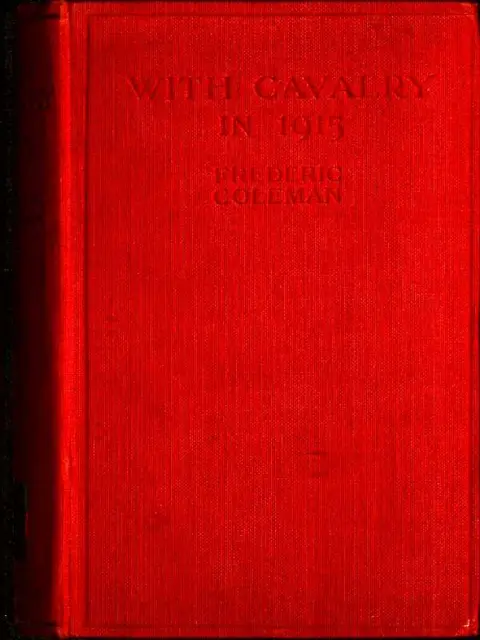
"With Cavalry in 1915" by Frederic Coleman is a historical account written during the early 20th century. It provides a detailed chronicle of the British cavalry's experiences during World War I, specifically focusing on the events surrounding the Second Battle of Ypres. The narrative explores the hardships of trench warfare, the valor of soldiers, and the dynamic between British and German forces during this critical period. The opening of the book introduces the author, who is one of the few remaining members of the original Royal Automobile Club Corps attached to the 1st Cavalry Division. He describes the dismal conditions in Flanders, his interactions with fellow officers, and the routines of military life during the winter of 1915. Coleman reflects on the extraordinary resilience and discipline of the British troops amidst the wet and muddy landscape, detailing various encounters along the front lines, including a poignant account of a temporary Christmas truce between opposing soldiers. His depiction captures the grim realities of war while hinting at the camaraderie and humor that could still thrive in such dire circumstances.
Introduction adapted from the source catalogue; source summaries may be automatically generated.
Free to read · English · 61,794 words · No account needed
MAKE TIME FOR A GOOD BOOK
On by default. Untick to stop anonymous reading totals. Each page counts after 10 seconds in view. How this works.
Anonymous counting is on unless you have switched it off.
By HAROLD HARVEY, of the Royal Fusiliers. Fully illustrated.
=3/6= net.
Revelations of German cruelty that will startle the Country.
By H. C. MAHONEY. Fully illustrated. =6=/- net.
By a well-known critic and novelist.
By FRANCIS GRIBBLE. Author of "The Comedy of Catherine the
Great." =7/6= net.
Sanctioned by the Admiralty.
By FRED T. JANE. Published annually. Fully illustrated with
photographs, plans and silhouettes. Detailed Prospectus gratis.
=21=/- net.
Officially adopted throughout the two Hemispheres.
By FRED T. JANE and C. G. GREY. The only recognised Aerial Annual published. Issued Annually. Fully illustrated. Detailed Prospectus gratis. =21=/- net.
Every Patriotic Britisher should read this book.
CONTINGENT DITTIES and other Soldier Songs of the Great War.
By the late FRANK S. BROWN, of Princess Pat's Own. Oblong cloth, =1=/- net. Presentation editions, =2/6= net to =4/6= net. Detailed Prospectus gratis.
++With Generals French, Smith-Dorrien, and De Lisle in the Firing
Line.++
"From Mons to Ypres with French."
By FREDERIC COLEMAN,
A Member of the R.A.C. Contingent at the Front.
50 Illustrations taken there. Sixth Large Printing in hand. Crown 8vo., cloth, gilt, =6=/- net.
Mr. Coleman gives his actual experiences in the thick of the fighting during the first four months of the War.
Reprinted with permission from "The Spectator," May 20th, 1916.
English politicians and journalists deserve some credit for the manner in which they have dealt with the attitude assumed by the United States of America during the present war. The policy pursued by President Wilson has unquestionably caused some surprise and disappointment on this side of the Atlantic. But the discussion has always been characterized by great restraint. Language calculated to wound the national susceptibilities of Americans has been studiously avoided. By far the most severe of President Wilson's critics have been his own countrymen. Several causes have contributed to bring about this result. Of these, the most important has been the fact that the genuine friendship entertained by most Englishmen for their Transatlantic kinsmen has made them very reluctant to criticize. Then, again, incipient criticism has been checked by a feeling that we owe some atonement for the harsh judgment most unfortunately passed by some sections of English society on American policy during the great struggle of half-a-century ago; by a just appreciation of the fact that, whatever we might think, Americans are not only the sole, but also the best judges of the conduct of their own Government; and by the reflection that the difficulties which beset President Wilson cannot be fully realized on this side of the Atlantic. But, in addition to these causes, there has been another which has largely contributed to prevent any estrangement between the two great branches of the Anglo-Saxon race. Englishmen, although they have been somewhat astonished at the equanimity with which the frequent German outrages against American life and property have been endured, have never resented the neutral attitude adopted by the United States Government; but they have felt that President Wilson failed to rise to the situation, that he did not adequately appreciate the extent to which the greatest democracy of the world was interested in the struggle against absolutism, and that, without any departure from an attitude of strict neutrality, a greater amount of sympathy might have been displayed for those who are the champions of progress and civilization against retrogression and an abhorrent State morality. At the same time, they felt that the attitude of official America did not accurately represent the real feelings and sentiments of the American public, or at all events of that portion of the public whose views were most entitled to respect. Hence, it has resulted that the opinions expressed by individual Americans, who were untrammelled by official responsibilities, have served as a healthy antidote to the acts and language of their Government. Amongst this class Mr. Frederic Coleman is entitled to occupy a distinguished place. In the very spirited and graphic account which he has written of his personal experiences with the British Expeditionary Force in France, he speaks with no uncertain voice. "Friends and readers," he says, "do not forget that most Americans feel much the same as I feel about the war. An overwhelming majority of those of my countrymen who know the truth would do what lies in their power to further the success of the Allies and their righteous cause." Moreover, he arraigns the criminal monarch who has been instrumental in bringing about the greatest catastrophe the world has ever witnessed before the bar of human and Divine justice. Speaking of the gallant Grenfell twin brothers, both of whom were sacrificed on the altar of German ambition, he uses words which should find a responsive echo in many a sorely-stricken French and English home. "Fine men of noble character, the Grenfells. Surely the monarch responsible for a war that mows down the flower of the world's manhood in the fulness of its youth must one day answer for his crime, in this world or the next."
Your reading position is saved on this browser. Take it to another device with a library code. Reading pages adapt to text, rather than matching a printed edition.
BEHIND THE BOOK
This eBook is for the use of anyone anywhere in the United States and most other parts of the world at no cost and with almost no restrictions whatsoever. You may copy it, give it away or re-use it under the terms of the Project Gutenberg License included with this eBook or online at www.gutenberg.org. If you are not located in the United States, you will have to check the laws of the country where you are located before using this eBook. Read the source licence.
The original source file, including credits and licence, is retained by this library. Request an original-format copy at no charge. Please include the book title and Project Gutenberg identifier #51285.
KEEP YOUR CURIOSITY GOING
Cécile Tormay

Moritz Busch
John L. Ransom
Frances Wright
Cécile Tormay

Mabel Potter Daggett