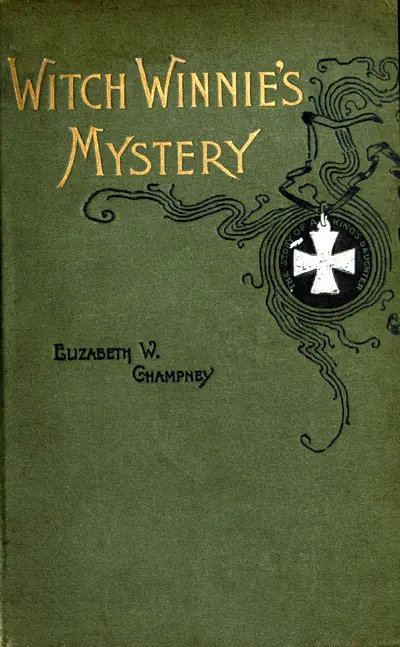
Witch Winnie’s Mystery, or The Old Oak Cabinet: The Story of a King’s Daughter
Elizabeth W. (Elizabeth Williams) Champney
THE CLASSIC COLLECTION · 1889
"Witch Winnie: The Story of a 'King's Daughter'" by Elizabeth W. Champney is a charming novel written in the late 19th century. The narrative revolves around the character of Witch Winnie, a vivacious and imaginative young girl, who is introduced into a boarding school known for its proper and well-behaved pupils. The story unfolds through the eyes of Nellie Smith, one of Winnie’s new classmates, who grapples with her shifting social dynamics as Winnie shakes up their well-ordered lives. The opening of the book introduces us to the structured life at Madame's boarding school, where the privileged girls of the "Amen Corner" take pride in their good behavior. The arrival of Witch Winnie disrupts their routine, and tensions arise as the girls react to her impulsive and lively antics. As Winnie finds her footing among her new peers, she ultimately wins their hearts through her generosity and daring spirit, turning initial disdain into friendship. This sets the stage for various escapades, highlighting themes of companionship, social class, and personal growth in a vibrant boarding school setting.
Introduction adapted from the source catalogue; source summaries may be automatically generated.
Free to read · English · 67,674 words · No account needed
MAKE TIME FOR A GOOD BOOK
On by default. Untick to stop anonymous reading totals. Each page counts after 10 seconds in view. How this works.
Anonymous counting is on unless you have switched it off.
Then we marched into chapel on tiptoe with excitement to see Madame wreak vengeance on the wrong-doers. Witch Winnie sat behind me, and turning, I saw that she looked pale, but resolute.
Madame rose in awful dignity, her wiry curls, which Milly said reminded her of spiral bed-springs, bristled ominously.
"Young ladies," she exclaimed, in a sharp tone of command, "you may all
rise." We rose.
"If you turn to the printed rules of this institution," she continued, "you will find under Section VII. the following paragraph--'Pupils are not allowed to disfigure the lawn by throwing from the windows any bits of paper, hair, apple-parings, peanut shells, or waste material of any kind. Scrap-baskets are provided for the reception of such matter, and any pupil throwing anything from her window upon the school grounds will be regarded as having committed a misdemeanor.'"
An impressive silence followed, in which Witch Winnie gave a sigh of relief, and whispered to Cynthia Vaughn, "We're all right; we didn't disfigure her precious lawn. The bouquets never touched the ground. I lowered them, with a string, in my scrap-basket (just where she says we ought to have put them), and the drum-major took them out and distributed them to the other boys."
"Young ladies," Madame continued, in tones of triumph, "those of you who have not broken this rule within the past week may sit down."
We all sat down--all but Emma Jane Anton, who remained in conspicuous discomfort. Adelaide pulled her by the basque, "Sit down!" she whispered; "Madame doesn't mean you."
Emma Jane stood like a martyr while Madame regarded her through her lorgnette with astonishment depicted on every feature.
"If you committed this infringement of the rules at any time other than last evening you may sit down."
Emma Jane remained standing.
"Then," said Madame, drawing herself up frigidly, "Miss Anton, you may explain: what was it you threw out?"
"Madame," replied Emma Jane, "the window was open--we were listening to the music--and a bat flew in; and, Madame, he would not stay in the waste-paper basket, and so, Madame, I threw him out."
Every one laughed; discipline was forgotten for the moment, until Madame rapped smartly on the desk and called for order. She complimented Emma Jane highly on her conscientiousness, but she looked provoked with her all the same, while Witch Winnie, who was stuffing her handkerchief into her mouth, nearly went into convulsions.
Your reading position is saved on this browser. Take it to another device with a library code. Reading pages adapt to text, rather than matching a printed edition.
Elizabeth W. (Elizabeth Williams) Champney
BEHIND THE BOOK
This eBook is for the use of anyone anywhere in the United States and most other parts of the world at no cost and with almost no restrictions whatsoever. You may copy it, give it away or re-use it under the terms of the Project Gutenberg License included with this eBook or online at www.gutenberg.org. If you are not located in the United States, you will have to check the laws of the country where you are located before using this eBook. Read the source licence.
The original source file, including credits and licence, is retained by this library. Request an original-format copy at no charge. Please include the book title and Project Gutenberg identifier #34551.
KEEP YOUR CURIOSITY GOING
Coulson Kernahan

Maurice Baring
Frances Wright
Cécile Tormay

Frederic Jesup Stimson

W. H. P. (William Henry Pope) Jarvis