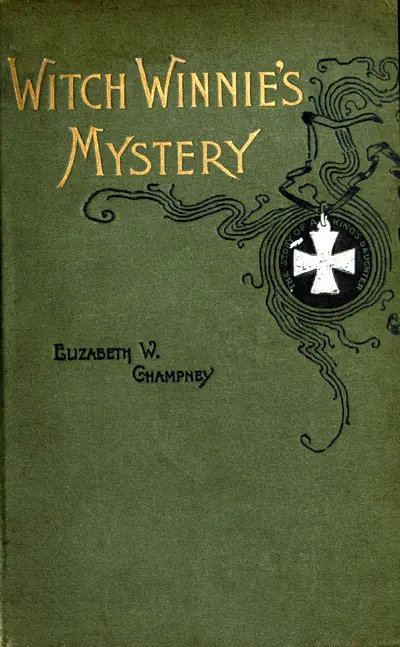
Witch Winnie’s Mystery, or The Old Oak Cabinet: The Story of a King’s Daughter
Elizabeth W. (Elizabeth Williams) Champney
THE CLASSIC COLLECTION · 1889
"Witch Winnie: The Story of a 'King's Daughter'" by Elizabeth W. Champney is a charming novel written in the late 19th century. The narrative revolves around the character of Witch Winnie, a vivacious and imaginative young girl, who is introduced into a boarding school known for its proper and well-behaved pupils. The story unfolds through the eyes of Nellie Smith, one of Winnie’s new classmates, who grapples with her shifting social dynamics as Winnie shakes up their well-ordered lives. The opening of the book introduces us to the structured life at Madame's boarding school, where the privileged girls of the "Amen Corner" take pride in their good behavior. The arrival of Witch Winnie disrupts their routine, and tensions arise as the girls react to her impulsive and lively antics. As Winnie finds her footing among her new peers, she ultimately wins their hearts through her generosity and daring spirit, turning initial disdain into friendship. This sets the stage for various escapades, highlighting themes of companionship, social class, and personal growth in a vibrant boarding school setting.
Introduction adapted from the source catalogue; source summaries may be automatically generated.
Free to read · English · 67,674 words · No account needed
MAKE TIME FOR A GOOD BOOK
On by default. Untick to stop anonymous reading totals. Each page counts after 10 seconds in view. How this works.
Anonymous counting is on unless you have switched it off.
"I had marigolds and columbines,
And pinks all pinks exceeding;
I'd a noble root of love-in-a-mist,
And plenty of love-lies-bleeding."
There was a bed of herbs, too, which my mother cherished--sweet-marjoram and summer savory, sage, rue, and rosemary.
Winnie took a great interest in all of these plants. The country girls thought it odd that she should care for the wild plants which were so common in our vicinity, not knowing Winnie's enthusiasm for botany, and her desire to make a large collection to show the princess. An unusually ignorant girl met her on one of her botanizing expeditions, and Winnie asked her if maiden-hair grew in our region. "Of course it does!" the girl replied, indignantly; "you didn't s'pose we all wore wigs, did you?"
It was some time before Winnie could control herself and explain that the maiden-hair of which she was in search was a kind of fern.
"Do you want it for a charm?" the girl asked.
"No," replied Winnie; "what will it do?"
"If you put it in your shoe and say the right kind of a charm, you will understand the language of the birds."
"Then I shall certainly try it," said Winnie, "for that would be great
fun."
Another day mother brought the same girl into the garden, where Winnie was at work, to give her some vegetables.
"Did you try the charm?" the girl asked.
"Yes, indeed," Winnie replied.
"And did it work?"
"Oh, famously! There is a wood-pecker in the old tree just outside of my window, and he wakes me by his drumming every morning. This morning I understood for the first time just what he has been saying. It was 'Wake up, wake up! little rascal, little rascal, little rascal!'"
The girl stared at Winnie in open-mouthed astonishment. "You must be a
witch," she said.
"That's what they call me--Witch Winnie."
They were standing beside mother's bed of herbs, and the frightened girl pulled up a stalk of rue and held it at arm's length, as though it were a protection. "Don't come nigh me! don't work any of your tricks on me!" she said.
Winnie explained that she was only in sport, but the girl was only half reassured, and still clung to the spray of rue.
Miss Prillwitz afterward explained that rue, like vervain, was supposed to "hinder witches of their will," probably from the fact that it was once used in the Church of Rome, bound in fagots, as a holy-water sprinkler, and is spoken of in old writings as the "Herb of Grace."
Your reading position is saved on this browser. Take it to another device with a library code. Reading pages adapt to text, rather than matching a printed edition.
Elizabeth W. (Elizabeth Williams) Champney
BEHIND THE BOOK
This eBook is for the use of anyone anywhere in the United States and most other parts of the world at no cost and with almost no restrictions whatsoever. You may copy it, give it away or re-use it under the terms of the Project Gutenberg License included with this eBook or online at www.gutenberg.org. If you are not located in the United States, you will have to check the laws of the country where you are located before using this eBook. Read the source licence.
The original source file, including credits and licence, is retained by this library. Request an original-format copy at no charge. Please include the book title and Project Gutenberg identifier #34551.
KEEP YOUR CURIOSITY GOING
Coulson Kernahan

Maurice Baring
Frances Wright
Cécile Tormay

Frederic Jesup Stimson

W. H. P. (William Henry Pope) Jarvis