
Dead letters
Maurice Baring
THE CLASSIC COLLECTION · 1898
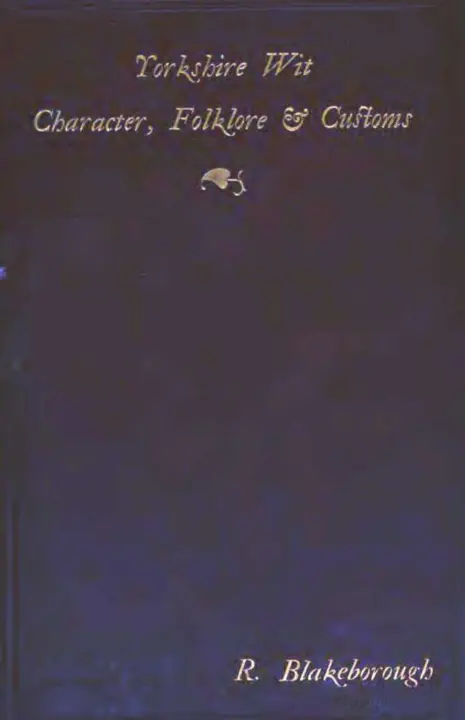
"Wit, Character, Folklore & Customs of the North Riding of Yorkshire" by Richard Blakeborough is a collection of anecdotes and observations reflecting the local wit and customs, likely written in the late 19th century. The work captures the essence of Yorkshire character through various humorous stories, sayings, and reflections on the dialect and social customs of the North Riding, aiming to preserve them from fading into obscurity. At the start of the work, the author introduces his intent to document the unique wit and character of Yorkshire, emphasizing the cautious yet practical mindset of its people. He provides illustrative stories revealing their straightforwardness, humor, and the nuances of their dialect. Through relatable anecdotes, Blakeborough paints a vivid picture of these residents, highlighting how their traditional views often clash with modernity, and illustrating their independent spirit and pride through humorous exchanges. The initial chapters draw readers into the richness of local culture and the distinctively candid personality of Yorkshire folk.
Introduction adapted from the source catalogue; source summaries may be automatically generated.
Free to read · English · 150,771 words · No account needed
MAKE TIME FOR A GOOD BOOK
On by default. Untick to stop anonymous reading totals. Each page counts after 10 seconds in view. How this works.
Anonymous counting is on unless you have switched it off.
Should you have no opportunity of joining others in the preparation of a dumb-cake, you may, if so inclined, on the Friday evening following that of St. Agnes (some say any Friday but Good Friday), have a vision of your future husband by a strict observance of the following:—
Make a flat dough cake about the size of a crown piece; on this prick the initials of the one you secretly love. Next procure three small keys, all different, and make an impression of each on the underside of the cake. On retiring to rest, thread the three keys on the garter of your left leg, wrapping the same about the little cake; stitch this ball to the inside of your nightdress so that it will rest in the centre of your bosom, and you will then dream, either of the man you love, or some other swain. If not of the one you love, then your affections for the present are misplaced.
The days in Holy Week are familiarly known as Collop Monday, Pancake Tuesday, Frutas or Fritters Wednesday, Bloody Thorsday,
An’ Lang Friday ’at’s nivver deean,
Seea lig i’ bed whahl Seterdaay neean.
The usual menu for the week is still pretty much as it was. Collops of bacon and fried eggs on Monday. Pancakes served with either treacle or lemon-juice and sugar on Tuesday. Frutas, or fritters, made from a light kind of tea-cake paste, only much richer in fruit and fried either in lard or butter, on Wednesday; and, with many of humble degree, black puddings on Thursday. Whilst on Friday, fast is kept on any frutas which may have been spared from Wednesday’s feast, and there always is a very considerable helping left over.
Paste-egg or Troll-egg[5] Day, is now celebrated on Easter Monday, but in days past Easter Day and Paste-egg Day were one. At the present time the last five Sundays of Lent and Easter Day are still called Tid, Mid, Miseray, Carlin’, and Paum, an’ Paste-egg Day. There is some uncertainty as to what Tid and Mid mean, but there can be no doubt that Miseray is a corruption of Miserere, the commencement of one of the psalms ordered to be read during Lent. The whole of the names, however, take us back to mediaeval times, and though some are inclined to think that Tid means ‘Te Deum’ and Mid ‘Mid Lent,’ it seems to me careful research will in time give a more plausible solution. Carling Sunday is still observed in many places, grey peas fried with bacon or in butter being a well-known dish on that day, many even carrying a goodly store about in paper bags. At Great Ayton, and in many parts of Cleveland, Carling Sunday is still fully observed. The same is equally true of Palm Sunday, or, as it is called, ‘Paum Sunda,’ catkins, or lambs’ tails, as they are universally designated, being carried in the hand, thrust in the buttonhole, or worn in the hat, whilst many a mantelpiece and ornament is often tastefully decorated with the same. From noon on Easter Day to noon the following day, an old custom which is now only kept up in remote villages, but which was quite general throughout the riding when I was a lad, was that of one or more young fellows seizing a female and forcibly pulling off her shoe, sometimes both, laces being no protection. These were held in bondage until a fine was paid. This very rough proceeding was formerly known as ’buckle-snatching,’ the old name for the theft during the days when buckles were worn. However, if the lads had their good time from the Sunday to Monday’s noon, the lasses did not fail to retaliate from that time until noon on Tuesday. From any hidden corner or doorway, out they rushed, and rarely failed to snatch either a hat, whip, stick, handkerchief, or something, they were not particular what, or to scratching either, generally managing to recuperate themselves for any losses of the day previous. On Easter Monday the bairns hie themselves to some field and roll or troll their hard-boiled eggs dyed in many colours; this lasts until the egg is broken, when the youngsters feed upon the contents. Many of the lads, however, have a much speedier method of either adding to their store of food or losing their egg. They jaup or jarp them together, i.e. one lad strikes his egg against that of his opponent, when one or both are broken; if only one, it is forfeited and becomes the property of the conqueror. Shuttlecock and battledoor is now greatly en evidence with the girls, and knur and spell with the lads. One might well, and with profit, write a chapter on the sequence of games, but such comes hardly within the scope of this work. But here and there a few will be noted when they have attached to them special peculiarities.
Your reading position is saved on this browser. Take it to another device with a library code. Reading pages adapt to text, rather than matching a printed edition.
BEHIND THE BOOK
This eBook is for the use of anyone anywhere in the United States and most other parts of the world at no cost and with almost no restrictions whatsoever. You may copy it, give it away or re-use it under the terms of the Project Gutenberg License included with this eBook or online at www.gutenberg.org. If you are not located in the United States, you will have to check the laws of the country where you are located before using this eBook. Read the source licence.
The original source file, including credits and licence, is retained by this library. Request an original-format copy at no charge. Please include the book title and Project Gutenberg identifier #62999.
KEEP YOUR CURIOSITY GOING
Maurice Baring
Francis Greenleaf Allinson & Anne C. E. (Anne Crosby Emery) Allinson
Stuart Dodgson Collingwood
Percy Keese Fitzhugh
Mary Macleod & Edmund Spenser

Cooke Don-Carlos