
Dead letters
Maurice Baring
THE CLASSIC COLLECTION · 1898
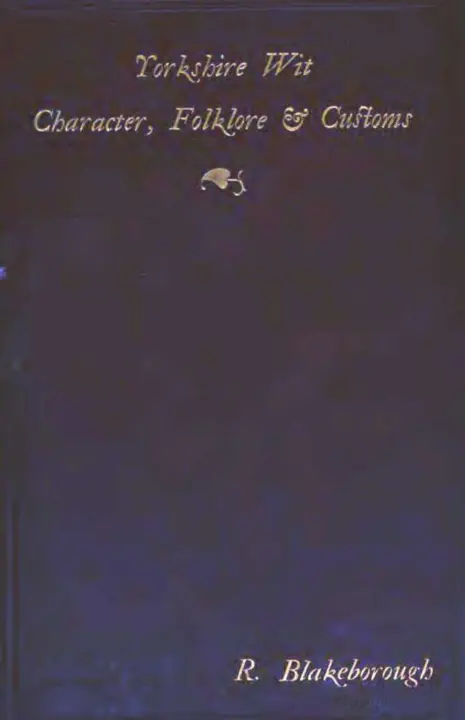
"Wit, Character, Folklore & Customs of the North Riding of Yorkshire" by Richard Blakeborough is a collection of anecdotes and observations reflecting the local wit and customs, likely written in the late 19th century. The work captures the essence of Yorkshire character through various humorous stories, sayings, and reflections on the dialect and social customs of the North Riding, aiming to preserve them from fading into obscurity. At the start of the work, the author introduces his intent to document the unique wit and character of Yorkshire, emphasizing the cautious yet practical mindset of its people. He provides illustrative stories revealing their straightforwardness, humor, and the nuances of their dialect. Through relatable anecdotes, Blakeborough paints a vivid picture of these residents, highlighting how their traditional views often clash with modernity, and illustrating their independent spirit and pride through humorous exchanges. The initial chapters draw readers into the richness of local culture and the distinctively candid personality of Yorkshire folk.
Introduction adapted from the source catalogue; source summaries may be automatically generated.
Free to read · English · 150,771 words · No account needed
MAKE TIME FOR A GOOD BOOK
On by default. Untick to stop anonymous reading totals. Each page counts after 10 seconds in view. How this works.
Anonymous counting is on unless you have switched it off.
+Scaldered, To be+, v. To have an unhealthy skin, so that the surface comes off in scales. Children’s heads are often said to be scaldered when suffering from dandruff.
+Scalderings+, n. Nodules of half-burnt lime.
+Scale+, +Scaling+, v. To scatter or spread, as manure; to cause the milk to be absorbed in the female breast.
+Scale-dish+, n. A shallow metal pan used to skim milk.
+Scallibrat+, n. A passionate, noisy child.
+Scamp+, v. To execute work in a dishonest manner, not paying attention to details which are hidden from view.
+Scar+, n. The face of a precipitous rock, or the rock itself.
+Scart+, v. Frightened.
+Scaud+, n. and v. A scold, a vixenish woman.
+Scaud-heead+, n. Applied both to dandruff and ringworm.
+Scau’p+, n. The head, the skull, the bare spots of rock and
stones on a hillside.
+Sconce+, n. 1. A screen, usually lined with tin, which is kept very bright so as to reflect; this is placed in front of any joint roasting before the fire. 2. Hence the usage of the word in the sense of a ‘ruse,’ ‘deception,’ i.e. a screen to hide one’s real intentions. Ex.—2. He aim’d at wa s’u’d think ’at he’d cum’d ti see t’ au’d chap, bud it war nowt bud a sconce ti finnd oot what wa’d gitten i’ t’ hoos. The word is also used in the sense of ‘tale-bearing’ in such a way as either to hide one’s own fault or to obtain one’s own ends.
+Scopperil+, n. A teetotum, a pierced bone button with a wooden
peg through it.
+Scourging top+, +Scurgy+, n. A whipping-top.
+Scow+, n. Confusion, hurried and somewhat disorganized preparation for an expected event, bustle with confusion.
+Scowder+, +Scowderment+, n. Confusion.
+Scraffle+, v. To struggle, to strive. Ex.—Ah mannished ti scraffle thruff’t, bud Ah s’all tak t’ hedge t’ next tahm. Sha’s deean mair ’an weel ti scraffle on wi’ a family leyke yon.
+Scrag-cauf+, n. A name applied to females whose legs are very
thin.
+Scraggy+, adj. Lean.
+Scran+, n. Food.
+Scranky+, adj. Very lank.
+Scrannel+, adj. Poor, worthless.
+Scrap+, v. and n. To quarrel.
+Scrape+, n. Misfortune, trouble.
+Scrape the tongue, To+, v. To speak affectedly.
+Scrat+, v. and n. 1. To scratch. 2. A scraping together of one’s belongings by hard toil. Ex.—2. Yan gits yan’s things scratted tigither oddly by tahms. Neeaboddy’s made a harder scrat foor what tha’ve gitten ’an Lisa Jane.
+Scrat+, n. A miser, the itch.
+Scrat, Au’d+, n. The devil.
+Scrawm+, v. To scratch irregular marks on any surface, to grope
about in the dark.
Your reading position is saved on this browser. Take it to another device with a library code. Reading pages adapt to text, rather than matching a printed edition.
BEHIND THE BOOK
This eBook is for the use of anyone anywhere in the United States and most other parts of the world at no cost and with almost no restrictions whatsoever. You may copy it, give it away or re-use it under the terms of the Project Gutenberg License included with this eBook or online at www.gutenberg.org. If you are not located in the United States, you will have to check the laws of the country where you are located before using this eBook. Read the source licence.
The original source file, including credits and licence, is retained by this library. Request an original-format copy at no charge. Please include the book title and Project Gutenberg identifier #62999.
KEEP YOUR CURIOSITY GOING
Maurice Baring
Francis Greenleaf Allinson & Anne C. E. (Anne Crosby Emery) Allinson
Stuart Dodgson Collingwood
Percy Keese Fitzhugh
Mary Macleod & Edmund Spenser

Cooke Don-Carlos