
Dead letters
Maurice Baring
THE CLASSIC COLLECTION · 1898
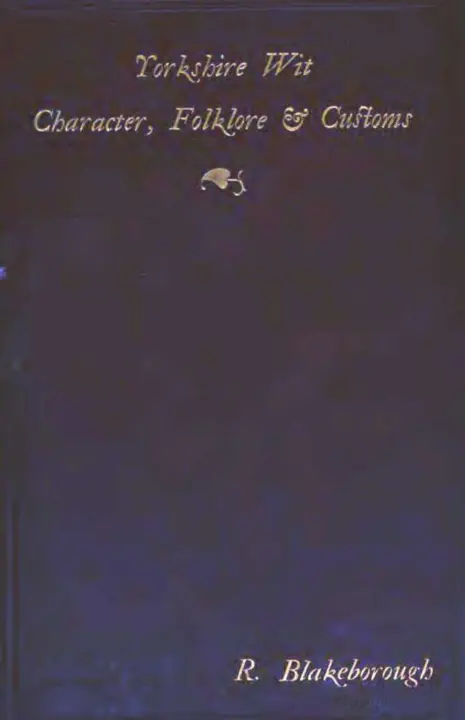
"Wit, Character, Folklore & Customs of the North Riding of Yorkshire" by Richard Blakeborough is a collection of anecdotes and observations reflecting the local wit and customs, likely written in the late 19th century. The work captures the essence of Yorkshire character through various humorous stories, sayings, and reflections on the dialect and social customs of the North Riding, aiming to preserve them from fading into obscurity. At the start of the work, the author introduces his intent to document the unique wit and character of Yorkshire, emphasizing the cautious yet practical mindset of its people. He provides illustrative stories revealing their straightforwardness, humor, and the nuances of their dialect. Through relatable anecdotes, Blakeborough paints a vivid picture of these residents, highlighting how their traditional views often clash with modernity, and illustrating their independent spirit and pride through humorous exchanges. The initial chapters draw readers into the richness of local culture and the distinctively candid personality of Yorkshire folk.
Introduction adapted from the source catalogue; source summaries may be automatically generated.
Free to read · English · 150,771 words · No account needed
MAKE TIME FOR A GOOD BOOK
On by default. Untick to stop anonymous reading totals. Each page counts after 10 seconds in view. How this works.
Anonymous counting is on unless you have switched it off.
+Nip off+, v. To run away, to move quickly.
+Nip up+, v. To snatch up quickly, to go up quickly. Ex.—He nipped it up afoor Ah c’u’d stop him. Nip upstairs an’ fetch mah hat doon.
+Nipper+, n. A young child.
+Nisly+, adj. Showery.
+Nit+, n. The egg of the louse.
+Nither+, +Nidder+, v. To shiver. Ex.—Ah nithered an’ dithered an’ trimm’ld all ower that mich whahl Ah c’u’dn’t mak oot if sha’d been shuvved, tumm’ld, slithered, or louped inti t’ beck.
+Nittering+, part. Subdued giggling.
+Nivver+, adj. Never.
+Nizy+, n. A dunce.
+Nizzled+, v. To be under the influence of drink.
+Noa ship+, n. Clouds said to resemble the Ark. A common saying is, T’ Ark’s oot, wa’re in foor a spell o’ bad weather.
+Nobbin+, n. The hair on the crown of the head.
Ex.—He teeak her biv t’ nobbin an’ pulled her backkards-waay
ower.
+Nobbut+, conj. If, only. ‘Only’ is rarely used.
+Nobby+, adj. Handy, nice.
+Nock+, +Nicking+, n. A method of keeping count by cutting
notches on a stick.
+Nodder+, v. To tremble.
+Noggen+, adj. Hard, rough.
+Noggin+, n. A quarter pint, a small jug.
+Nominy+, n. The name given to any doggerel rhyme.
+None+, +Noan+, +Neean+, adv. Not at all. Ex.—He’ll neean ho’d back, he’ll deea ’t hard eneeaf. ‘Neean’ in this case means more than ‘not’; the idea conveyed is, ‘He will not in any sense hold back.’ He’s neean lost owt, i.e. ‘He has lost nothing at all.’
+Nooatish+, v. To notice.
+Noo+, adv. Now, well. The use of this word is most curious. Noo, Noo, Noo! Noo, said one man on meeting a friend. ‘Noo’ the first meant either ‘good morning,’ ‘now then,’ or ‘well.’ ‘Noo’ the second was addressed to the dog, and meant ‘lie down.’ ‘Noo’ the third, with a different inflection, was understood by the dog to imply, ‘If you do not lie down at once, I shall hit you.’ And ‘Noo’ the fourth clearly denoted, the dog having laid down, ‘Now, then, we can talk.’ This inflective power throughout the whole vocabulary lessens or adds force to words. Unfortunately it is impossible to render in print these varying tones, which are the life and soul of the dialect. When used as an interjection, it is equivalent to ‘How do you do?’
+Nooa+, Vide +Neea+.
+Noos an’ agaains+ }
+Noos an’ thens+ } = By chance, now and again, occasionally.
+Noration+, Vide +Oration+.
+Notified+, +Nooatified+, adj. Well-known. Ex.—Aye, he war a nooatified chap yance ower.
+Not ti fail+, Without fail.
Ex.—Ah’ll tell him ti cum an’ not ti fail.
Your reading position is saved on this browser. Take it to another device with a library code. Reading pages adapt to text, rather than matching a printed edition.
BEHIND THE BOOK
This eBook is for the use of anyone anywhere in the United States and most other parts of the world at no cost and with almost no restrictions whatsoever. You may copy it, give it away or re-use it under the terms of the Project Gutenberg License included with this eBook or online at www.gutenberg.org. If you are not located in the United States, you will have to check the laws of the country where you are located before using this eBook. Read the source licence.
The original source file, including credits and licence, is retained by this library. Request an original-format copy at no charge. Please include the book title and Project Gutenberg identifier #62999.
KEEP YOUR CURIOSITY GOING
Maurice Baring
Francis Greenleaf Allinson & Anne C. E. (Anne Crosby Emery) Allinson
Stuart Dodgson Collingwood
Percy Keese Fitzhugh
Mary Macleod & Edmund Spenser

Cooke Don-Carlos