
Dead letters
Maurice Baring
THE CLASSIC COLLECTION · 1898
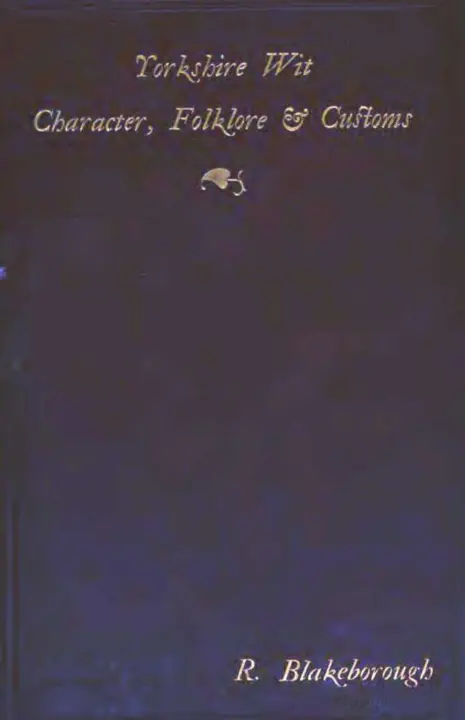
"Wit, Character, Folklore & Customs of the North Riding of Yorkshire" by Richard Blakeborough is a collection of anecdotes and observations reflecting the local wit and customs, likely written in the late 19th century. The work captures the essence of Yorkshire character through various humorous stories, sayings, and reflections on the dialect and social customs of the North Riding, aiming to preserve them from fading into obscurity. At the start of the work, the author introduces his intent to document the unique wit and character of Yorkshire, emphasizing the cautious yet practical mindset of its people. He provides illustrative stories revealing their straightforwardness, humor, and the nuances of their dialect. Through relatable anecdotes, Blakeborough paints a vivid picture of these residents, highlighting how their traditional views often clash with modernity, and illustrating their independent spirit and pride through humorous exchanges. The initial chapters draw readers into the richness of local culture and the distinctively candid personality of Yorkshire folk.
Introduction adapted from the source catalogue; source summaries may be automatically generated.
Free to read · English · 150,771 words · No account needed
MAKE TIME FOR A GOOD BOOK
On by default. Untick to stop anonymous reading totals. Each page counts after 10 seconds in view. How this works.
Anonymous counting is on unless you have switched it off.
+Hoity-toity+, intj. An exclamation of surprise, carrying with it slight indignation. adj. Somewhat ruffled in temper.
+Holl+, n. A narrow deep depression in the face of the land, varying in length, but never extensive; the dead of night.
+Hollin+, n. The holly.
+Holm+, n. Land by the side of a stream, low-lying and subject
to being flooded.
+Holy+ or +Lemmel steean+, n. Any water-rolled stone of small
size having a hole through, once valued as a charm against
witches.
+Home-coming+, n. The return home of an absent one, the festivities on such an occasion after a wedding or long absence.
+Honey+, A term of endearment, often preceded or followed by some other word to add greater force. Little conception can be formed of the love and tenderness which is thrown into and expressed by this word; it must be heard as coming from a mother’s lips. Ex.—‘Oh, mah sweet honey bairn!’ said as a mother picked up a fallen child. ‘Thoo little honey!’ as the baby was clasped to its mother’s breast. ‘Gan thi ways, honey dear; Cu’ thi ways, mah honey pet,’ &c.
+Honey-fall+, n. A piece of rare luck, money left from some
unexpected quarter.
+Honeysouk+, n. Honeysuckle.
+Hoo+, adv. How.
+Hood-end+, n. The flat portion found on either side of old-style fire grates, upon which a kettle or pan may be placed.
+Hoos+, n. House. Vide +House+.
+Hooze+, Vide +Heeze+.
+Hopper+, n. The basket or skep containing the seed corn when sowing, usually suspended by a strap over the shoulders.
+Hopple+, v. 1. To tie the legs of an animal so as to prevent its running away. 2. To hinder. Ex.—2. It’s neea ewse his endivering when he’s hoppled wiv a weyfe leyke yon; sha’s nowt bud a clog tiv his foot, i.e. ‘It is no use his striving when he is hindered or tied to a wife like that; she is nothing but a drag on him.’
+Hork+, v. To trail about.
+Horry+, v. To hurry.
+Horse-gogs+ or +Hoss-gogs+, n. A common, astringent, purple
brown plum.
+Hoss-steean+, +Hoss-block+, +Hossin’-steps+, n. A stone or steps used to stand upon when about to mount a horse.
+Hosses together, They deean’t put ther+ = Not friendly.
+Hoss-teng+, n. The common dragon-fly.
+Hoss-trod+, n. A bridle-road.
+Hostle+, v. To put up at an inn. ‘Hostle’ is only used in connexion with an inn. We ‘put up’ and ‘hostle’ at an inn, and ‘lowse out’ at a friend’s. Ex.—Ah can lowse oot at thi pleeace, caan’t Ah? or Ah’ll put up at t’ Black Swan. Ah hostles at t’ Blew Pig.
+Ho’t+, Pronunciation of +Hurt+.
Your reading position is saved on this browser. Take it to another device with a library code. Reading pages adapt to text, rather than matching a printed edition.
BEHIND THE BOOK
This eBook is for the use of anyone anywhere in the United States and most other parts of the world at no cost and with almost no restrictions whatsoever. You may copy it, give it away or re-use it under the terms of the Project Gutenberg License included with this eBook or online at www.gutenberg.org. If you are not located in the United States, you will have to check the laws of the country where you are located before using this eBook. Read the source licence.
The original source file, including credits and licence, is retained by this library. Request an original-format copy at no charge. Please include the book title and Project Gutenberg identifier #62999.
KEEP YOUR CURIOSITY GOING
Maurice Baring
Francis Greenleaf Allinson & Anne C. E. (Anne Crosby Emery) Allinson
Stuart Dodgson Collingwood
Percy Keese Fitzhugh
Mary Macleod & Edmund Spenser

Cooke Don-Carlos