
Dead letters
Maurice Baring
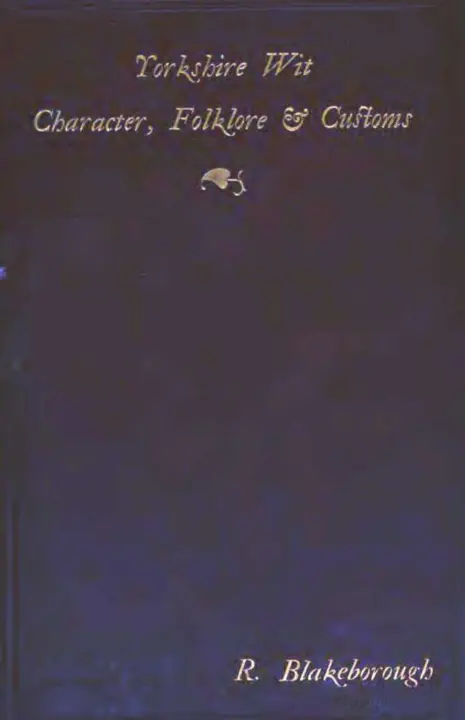
THE CLASSIC COLLECTION · 1898
"Wit, Character, Folklore & Customs of the North Riding of Yorkshire" by Richard Blakeborough is a collection of anecdotes and observations reflecting the local wit and customs, likely written in the late 19th century. The work captures the essence of Yorkshire character through various humorous stories, sayings, and reflections on the dialect and social customs of the North Riding, aiming to preserve them from fading into obscurity. At the start of the work, the author introduces his intent to document the unique wit and character of Yorkshire, emphasizing the cautious yet practical mindset of its people. He provides illustrative stories revealing their straightforwardness, humor, and the nuances of their dialect. Through relatable anecdotes, Blakeborough paints a vivid picture of these residents, highlighting how their traditional views often clash with modernity, and illustrating their independent spirit and pride through humorous exchanges. The initial chapters draw readers into the richness of local culture and the distinctively candid personality of Yorkshire folk.
Introduction adapted from the source catalogue; source summaries may be automatically generated.
Free to read · English · 150,771 words · No account needed
MAKE TIME FOR A GOOD BOOK
On by default. Untick to stop anonymous reading totals. Each page counts after 10 seconds in view. How this works.
Anonymous counting is on unless you have switched it off.
+Had away+, A corruption of the Scotch ‘haud awa.’ It is quite common, and used in the sense of ‘come or go quickly.’
+Haffle+, v. 1. To hesitate when speaking, to stammer, to appear desirous of keeping something back. 2. To exhibit indecision of character. 3. To quibble. Ex.—1. Deean’t haffle leyke that, bud speeak plain. 2. Naay, what! he’s lost t’ job, he haffled seea; fust he wad an’ then he wadn’t, whahl t’ gaffer gav it ti sumbody else. 3. He awlus haffles on that mich, whahl neeabody ho’ds ti owt he sez.
+Hag+, n. A thick white fog which, when followed by a frost, forms frost-hag; a coppice, such as often grows on a rough bank or broken ground; a broken rugged bank.
+Hag-berry+, n. The fruit of the bird-cherry (Prunus padus). NOTE.—In many parts of the North Riding Bug-berry is the common name, bägg being the Swedish for the same.
+Hag-clog+, n. A wooden block, varying in size, used as a
chopping block.
+Haggle+, v. To chop or cut anything unevenly, to tease, to beat down in a bargain, to argue in a contentious spirit.
+Haggy+, adj. Rough, boggy, always applied to land.
+Hag snars+, n. The stubs left standing after the chopping down
of young trees.
+Hag-worm+, n. The viper or adder (Pelias berus). The name is never applied to the blind-worm.
+Hair-breed+, n. 1. By little and little. 2. Slow degrees. 3. The narrowest margin. Ex.—1. Wa’re bodduming what tha did byv hair-breeds, i.e. ‘We are finding out what they did little by little.’ 2. Willie mends, bud it’s nobbut byv hair-breeds. 3. He ’scaped wiv his leyfe, bud it war nobbut byv a hair-breed, lit. ‘A hair’s breadth.’
+Hairy-worm+, n. Any caterpillar of a hairy kind.
+Hake+, n. An importunate beggar, not necessarily a pauper; a
greedy, grasping person.
+Hake+, v. To be pertinacious, to weary with importunities.
+Hale+, v. To empty a vessel by inclining it to one side.
+Hales+, n. The handles of a plough.
+Half-marrow+, n. One considered as but a youth at his calling,
half-grown.
+Half nowt+, Beneath consideration, either as to money or character. Ex.—Ah gat it foor hauf nowt. Its nobbut a hauf-nowt when it’s deean. T’ father’s i’ prison an’ t’ lad’s a hauf nowt.
+Half-rocked+ or +-baked+, adj. Half-witted, foolish. Ex.—He knaws nowt, he’s nobbut hauf-rocked. It’s nobbut a hauf-rocked thing foor onnybody ti deea.
+Hallock+, v. To wander aimlessly about. Ex.—If he isn’t risting up agaain a wall, he’ll be hallocking sumwheear. If thoo aims ’at hallocking aboot ’ll finnd tha a job, thoo’s grandly mista’en.
Your reading position is saved on this browser. Take it to another device with a library code. Reading pages adapt to text, rather than matching a printed edition.
BEHIND THE BOOK
This eBook is for the use of anyone anywhere in the United States and most other parts of the world at no cost and with almost no restrictions whatsoever. You may copy it, give it away or re-use it under the terms of the Project Gutenberg License included with this eBook or online at www.gutenberg.org. If you are not located in the United States, you will have to check the laws of the country where you are located before using this eBook. Read the source licence.
The original source file, including credits and licence, is retained by this library. Request an original-format copy at no charge. Please include the book title and Project Gutenberg identifier #62999.
KEEP YOUR CURIOSITY GOING
Maurice Baring
Francis Greenleaf Allinson & Anne C. E. (Anne Crosby Emery) Allinson
Stuart Dodgson Collingwood
Percy Keese Fitzhugh
Mary Macleod & Edmund Spenser

Cooke Don-Carlos