
Dead letters
Maurice Baring
THE CLASSIC COLLECTION · 1898
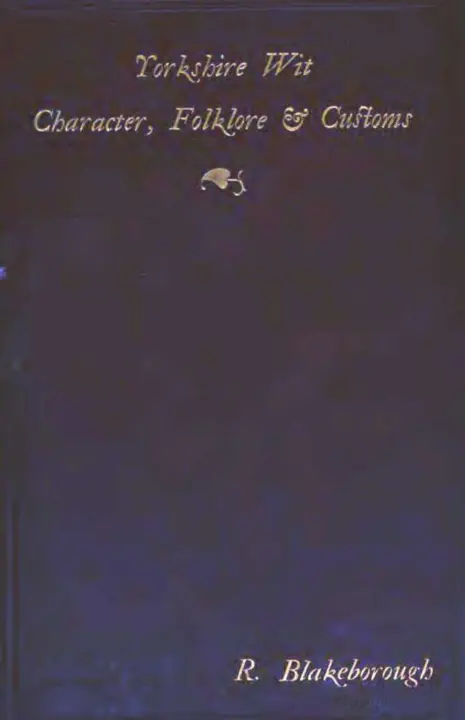
"Wit, Character, Folklore & Customs of the North Riding of Yorkshire" by Richard Blakeborough is a collection of anecdotes and observations reflecting the local wit and customs, likely written in the late 19th century. The work captures the essence of Yorkshire character through various humorous stories, sayings, and reflections on the dialect and social customs of the North Riding, aiming to preserve them from fading into obscurity. At the start of the work, the author introduces his intent to document the unique wit and character of Yorkshire, emphasizing the cautious yet practical mindset of its people. He provides illustrative stories revealing their straightforwardness, humor, and the nuances of their dialect. Through relatable anecdotes, Blakeborough paints a vivid picture of these residents, highlighting how their traditional views often clash with modernity, and illustrating their independent spirit and pride through humorous exchanges. The initial chapters draw readers into the richness of local culture and the distinctively candid personality of Yorkshire folk.
Introduction adapted from the source catalogue; source summaries may be automatically generated.
Free to read · English · 150,771 words · No account needed
MAKE TIME FOR A GOOD BOOK
On by default. Untick to stop anonymous reading totals. Each page counts after 10 seconds in view. How this works.
Anonymous counting is on unless you have switched it off.
There is no rule to guide the student in the use of thoo, tha, ta. In a general way ta follows an auxiliary verb, and thoo, used in the accusative case, is definite in its application. ‘He’s shooting o’ thoo,’ and ’he’s shooting o’ tha,’ have a well-marked distinction of meaning. ‘He’s shooting o’ thoo’ implies that the person told of the fact is the actual person being shouted of; not only does it point him out from amongst many, but the fact that thoo was used further implies that the shouting had better be attended to at once. ‘He’s shooting o’ tha,’ is merely certain information given, making known to some other person that he was being called for without regard to others.
Who which that.
Wheea or whau which that or ’at[100].
Who and which are declined as follows. That and what as in
standard English.
STAND. ENG. NTH. RIDING. | STAND. ENG. NTH. RIDING. Nom. Who whau, | Which which. wheea. | Poss. Whose whaus | Whose wheeas, wheeas. | whaus. Obj. Whom whaum. | Which which.
The compound relatives are formed by the addition of ever and soever; ’at forming the compound ’ativver, i.e. whatever.
POSSESSIVE PRONOUNS and the compound personal and possessives are
formed as under:—
STAND. ENG. My mine thy thine his her NTH. RIDING. Mah mahn {thah} thahn his her {thi }
STAND. ENG. Its our your their own NTH. RIDING. Its oor or wer yer ther awn
STAND. ENG. Myself thyself himself herself NTH. RIDING. {Mahsel thisel hissel hersel {Mahsen thisen hissen hersen
STAND. ENG. Itself ourselves yourselves NTH. RIDING. {Itsel oorsels or -sens yersels {Itsen wersels or -sens yersens
STAND. ENG. Theirselves ownselves.
NTH. RIDING. {Thersels awnsels
{Thersens awnsens.
This and that are used as follows:—
This refers to an object near at hand, that is rarely used, yon being almost universal, e.g. ‘Yon man ower theer ’ll tell tha.’ Q. ‘Which is Mister Thompson?’ A. ‘Yon chap’s him,’ i.e. ‘That man is Mr. Thompson.’
Any both some other another one none such Onny beeath sum uther anuther yan neean sich, sike
Yan and yah are noticed elsewhere, also vide Glossary.
Adverbial peculiarities are fully noticed in the Glossary.
The PREPOSITIONS and ADVERBS mostly in use are:—
About, aboot.
Above, aboon.
Across, quarrelled. ‘Him an’ me’s gitten across.’
After, efter or efther[101].
Against, ower agaanst, near to.
Among, amang. Amongst, amangst.
Before, afoor. ‘For afore the harvest, when the bud is perfect’
(Isa. xviii. 5).
Behind, ahint.
Between, atween.
Betwixt, atwixt.
Beyond, ayont, beyont.
By, byv or by, pronounced be.
From, fra before a consonant, frev before a vowel.
Your reading position is saved on this browser. Take it to another device with a library code. Reading pages adapt to text, rather than matching a printed edition.
BEHIND THE BOOK
This eBook is for the use of anyone anywhere in the United States and most other parts of the world at no cost and with almost no restrictions whatsoever. You may copy it, give it away or re-use it under the terms of the Project Gutenberg License included with this eBook or online at www.gutenberg.org. If you are not located in the United States, you will have to check the laws of the country where you are located before using this eBook. Read the source licence.
The original source file, including credits and licence, is retained by this library. Request an original-format copy at no charge. Please include the book title and Project Gutenberg identifier #62999.
KEEP YOUR CURIOSITY GOING
Maurice Baring
Francis Greenleaf Allinson & Anne C. E. (Anne Crosby Emery) Allinson
Stuart Dodgson Collingwood
Percy Keese Fitzhugh
Mary Macleod & Edmund Spenser

Cooke Don-Carlos