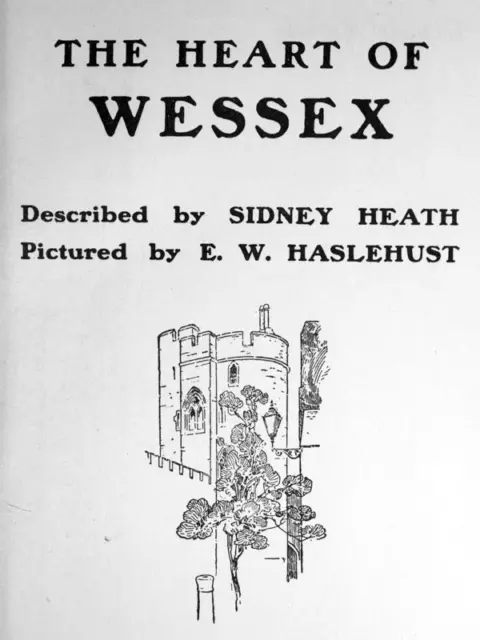
The Heart of Wessex
Sidney Heath
THE CLASSIC COLLECTION · 1911
"Winchester" by Sidney Heath is a historical account written in the early 20th century. The book explores the rich heritage of the ancient city of Winchester, detailing its significance as a royal city and its architectural marvels, particularly the Winchester Cathedral. It paints a picture of the city's development through various historical eras, emphasizing its role in English history. The book provides an insightful journey through Winchester, highlighting key figures such as Alfred the Great, St. Swithun, and William of Wykeham. Heath chronicles the city's evolution from its origins as a British settlement and Roman town to its prominence during the Saxon era and beyond. Through vivid descriptions, the author captures the essence of the cathedral's grandeur, the lore surrounding notable legends like that of Guy, Earl of Warwick, and the establishment of educational institutions founded by Wykeham. Readers are invited to appreciate the melding of history, architecture, and legend within this beautiful English city, which remains a symbol of England's cultural heritage.
Introduction adapted from the source catalogue; source summaries may be automatically generated.
Free to read · English · 13,941 words · No account needed
MAKE TIME FOR A GOOD BOOK
On by default. Untick to stop anonymous reading totals. Each page counts after 10 seconds in view. How this works.
Anonymous counting is on unless you have switched it off.
Wykeham's idea in founding these two colleges was one for which he had no precedent before him, so that his design was to a large extent in the nature of an experiment. His idea, of course, was to enable those who proceeded from the Winchester to the Oxford College to receive a systematic and continuous education. Where Wykeham led, others were not long in following. Two of his successors in the see of Winchester, Waynflete and Fox, gave to Oxford the beautiful colleges of Magdalen and Corpus Christi respectively. Archbishop Chichele, one of Wykeham's first scholars, built St. Bernard's College, now St. John Baptist's, which he gave to the Cistercians before its completion; and later in life he founded the College of All Souls, while in his native village of Higham Ferrers, Northants, he built and endowed a school, bede-house, and church, which are among some of the loveliest pieces of building we possess. Henry VI made himself intimately acquainted with the works of Wykeham, and copied them for his two colleges of Eton, and King's College, Cambridge. Until Wykeham's time, schools had been under or connected with monastic houses; now they were distinct foundations, with priests still as masters, but priests secular and not religious. Wykeham was, indeed, the pioneer of the public-school system, of which, with all its shortcomings, England is so justly proud.
Each of the bishop's colleges took about six years in building, and that at Oxford was the first to be finished. It must have been a proud day for Winchester when, on March 28, 1393, the "seventy faithful boys", headed by their master, came in procession from St. Giles's Hill, where they had been temporarily housed, and, all chanting psalms, entered into possession of their fair college.
The buildings have been but little altered since their founder's day, and extend now, as then, on the south side of the Close, and along the bank of the Itchen. They consist mainly of two quadrangles, in the first of which, entered from College Street by a gateway, are the Warden's house and other offices. Here is the brewhouse, quite unaltered; but the Warden's house has absorbed the old bakehouse, slaughterhouse, and butcher's room. Over the second archway are figures of the Virgin, with Gabriel on her right, and Wykeham kneeling on her left. Here was a room for the Warden, from which he could see all who entered or left the college; and here also is the site of the old penthouse under which the scholars used to perform their ablutions, and which they called "Moab". The old Society comprised the Warden, ten Fellows, three Chaplains, sixteen Queristers, and seventy scholars. The boys, the chaplains, and the choristers lived within the inner quadrangle, the northern side of which is formed by the chapel and the refectory. The original chapel, with the exception of the beautiful fan-groining of its roof, was much defaced in the seventeenth century, but was restored in the nineteenth, when a new reredos was added. The refectory remains practically untouched, and has a roof enriched with some beautiful carved woodwork, the painted heads of kings and bishops, and some great mullioned windows. Over the buttery is the audit-room, hung with ancient and rare tapestries, and containing a large chest known as Wykeham's money box. The original schoolroom was in the basement, and has long been put to other uses. The chantry, the beautiful cloisters, and the chapel tower were all built after the founder's death, but he provided a wooden bell tower, which stood away from the chapel, so that the main building should not be injured by the vibration of the bells. The remaining portions are mostly modern, and the foundation has naturally been much enlarged since Wykeham's day, the last addition being the gateway in Kingsgate Street, erected as a memorial to the many Wykehamists who fell in the South African War.
Your reading position is saved on this browser. Take it to another device with a library code. Reading pages adapt to text, rather than matching a printed edition.
Sidney Heath
Sidney Heath
Sidney Heath
Sidney Heath
BEHIND THE BOOK
This eBook is for the use of anyone anywhere in the United States and most other parts of the world at no cost and with almost no restrictions whatsoever. You may copy it, give it away or re-use it under the terms of the Project Gutenberg License included with this eBook or online at www.gutenberg.org. If you are not located in the United States, you will have to check the laws of the country where you are located before using this eBook. Read the source licence.
The original source file, including credits and licence, is retained by this library. Request an original-format copy at no charge. Please include the book title and Project Gutenberg identifier #15706.
KEEP YOUR CURIOSITY GOING
Wilfrid Scawen Blunt
Wilfrid Scawen Blunt

E. W. (Edgar Watson) Howe
Cécile Tormay

Moritz Busch
John L. Ransom