THE CLASSIC COLLECTION✦An outlaw’s diary: the CommuneCLASSIC FREE BOOKS
An outlaw’s diary: the Commune
Cécile Tormay
THE CLASSIC COLLECTION · 1897
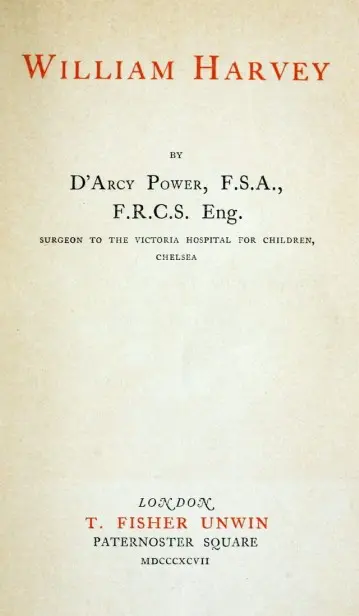
"William Harvey" by Sir D'Arcy Power is a historical account written in the late 19th century. The biography details the life and contributions of William Harvey, the renowned physician known for discovering the circulation of blood. The text aims to encapsulate Harvey's legacy within the broader context of medical history, showcasing his background, education, and scientific achievements. The opening of the biography outlines the lineage of the Harvey family and provides a glimpse into the early life of William Harvey, who was born in Folkestone in 1578. It describes the familial context from which he emerged, emphasizing his father's involvement in local governance. The narrative reveals that not much is known about Harvey's formative years but indicates that he was likely influenced by the tumultuous events of his time, including the threat of the Spanish Armada, as well as his education at the King's School in Canterbury. The account sets the stage for exploring Harvey's journey in medicine, gradually leading into his later studies at prestigious institutions, such as Caius College in Cambridge and the University of Padua, where his fascination with anatomy and physiological principles took root.
Introduction adapted from the source catalogue; source summaries may be automatically generated.
Free to read · English · 59,234 words · No account needed
MAKE TIME FOR A GOOD BOOK
On by default. Untick to stop anonymous reading totals. Each page counts after 10 seconds in view. How this works.
Anonymous counting is on unless you have switched it off.
In this year, 1643, Harvey received his last payment as physician to St. Bartholomew's Hospital. The Journals contain no record of his retirement from office in the hospital, but the ledgers, which have been kept with great accuracy and minuteness ever since the granting of the Charter in 1547, show the entry standing in its usual place, but for the last time. "Item to Doctor Harvey, Physician, xxxiii li. vi s. viii d." Harvey was resident in Oxford at the time of his retirement, and the absence of any allusion to so important an event in the history of the hospital must be ascribed in part to the confusion of the times. The Journals of the House of Commons, however, contain a significant note: "Feb. 12, an. 1643-1644. A motion this day made for Dr. Micklethwayte to be recommended to the Wardens and Masters of St. Bartholomew's Hospital, to be physician in the place of Dr. Harvey, who hath withdrawn himself from his charge and is retired to the party in arms against the Parliament." (Sir) John Micklethwaite was as a matter of fact appointed Physician in reversion to St. Bartholomew's Hospital, May 26, 1648, and he succeeded to the post of full physician May 13, 1653. He was one of the physicians in ordinary to Charles II., and died in 1682.
Harvey's presence in Oxford, and his method of working by experiment and by logical deduction from observation, must have been singularly agreeable to that band of experimental philosophers who in a few years were destined to found the Royal Society. Harvey's leaven worked successfully in the brains of such men as Scarborough, Highmore, Willis, and Wren, and in due season the pupils brought forth fruit worthy of their master.
Harvey's connection with the University of Oxford was destined soon to become both intimate and honourable, though it was unfortunately only of short duration. In 1645 he was elected Warden of Merton College, in succession to Sir Nathaniel Brent. The present Warden of Merton, the Hon. G. C. Brodrick, says that on the 27th of Jan., 1645, letters were received from the King, then lodged at Christ Church, reciting that Sir Nathaniel Brent had absented himself for nearly three years, had adhered to the rebels, and had accepted the office of Judge Marshal in their ranks, to which might have been added that he had actually signed the Covenant, for he gradually became more and more Presbyterian in his views though he was originally a friend of Laud. We learn from the articles afterwards exhibited against [Sir] John Greaves, then a Fellow of the College, Savilian Professor of Astronomy, and the senior Linacre lecturer upon anatomy, that he was the person who drew up the petition against the Warden, and "inveigled some unwary young men to subscribe to it." The King's letters accordingly pronounce the deposition of Brent, and direct the seven senior Fellows to present three persons as eligible to be his successor, out of whom the King would choose one. The Royal mandate was obeyed, but there were some irregularities in the consequent election, against which Peter Turner protested and resigned his Fellowship on his protest being overruled by Lord Hertford, who had succeeded the Earl of Pembroke as Chancellor of the University in October, 1645. However, five out of the seven seniors, including the Sub-Warden, placed Harvey first on their lists, and the King lost no time in nominating him. He was solemnly admitted Warden according to ancient custom, on the 9th of April, and two days later, on April 11th, he addressed the Fellows in a short speech which is still preserved. The extract from the College register runs:--"Dominus Custos, Convocatis in Altâ Gaul Sociis, haec verba ad illos fecit. Forsitan decessores Custodiam Collegii ambiisse, ut exinde sese locupletarent, se vere longe alio animo nimirum ut College lucro et emolumento potius foret: simulque socios, ut concordiam amicitiamque inter se colerent sedule solliciteque hortatus est." [The Warden spoke thus to the Fellows assembled in the Great Hall. He said that it was likely enough that some of his forerunners had sought the Wardenship to enrich themselves, but that for his own part he undertook its duties with far other motives, wishing as he did to increase the wealth and prosperity of the College. At the same time he appealed earnestly and anxiously to the Fellows to cherish amongst themselves an harmonious friendship.] The speech was thought at the time to be somewhat "Pharisaical," but there seems to be no doubt that Harvey was really expressing his feelings. There had always been a close bond between Merton and the medical profession from the days when John of Gaddesden, one of the earliest Englishmen to write a complete treatise on medicine, was a Fellow, and it was peculiarly fitting that Harvey should have been elected head of the College. He was a rich man, childless, without expensive habits, and so devoted to the pursuit of science that there is but little doubt that if he had retained his position he would have become one of the greatest benefactors of the College. As it was, the College during Harvey's year of office presented more the appearance of a Court than of a seat of learning. From 1643 to 1646, when the Queen was in Oxford, she lodged in Merton College, occupying the Warden's House, and living in the room still known as "the Queen's room," with the drawing-room adjoining it. Anthony Wood says that during her occupation "there were divers marriages, christenings, and burials carefully registered in a private register by Mr. John Gurgany, one of the chaplains of Merton College; but about the time of the surrender of Oxford the said register, among other books, was stolen by the soldiers out of his window in his chamber joining to the church door." Many officers too were quartered in Merton, and the College was so full on the 1st of August, 1645, that the annual meeting had to be held in the library, as neither the Hall nor the Warden's lodgings were available for the purpose.
Your reading position is saved on this browser. Take it to another device with a library code. Reading pages adapt to text, rather than matching a printed edition.
BEHIND THE BOOK
This eBook is for the use of anyone anywhere in the United States and most other parts of the world at no cost and with almost no restrictions whatsoever. You may copy it, give it away or re-use it under the terms of the Project Gutenberg License included with this eBook or online at www.gutenberg.org. If you are not located in the United States, you will have to check the laws of the country where you are located before using this eBook. Read the source licence.
The original source file, including credits and licence, is retained by this library. Request an original-format copy at no charge. Please include the book title and Project Gutenberg identifier #46664.
KEEP YOUR CURIOSITY GOING
Cécile Tormay

Moritz Busch
John L. Ransom
Frances Wright
Cécile Tormay

Mabel Potter Daggett