THE CLASSIC COLLECTION✦An outlaw’s diary: the CommuneCLASSIC FREE BOOKS
An outlaw’s diary: the Commune
Cécile Tormay
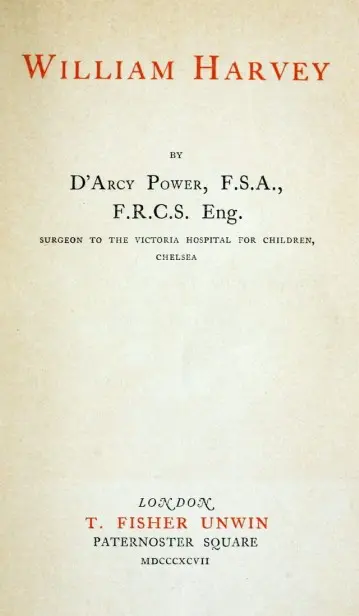
THE CLASSIC COLLECTION · 1897
"William Harvey" by Sir D'Arcy Power is a historical account written in the late 19th century. The biography details the life and contributions of William Harvey, the renowned physician known for discovering the circulation of blood. The text aims to encapsulate Harvey's legacy within the broader context of medical history, showcasing his background, education, and scientific achievements. The opening of the biography outlines the lineage of the Harvey family and provides a glimpse into the early life of William Harvey, who was born in Folkestone in 1578. It describes the familial context from which he emerged, emphasizing his father's involvement in local governance. The narrative reveals that not much is known about Harvey's formative years but indicates that he was likely influenced by the tumultuous events of his time, including the threat of the Spanish Armada, as well as his education at the King's School in Canterbury. The account sets the stage for exploring Harvey's journey in medicine, gradually leading into his later studies at prestigious institutions, such as Caius College in Cambridge and the University of Padua, where his fascination with anatomy and physiological principles took root.
Introduction adapted from the source catalogue; source summaries may be automatically generated.
Free to read · English · 59,234 words · No account needed
MAKE TIME FOR A GOOD BOOK
On by default. Untick to stop anonymous reading totals. Each page counts after 10 seconds in view. How this works.
Anonymous counting is on unless you have switched it off.
Diascordium dark and thin, without a due proportion of the gums. [It was a compound electuary containing no less than 19 ingredients. It was considered useful in the treatment of epilepsy, megrim, want of appetite, wind, colic, and malignant fevers.]
London Laudanum, a dry, hard substance, without smell or colour.
Diascordium too thin (let down with honey, I suppose).
Venice treacle, a thin body, much candied. [This, like Diascordium and Mithridate, was one of the complex electuary medicines of the Middle Ages. Its proportions were almost word for word those recommended by Galen in his treatise, [Greek: Peri Antidotôn]. It was also known as the treacle of Andromachus.]
London Laudanum, a dry, hard substance, without smell or colour.
Diascordium thin bodied, much candied.
Venice treacle thin, candied, without its proportions.
London Laudanum, a dry, hard substance.
Paracelsus without its powders or gums.
Oxycroceum of a dark colour.
Diascordium of a thin substance.
Gascoin's powder without bezoar. [This was the compound powder of crabs' claws much used in measles, smallpox, and all spotted fevers. It contained in addition to bezoar and crabs' eyes, red coral, white amber, hart's horn philosophically prepared, and jelly of English vipers' skins.]
London Laudanum hard, without smell or colour.
Pil. ex duobus without the oil of cloves. [This was reckoned one of the best and most general pills in the Dispensatory, being strong but yet safe. It was especially useful against scurvy, dropsy, and gout. It consisted of colocynth, scammony, and cloves.]
Diascordium of a thin body without the gums.
Mithridate no colour of saffron. [This was the remedy par excellence until the middle of the eighteenth century. It was said to owe its name to Mithridates, King of Pontus and Bithynia, who invented it. Like Diascordium it was an electuary, though it was more complex, for it contained over fifty ingredients. Mithridate was reputed to cure the bites and stings of any poisonous animal. It expelled poison and cured nearly every disease. It was not only a cure, but a preservative against the plague and all pestilential and infectious fevers.]
London Laudanum neither smell nor colour.
Liquid Laudanum no smell, thin, no colour of saffron.
Gascoin's powder without bezoar.
Your reading position is saved on this browser. Take it to another device with a library code. Reading pages adapt to text, rather than matching a printed edition.
BEHIND THE BOOK
This eBook is for the use of anyone anywhere in the United States and most other parts of the world at no cost and with almost no restrictions whatsoever. You may copy it, give it away or re-use it under the terms of the Project Gutenberg License included with this eBook or online at www.gutenberg.org. If you are not located in the United States, you will have to check the laws of the country where you are located before using this eBook. Read the source licence.
The original source file, including credits and licence, is retained by this library. Request an original-format copy at no charge. Please include the book title and Project Gutenberg identifier #46664.
KEEP YOUR CURIOSITY GOING
Cécile Tormay

Moritz Busch
John L. Ransom
Frances Wright
Cécile Tormay

Mabel Potter Daggett