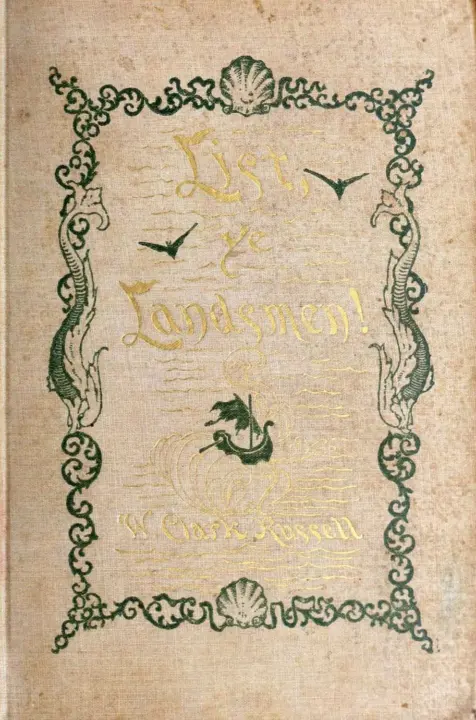
List, Ye Landsmen! A Romance of Incident
William Clark Russell

THE CLASSIC COLLECTION · 1889
"William Dampier" by W. Clark Russell is a historical account written in the late 19th century. The book explores the life and adventures of the famous 17th-century explorer, pirate, and natural historian, William Dampier. It delves into Dampier's experiences on the seas, connecting his narrative to the broader context of navigation and piracy during that era. The opening of the narrative introduces readers to the world of 17th-century buccaneers, characterizing them as a rugged and "savage" community engaged in hunting and piracy. It discusses the challenges faced by early mariners and the art of navigation at that time, illustrating the difficulties they encountered aboard unwieldy ships without modern instruments. This section sets the stage for focusing on Dampier himself, shedding light on how he differed from his contemporaries by possessing qualities of courage and seamanship, while also hinting at the romanticized yet brutal life of piracy and exploration that defined his voyages.
Introduction adapted from the source catalogue; source summaries may be automatically generated.
Free to read · English · 57,549 words · No account needed
MAKE TIME FOR A GOOD BOOK
On by default. Untick to stop anonymous reading totals. Each page counts after 10 seconds in view. How this works.
Anonymous counting is on unless you have switched it off.
“The Creatures are the ugliest in Nature; the Shell, not unlike the Top of an old Hackney-coach, as black as Jet; and so is the outside Skin, but shriveled and very rough. The Legs and Neck are long and about the Bigness of a Man's Wrist; and they have Clubbed Feet as big as one's Fist, shaped much like those of an Elephant, with five Nails on the Forefeet and but Four behind, and the Head little, and Visage small like Snakes; and look very old and black. When at first surprised they shrink their Head, Neck, and Legs, under their Shell.”
This is the kind of simplicity that makes the perusal of the old voyages wonderfully refreshing and delightful. The old fellows looked at life with the eyes of a child but with the intelligence of a man; and so it happens that their representations combine a most perfect and fascinating simplicity with the highest possible qualities of acuteness and sagacity.
On October 1st the ships were off the Mexican coast. When the form of the land grew visible Dampier told Rogers that it was hereabouts he attacked the Manila ship in the St. George. He might have been right, but Rogers does not speak as if he thought so, for he says: “Captain Dampier indeed had been here, but it was a long time ago, and therefore he seemed to know but little of the Matter; yet when he came to land in Places he recollected them very readily.” They suffered much from scarcity of fresh water, and sent the pinnace to explore some islands—the Tres Marias—lying off Cape Corrientes. On one of them they found a human skull, which was supposed to have belonged to an Indian who, with another poor wretch of his own race, had been left there by Captain Swan some twenty-three years before. Dampier of course well remembered the circumstance; he had been with Swan in the Cygnet at the time, and could recollect that provisions being scarce they had left the unhappy Indians to make, as Rogers says, a miserable end on a desert Island. To judge, however, from the refreshments these uninhabited spots yielded, the Indians could not have perished from starvation. The buccaneers met with hares, turtle-doves, pigeons, and parrots, on all of which they fared sumptuously. The sick thrived, and the general health of the crews was never better. On November 1st they were in view of the high coast of California. It was much about the date when Sir Thomas Candish had taken the Manila ship, and, strangely enough, their keels ploughed the very tract of water in which that remarkable feat had been achieved. The memory, aged to us, but lacking nothing of its old lustre, was to those men comparatively recent, and the recollection was one to animate them with great hopes and stern resolves. They were indeed bent now on the adventure whose successful issue had loaded Candish's ship with treasure. They were on the look-out for the galleon, and that nothing might be omitted to render fortune propitious, they again put in force the rules which had formerly been laid down for cruising, established fresh regulations, and made clear every dubious item in their programme of proceedings and plunder. It was this galleon that was to make their fortunes; she it was also that formed the grand hope of the Bristol committee of merchant adventurers; and the design of capturing her was the mainspring of the whole expedition. After a consultation it was agreed that they should dispose themselves thus: the Marquis was to keep off the land at a distance of from six to nine leagues at least; the Duke was to cruise at a range that would cover forty-five miles; and the Dutchess was to occupy the waters between her consorts. There were, of course, false alarms; as, for instance, on the 28th the Marquis fired a gun, which was promptly answered by the Dutchess, on which the Duke hauled her wind for the coast. It then turned out that the Marquis had mistaken the Duke for the Manila ship, and fired as a signal for the Dutchess to chase. They had to wait a long time before the vessel they wanted hove in sight. It was now a month later than the usual time of her appearance in this part of the sea where she was being waited for, and the anxiety of the buccaneers was increased by their inability to obtain any intelligence of her. Provisions were again scarce, and even on short allowance there was barely bread enough to last for seventy days,—a serious matter in the face of the inevitable run later on to the Ladrone Islands, which promised to occupy fifty days at the very least. This most unfortunate dearth of stores, coupled with the growing dejection and mutinous sulkiness of the men, determined Rogers and his brother commanders to give themselves another week's chance, and then, if the galleon did not appear, to sail away to the Indies.
Your reading position is saved on this browser. Take it to another device with a library code. Reading pages adapt to text, rather than matching a printed edition.
William Clark Russell
William Clark Russell
William Clark Russell

William Clark Russell
BEHIND THE BOOK
This eBook is for the use of anyone anywhere in the United States and most other parts of the world at no cost and with almost no restrictions whatsoever. You may copy it, give it away or re-use it under the terms of the Project Gutenberg License included with this eBook or online at www.gutenberg.org. If you are not located in the United States, you will have to check the laws of the country where you are located before using this eBook. Read the source licence.
The original source file, including credits and licence, is retained by this library. Request an original-format copy at no charge. Please include the book title and Project Gutenberg identifier #54284.
KEEP YOUR CURIOSITY GOING
Cécile Tormay

Moritz Busch
John L. Ransom
Frances Wright
Cécile Tormay

Mabel Potter Daggett