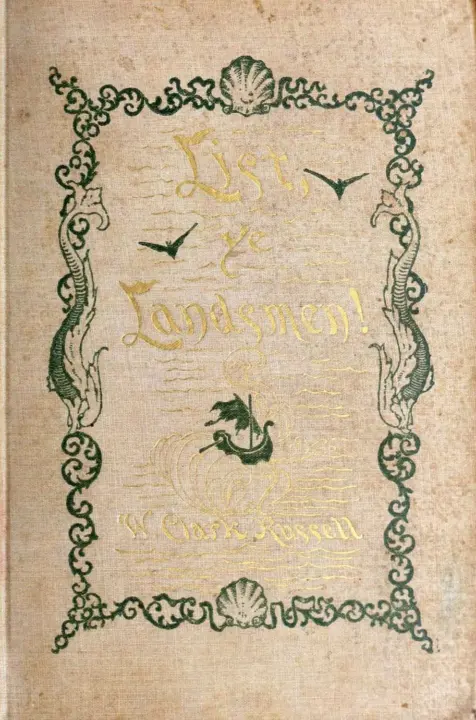
List, Ye Landsmen! A Romance of Incident
William Clark Russell

THE CLASSIC COLLECTION · 1889
"William Dampier" by W. Clark Russell is a historical account written in the late 19th century. The book explores the life and adventures of the famous 17th-century explorer, pirate, and natural historian, William Dampier. It delves into Dampier's experiences on the seas, connecting his narrative to the broader context of navigation and piracy during that era. The opening of the narrative introduces readers to the world of 17th-century buccaneers, characterizing them as a rugged and "savage" community engaged in hunting and piracy. It discusses the challenges faced by early mariners and the art of navigation at that time, illustrating the difficulties they encountered aboard unwieldy ships without modern instruments. This section sets the stage for focusing on Dampier himself, shedding light on how he differed from his contemporaries by possessing qualities of courage and seamanship, while also hinting at the romanticized yet brutal life of piracy and exploration that defined his voyages.
Introduction adapted from the source catalogue; source summaries may be automatically generated.
Free to read · English · 57,549 words · No account needed
MAKE TIME FOR A GOOD BOOK
On by default. Untick to stop anonymous reading totals. Each page counts after 10 seconds in view. How this works.
Anonymous counting is on unless you have switched it off.
Be all this as it may, the St. George and the bark proceeded amicably together to the Gulf of Amapalla, at which place they arrived on January 26th, and the people at once went to work to divide the provisions between the two ships. Before the bark sailed two of the men who had resolved to stay with Captain Dampier left him, and joined Funnell's party, which now numbered thirty-five—namely, thirty-four English and a negro-boy. Meanwhile Dampier's men were busy in refitting their craft. The carpenter stopped the holes which the cannon-balls of the galleon had made in her with tallow and charcoal, not daring to drive in a nail. Four guns were struck into the hold, which yet left sixteen mounted, a greater number than Dampier had men to fight, if the need arose, “for,” says Funnell, “there remained with him no more than twenty-eight Men and Boys, and most of them landmen; which was a very insignificant Force for one who was to make War on a whole Nation.” One might think that the spectacle of such a ship as this would inspire even a larger spirit of desertion than her crew manifested. Certainly there was nothing in the aspect of the tottering and rotten vessel to coax Funnell and his companions back into Dampier's service. They were supplied with four pieces of cannon, along with a fair proportion of small arms and ammunition, and on February 1st they bade farewell to their old associates and started on their perilous voyage.
The subsequent adventures of Dampier need not take long to relate. As we have seen, his crew consisted of twenty-eight men only; the St. George was in a pitiable condition, her seams open, every timber in her decayed, her sails and rigging worn out, and in no sense was she fit to keep the sea. Dampier was in the situation of a gambler who has lost all but the guinea which he now proposes to stake. Indeed, we find him throughout confiding a great deal too much in luck. It is seldom that he attempts to force fortune's hand by prompt, vigorous, and original measures. One by one his brother officers had abandoned him; his crew had deserted him by the score at a time; and yet in a ship rotten to the heart of her, and with a beggarly following of twenty-eight gaunt and dissatisfied men, he clings to the scene of his distresses and his disappointments with no further expectation than the gambling hope that, since he is at the very bottom of the wheel, the next revolution must certainly raise him. Had he and his twenty-eight men come fresh to these seas, they might have flattered themselves with brilliant prospects; smaller companies of buccaneers had achieved incredible things, enlarged their ranks as they progressed, shifted their flag from ship to ship, until they found themselves in possession of a fleet equal to any such force as the enemy in those waters had it in his power to send against them. But Dampier's men were dissatisfied and miserable, surly and despondent with disappointment, and exhausted by privation and severe labours. They looked at the future as promising but a darker picture of what they had already suffered. It was indeed time for them to go home; the privateering spirit amongst them was moribund; all heart had been taken out of them. It speaks well for Dampier's personal influence, whilst it also illustrates his singular genius of persuasion, that he should have succeeded in keeping these men together by representations in which possibly he had as little faith as they. He told them that there was nothing easier than to make their fortunes by surprising some small Spanish town, and that the fewer there were of them, the fewer there would be to share the booty. They listened and sullenly acquiesced—animated, perhaps, by a faint expiring gleam of their old buccaneering instincts. Thereupon Dampier attacked Puna in Ecuador, then a village formed of a small church and about thirty houses. The night was dark when he landed, the inhabitants were in bed; no resistance was offered, and the place was captured without trouble. Having plundered this town, they sailed to Lobos de la Mar, where they let go their anchor, whilst they deliberated what they should do next. On the way to this island they captured a small Spanish vessel full of provisions. Dampier called a council, and it was resolved that they should quit the St. George and sail away to the East Indies in their prize. It is manifest from this resolution that their easy plundering of Puna, and their equally easy capture of the bark,[23] had failed to reconcile them to a longer cruise against the Spaniards. Having transferred everything likely to be of use to them from the St. George, they left that crazy fabric rolling at her anchor and steered westwards for the Indies.
Your reading position is saved on this browser. Take it to another device with a library code. Reading pages adapt to text, rather than matching a printed edition.
William Clark Russell
William Clark Russell
William Clark Russell

William Clark Russell
BEHIND THE BOOK
This eBook is for the use of anyone anywhere in the United States and most other parts of the world at no cost and with almost no restrictions whatsoever. You may copy it, give it away or re-use it under the terms of the Project Gutenberg License included with this eBook or online at www.gutenberg.org. If you are not located in the United States, you will have to check the laws of the country where you are located before using this eBook. Read the source licence.
The original source file, including credits and licence, is retained by this library. Request an original-format copy at no charge. Please include the book title and Project Gutenberg identifier #54284.
KEEP YOUR CURIOSITY GOING
Cécile Tormay

Moritz Busch
John L. Ransom
Frances Wright
Cécile Tormay

Mabel Potter Daggett