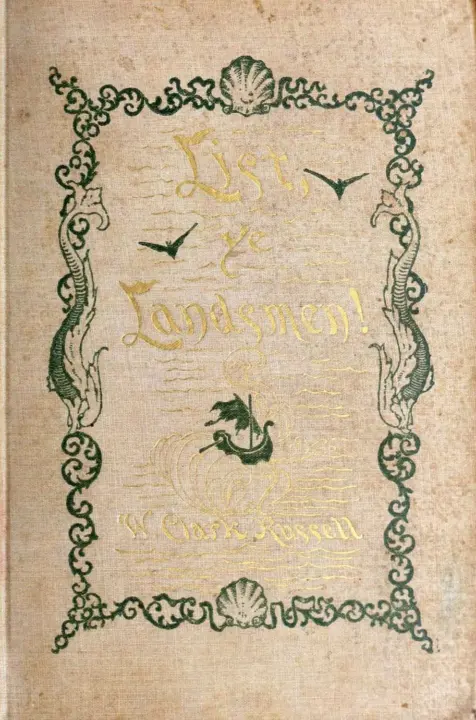
List, Ye Landsmen! A Romance of Incident
William Clark Russell
THE CLASSIC COLLECTION · 1889
"William Dampier" by W. Clark Russell is a historical account written in the late 19th century. The book explores the life and adventures of the famous 17th-century explorer, pirate, and natural historian, William Dampier. It delves into Dampier's experiences on the seas, connecting his narrative to the broader context of navigation and piracy during that era. The opening of the narrative introduces readers to the world of 17th-century buccaneers, characterizing them as a rugged and "savage" community engaged in hunting and piracy. It discusses the challenges faced by early mariners and the art of navigation at that time, illustrating the difficulties they encountered aboard unwieldy ships without modern instruments. This section sets the stage for focusing on Dampier himself, shedding light on how he differed from his contemporaries by possessing qualities of courage and seamanship, while also hinting at the romanticized yet brutal life of piracy and exploration that defined his voyages.
Introduction adapted from the source catalogue; source summaries may be automatically generated.
Free to read · English · 57,549 words · No account needed
MAKE TIME FOR A GOOD BOOK
On by default. Untick to stop anonymous reading totals. Each page counts after 10 seconds in view. How this works.
Anonymous counting is on unless you have switched it off.
Such was the scientific equipment of a man bound on a Polar voyage in the year 1632. It is not to be supposed that such mariners as Dampier and his buccaneering associates went half as well furnished. Indeed their poverty in this direction was so great that one may read here and there of their employing their leisure on shipboard in making quadrants to replace those which were lost or worn out. Their Norie, Raper, and Nautical Almanac in one was the crude Speculum Nauticum of Wagener, made English by Anthony Ashley in 1588, and universally known by the seamen in those days as Waggoner.[5] Sir Thomas Browne, writing in 1664 to his son Thomas, a naval officer, says, “Waggoner you will not be without, which will teach the particular coasts, depths of roades, and how the land riseth upon the several points of the compass.” It will not be supposed that Waggoner's instructions were very trustworthy. The art of surveying was scarcely understood; charts even in Dampier's time were absurdly ill-digested, and portions of the world are barely recognisable in the grotesque tracings. Therefore it happened that the early mariner was forced to depend upon his own judgment and experience to a degree scarce realisable in these days of exact science and matured inventions. He hardly understood what was signified by the variation of the compass, and there was very little outside the Pole Star that was not doubtful. But happily for him there was no obligation of hurry. There was no managing owner to worry him. Prompt despatch was no condition of the charter-party. His was the day of ambling, and he was happy if he could confirm with his lead and log-line the reckonings he arrived at with his forestaff.
It is proper to remember all these conditions of the sea-vocation in reviewing the life of William Dampier. The habit of self-reliance makes the character of the sea-worthies of his age admirable, and it qualified them for their great undertakings and achievements. They were helped with nothing from science that can be mentioned with gravity. The ocean was to them as blank as it looks to the landsman's eye, and it was their business to find out the roads to the wonders and mysteries which lay hidden leagues down behind its familiar shining line. If a sailor nowadays is at fault he can seek and find the hints and assurances he desires in twenty directions. He has Admiralty charts of incomparable accuracy. He has a deep-sea lead with which he can feel the ground whilst his ship moves through the water at fourteen knots an hour. He has instruments for indicating the angle to which his vessel rolls, and for showing him instantly her trim as she sits upon the water. He has a dial that registers on deck, under his eye, the number of miles his ship has made since any hour he chooses to time her from. His chronometer may be accepted as among the most perfect examples of human skill. Dampier and such as he wanted all these adjuncts to their calling. But it cannot be disputed that they were the better sailors for the very poverty of their equipment in this way. It forced upon them faith in nothing but their own observation, so that there never was a race of sailors who kept their eyes wider open and examined more closely those points which have long since slided into the dull prosaics of the deep. No one can follow them without wonder and admiration. We find them in crafts of forty, twenty, even ten tons—boats half-decked and undecked—exploring the frozen silence of the North Pole, beating to the westward against the fierce surge of the Horn, seeking land amidst the vast desolation of the southern ocean, and making new history for their country upon the coast of North America and in the waters of the Mozambique. Their lion-hearts carry them all over the world, and they have nothing to help them but the lead-line over the side and a quadrant big enough to serve as a gallows. Nor was the ocean quite as it is now. In Dampier's time it was still gloomy with mysteries, and there lingered many a dark and terrifying superstition, whose origin was to be traced to those early Portuguese and Spanish sailors who chanted a litany when they saw St. Elmo's Fire glittering at the masthead, and exorcised the demon of the waterspout by elevating their swords in the form of crosses. The mermaid still rose in the tranquil blue waters alongside, and with impassioned eyes and white and wooing arms courted the startled seaman to share her coral pavilion at the bottom of the sea. The enchanted island, steeped in the purple splendour of a radiance that owed nothing of its glory to the heavens, was yet to be discovered by seeking. The darkness of the storm was thronged with gigantic shadowy shapes of fleeting spirits. Amid the tranquillity of the midnight calm, dim fiery figures of undeterminable proportions floated in the black profound, and voices as of human creatures could be heard out of the hush on the deep syllabling the names of the listening and affrighted crew. It is true that the Jack of Dampier's time was not so amazingly superstitious as we find him in the pages of Purchas and Hackluyt. He was not quite so young-eyed as the ancient mariner of the Elizabethan and preceding ages. Nevertheless he was still exceedingly credulous, and he never embarked on a voyage into distant parts without a mind prepared for marvels of many sorts. Also let us remember the shadowiness of the globe whose oceans he was to navigate, the vagueness of countries now as well known to us as our own island home. Australia was rising upon the gaze of the world like a new moon, the greater part of whose disk lies in black shadow. Islands which now have their newspapers and their hotels were uncharted, were less real than the white shoulders of clouds dipping upon the sea-line. Of countries whose coast had been sighted, but whose interiors were unknown, wild guesses at the wonders within resulted in hair-stirring imaginations. These and more than there is room to name are conditions of the early mariner's vocational life, which we must take care to bear in mind as we accompany him in his adventures, or certainly we shall fail to compass the full significance of his magnificent resolution, his incomparable spirit, and his admirable intrepidity.
Your reading position is saved on this browser. Take it to another device with a library code. Reading pages adapt to text, rather than matching a printed edition.
William Clark Russell
William Clark Russell
William Clark Russell

William Clark Russell
BEHIND THE BOOK
This eBook is for the use of anyone anywhere in the United States and most other parts of the world at no cost and with almost no restrictions whatsoever. You may copy it, give it away or re-use it under the terms of the Project Gutenberg License included with this eBook or online at www.gutenberg.org. If you are not located in the United States, you will have to check the laws of the country where you are located before using this eBook. Read the source licence.
The original source file, including credits and licence, is retained by this library. Request an original-format copy at no charge. Please include the book title and Project Gutenberg identifier #54284.
KEEP YOUR CURIOSITY GOING
Cécile Tormay

Moritz Busch
John L. Ransom
Frances Wright
Cécile Tormay

Mabel Potter Daggett