READ · DISCOVER · ENJOYClassic literature · Always free
William Dampier — digital edition cover

THE CLASSIC COLLECTION · 1889

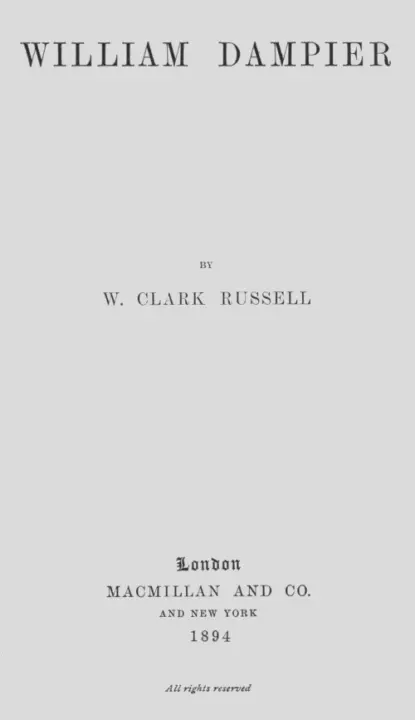
William Dampier

"William Dampier" by W. Clark Russell is a historical account written in the late 19th century. The book explores the life and adventures of the famous 17th-century explorer, pirate, and natural historian, William Dampier. It delves into Dampier's experiences on the seas, connecting his narrative to the broader context of navigation and piracy during that era. The opening of the narrative introduces readers to the world of 17th-century buccaneers, characterizing them as a rugged and "savage" community engaged in hunting and piracy. It discusses the challenges faced by early mariners and the art of navigation at that time, illustrating the difficulties they encountered aboard unwieldy ships without modern instruments. This section sets the stage for focusing on Dampier himself, shedding light on how he differed from his contemporaries by possessing qualities of courage and seamanship, while also hinting at the romanticized yet brutal life of piracy and exploration that defined his voyages.

Introduction adapted from the source catalogue; source summaries may be automatically generated.

Start reading ↓

Free to read · English · 57,549 words · No account needed

MAKE TIME FOR A GOOD BOOK

William Dampier

On by default. Untick to stop anonymous reading totals. Each page counts after 10 seconds in view. How this works.

Anonymous counting is on unless you have switched it off.

William Dampier

Dampier describes the country hereabouts as mountainous and wooded, full of rich valleys and pleasant fresh-water brooks. He named it Port Montague, in honour of the patron to whom he had dedicated his first volume. The Roebuck sailed from this place on March 22nd, and two days afterwards, in the evening, Dampier, who was indisposed and lying down in his cabin, was hastily called on deck to behold what the crew regarded as a miracle. The wonder was no more than a burning mountain, but then those were days when enchanted islands[17] were to be met with at sea, and this great flaming scene was at once a prodigy and a terror to the sun-tanned mariners, who stared at it over the rail with every superstitious instinct in them astir. Tasman had viewed it, but the honest old Batavian did not wield Dampier's pen. It was a grand sight indeed,—a large pillar of fire crimsoning the north-west blackness, rearing its blood-red blaze higher and higher for three or four minutes at a time, then sinking till it seemed to have died, then rising afresh flaming furiously. They got a better view of this volcano a little later. “At every explosion we heard a dreadful noise like thunder, and saw a flame of fire after it the most terrifying that ever I beheld.” Streams of liquid light ran down to the foreshore and overflowed the beach with incandescent lakes. The description of this burning mountain is, I think, one of the finest passages in Dampier's writings.

All this while he supposed that he was still off the coast of New Guinea; but following the trend of the shore, he arrived at those straits which still bear his name, and then discovered that the little country whose seaboard he had been exploring was an island. This land he called Nova Britannia, or, as we now know it, New Britain. Happy would it have been for the reputation of Dampier if, instead of steering east through his straits, he had continued to skirt the New Guinea coast to the south-east, for by so doing he must have rounded into the Gulf of Papua, struck the channel called Torres Straits, and, catching sight of Cape York, have been encouraged to pursue his exploration of the coast of New Holland on that side of the great continent whose fruitfulness, beauty, and conveniency have courted the civilisation of Europe. It is true that the Roebuck was provisioned for twenty months only, but an ardent and ambitious navigator would have made little or nothing of such a condition of his voyage as this when close aboard of him were lands filled with fruit, hogs, fowls, and fresh water. But there is no question that Dampier had long grown weary of this business. He could see nothing but honour (and little enough of that, as things went) to be got out of this journey, and as a poor man, with the heart of a buccaneer in him besides, he would appreciate the need of something more substantial than fame. Be this as it may, he had now, it being April 26th, 1700, started on his return home, intending on the way to call at Batavia to careen and doctor his crazy ship for the long voyage to England. When clear of the straits a vessel hove in sight at dusk, and as her manœuvrings were puzzling they loaded their guns, lighted the matches, and made ready to fight her. She sheered off, but was in sight at daybreak, and then proved to be nothing more dangerous than a Chinese junk laden with tea, porcelain, and other commodities, and bound for Amboyna. The Roebuck's progress was very slow; she was coated with weeds and barnacles, and in a sea-way her timbers worked like a basket. It was not until June 23rd that they arrived at the Straits of Sunda, and at the close of the month they dropped anchor off Batavia. Here Dampier stayed for three months whilst his ship was careened and repaired. Her condition was such that one can only wonder that he and his crew ventured to sail home in her. We might scarcely credit that Dampier's patrons honestly felt much faith in his representations, and in the hopes he held out of vast and important discoveries, when we find them putting him and his crew of boys into a ship which time had made rotten probably some years before she was equipped for this voyage, if it were not that the later experiences of Anson exhibit the same profound departmental indifference and neglect on an occasion which we may assume was regarded as far more significant than Dampier's expedition. Of all the wonderful accomplishments of the English sailor, nothing to my mind is so amazing as the triumphs with which he crowns the cause of his country in defiance of the miserable indifference of the British Admiralty to him and to his labours. The best that Dampier could do with his ship was so to patch her up as to enable her to carry her people home with the pumps going day and night. They sailed from Batavia on October 17th, arrived at the Cape of Good Hope on December 30th, and brought up at the island of Ascension in a sinking condition on February 21st, 1701. Even whilst Ascension was in sight the Roebuck had sprung a fresh leak, and when she anchored both hand and chain pumps were going. There was still a long stretch of ocean for them to traverse, and a ship like a sieve to measure it with. The tinkering of the carpenters apparently increased the mischief, and whilst Dampier was waiting below to receive the news of the leak being stopped, the boatswain arrived with a long face to tell him that the vessel was sinking. “The plank was so rotten,” says Dampier, “it broke away like Dirt, and now it was impossible to save the Ship; for they could not come at the Leak because the water in the run was got above it. I worked myself to encourage my Men, who were very diligent, but the Water still increased, and we now thought of nothing but saving our lives: Wherefore I hoisted out the boat that if the Ship should sink we might be saved; and in the Morning we weighed our anchor and Warped in nearer the shore, tho' we did but little good.” The men with their clothes and bedding were sent ashore on rafts; the sails were unbent and converted into tents for the use of Dampier and his officers; fresh water and rice had been landed for the use of all, “but,” writes the unfortunate commander, “great part of it was stolen away before I came ashore, and many of my books and papers lost.” Luckily there was no lack of turtle, but those who have visited Ascension will understand the distresses of a numerous crew cast away upon an uninhabited island of cinders and volcanic cones, with one green hill only far away in the middle of the calcined heap for the eye to find refreshment in. They were fortunate enough to discover a spring of fresh water; the men carried their beds into the hollows of the rocks, and perhaps thought themselves better off than in the wet, dark, half-drowned, cockroach-laden forecastle of the Roebuck. Moreover, in addition to turtle there were crabs, goats'-flesh, and sea-birds for food; and as the air of Ascension is about the sweetest and most wholesome in the world, the castaways kept their health and spirits, and managed on the whole very well indeed.

Your reading position is saved on this browser. Take it to another device with a library code. Reading pages adapt to text, rather than matching a printed edition.

More from this author

BEHIND THE WORDS

About William Clark Russell

William Clark Russell (1844–1911). Explore List, Ye Landsmen! A Romance of Incident, The Yarn of Old Harbour Town, Heart of Oak: A Three-Stranded Yarn, vol. 3 and other works in this collection. These books span adventure, classic fiction, history.
Explore this author’s books →

THE READERS’ VERDICT

How did this story stay with you?

Not rated yet
Your rating for William Dampier

Be the first to share your verdict.

One rating per browser, which you can change or remove. A necessary browser identifier remembers your vote. How ratings work

A GOOD STORY DESERVES COMPANY

Pass this book along.

A great read is even better when it’s shared.

SEND A LITTLE INSPIRATION

Share this book

BEHIND THE BOOK

Edition & source details.

Title
William Dampier
Author
William Clark Russell
First publication (Open Library catalogue match)
1889
Digital edition publisher
Project Gutenberg
Gutenberg release date
2017-03-05
Language
English
Source edition imprint
Not stated in source catalogue
Source identifier
Project Gutenberg #54284
Contributors
No additional named contributors in source metadata

Public-domain source & licence

This eBook is for the use of anyone anywhere in the United States and most other parts of the world at no cost and with almost no restrictions whatsoever. You may copy it, give it away or re-use it under the terms of the Project Gutenberg License included with this eBook or online at www.gutenberg.org. If you are not located in the United States, you will have to check the laws of the country where you are located before using this eBook. Read the source licence.

Full source licence and obtaining an original copy

The original source file, including credits and licence, is retained by this library. Request an original-format copy at no charge. Please include the book title and Project Gutenberg identifier #54284.

the full Project Gutenberg License must appear
prominently whenever any copy of a Project Gutenberg work (any work
on which the phrase “Project Gutenberg” appears, or with which the
phrase “Project Gutenberg” is associated) is accessed, displayed,
performed, viewed, copied or distributed:

This eBook is for the use of anyone anywhere in the United States and most
other parts of the world at no cost and with almost no restrictions
whatsoever. You may copy it, give it away or re-use it under the terms
of the Project Gutenberg™ License included with this eBook or online
at www.gutenberg.org. If you
are not located in the United States, you will have to check the laws
of the country where you are located before using this eBook.

1.E.2. If an individual Project Gutenberg electronic work is
derived from texts not protected by U.S. copyright law (does not
contain a notice indicating that it is posted with permission of the
copyright holder), the work can be copied and distributed to anyone in
the United States without paying any fees or charges. If you are
redistributing or providing access to a work with the phrase “Project
Gutenberg” associated with or appearing on the work, you must comply
either with the requirements of paragraphs 1.E.1 through 1.E.7 or
obtain permission for the use of the work and the Project Gutenberg
trademark as set forth in paragraphs 1.E.8 or 1.E.9.

1.E.3. If an individual Project Gutenberg electronic work is posted
with the permission of the copyright holder, your use and distribution
must comply with both paragraphs 1.E.1 through 1.E.7 and any
additional terms imposed by the copyright holder. Additional terms
will be linked to the Project Gutenberg License for all works
posted with the permission of the copyright holder found at the
beginning of this work.

1.E.4. Do not unlink or detach or remove the full Project Gutenberg
License terms from this work, or any files containing a part of this
work or any other work associated with Project Gutenberg.

1.E.5. Do not copy, display, perform, distribute or redistribute this
electronic work, or any part of this electronic work, without
prominently displaying the sentence set forth in paragraph 1.E.1 with
active links or immediate access to the full terms of the Project
Gutenberg License.

1.E.6. You may convert to and distribute this work in any binary,
compressed, marked up, nonproprietary or proprietary form, including
any word processing or hypertext form. However, if you provide access
to or distribute copies of a Project Gutenberg work in a format
other than “Plain Vanilla ASCII” or other format used in the official
version posted on the official Project Gutenberg website
(www.gutenberg.org), you must, at no additional cost, fee or expense
to the user, provide a copy, a means of exporting a copy, or a means
of obtaining a copy upon request, of the work in its original “Plain
Vanilla ASCII” or other form. Any alternate format must include the
full Project Gutenberg License as specified in paragraph 1.E.1.

1.E.7. Do not charge a fee for access to, viewing, displaying,
performing, copying or distributing any Project Gutenberg works
unless you comply with paragraph 1.E.8 or 1.E.9.

1.E.8. You may charge a reasonable fee for copies of or providing
access to or distributing Project Gutenberg electronic works
provided that:

• You pay a royalty fee of 20% of the gross profits you derive from
the use of Project Gutenberg works calculated using the method
you already use to calculate your applicable taxes. The fee is owed
to the owner of the Project Gutenberg trademark, but he has
agreed to donate royalties under this paragraph to the Project
Gutenberg Literary Archive Foundation. Royalty payments must be paid
within 60 days following each date on which you prepare (or are
legally required to prepare) your periodic tax returns. Royalty
payments should be clearly marked as such and sent to the Project
Gutenberg Literary Archive Foundation at the address specified in
Section 4, “Information about donations to the Project Gutenberg
Literary Archive Foundation.”

• You provide a full refund of any money paid by a user who notifies
you in writing (or by e-mail) within 30 days of receipt that s/he
does not agree to the terms of the full Project Gutenberg™
License. You must require such a user to return or destroy all
copies of the works possessed in a physical medium and discontinue
all use of and all access to other copies of Project Gutenberg™
works.

• You provide, in accordance with paragraph 1.F.3, a full refund of
any money paid for a work or a replacement copy, if a defect in the
electronic work is discovered and reported to you within 90 days of
receipt of the work.

• You comply with all other terms of this agreement for free
distribution of Project Gutenberg™ works.


1.E.9. If you wish to charge a fee or distribute a Project
Gutenberg™ electronic work or group of works on different terms than
are set forth in this agreement, you must obtain permission in writing
from the Project Gutenberg Literary Archive Foundation, the manager of
the Project Gutenberg™ trademark. Contact the Foundation as set
forth in Section 3 below.

1.F.

1.F.1. Project Gutenberg volunteers and employees expend considerable
effort to identify, do copyright research on, transcribe and proofread
works not protected by U.S. copyright law in creating the Project
Gutenberg™ collection. Despite these efforts, Project Gutenberg™
electronic works, and the medium on which they may be stored, may
contain “Defects,” such as, but not limited to, incomplete, inaccurate
or corrupt data, transcription errors, a copyright or other
intellectual property infringement, a defective or damaged disk or
other medium, a computer virus, or computer codes that damage or
cannot be read by your equipment.

1.F.2. LIMITED WARRANTY, DISCLAIMER OF DAMAGES - Except for the “Right
of Replacement or Refund” described in paragraph 1.F.3, the Project
Gutenberg Literary Archive Foundation, the owner of the Project
Gutenberg™ trademark, and any other party distributing a Project
Gutenberg™ electronic work under this agreement, disclaim all
liability to you for damages, costs and expenses, including legal
fees. YOU AGREE THAT YOU HAVE NO REMEDIES FOR NEGLIGENCE, STRICT
LIABILITY, BREACH OF WARRANTY OR BREACH OF CONTRACT EXCEPT THOSE
PROVIDED IN PARAGRAPH 1.F.3. YOU AGREE THAT THE FOUNDATION, THE
TRADEMARK OWNER, AND ANY DISTRIBUTOR UNDER THIS AGREEMENT WILL NOT BE
LIABLE TO YOU FOR ACTUAL, DIRECT, INDIRECT, CONSEQUENTIAL, PUNITIVE OR
INCIDENTAL DAMAGES EVEN IF YOU GIVE NOTICE OF THE POSSIBILITY OF SUCH
DAMAGE.

1.F.3. LIMITED RIGHT OF REPLACEMENT OR REFUND - If you discover a
defect in this electronic work within 90 days of receiving it, you can
receive a refund of the money (if any) you paid for it by sending a
written explanation to the person you received the work from. If you
received the work on a physical medium, you must return the medium
with your written explanation. The person or entity that provided you
with the defective work may elect to provide a replacement copy in
lieu of a refund. If you received the work electronically, the person
or entity providing it to you may choose to give you a second
opportunity to receive the work electronically in lieu of a refund. If
the second copy is also defective, you may demand a refund in writing
without further opportunities to fix the problem.

1.F.4. Except for the limited right of replacement or refund set forth
in paragraph 1.F.3, this work is provided to you ‘AS-IS’, WITH NO
OTHER WARRANTIES OF ANY KIND, EXPRESS OR IMPLIED, INCLUDING BUT NOT
LIMITED TO WARRANTIES OF MERCHANTABILITY OR FITNESS FOR ANY PURPOSE.

1.F.5. Some states do not allow disclaimers of certain implied
warranties or the exclusion or limitation of certain types of
damages. If any disclaimer or limitation set forth in this agreement
violates the law of the state applicable to this agreement, the
agreement shall be interpreted to make the maximum disclaimer or
limitation permitted by the applicable state law. The invalidity or
unenforceability of any provision of this agreement shall not void the
remaining provisions.

1.F.6. INDEMNITY - You agree to indemnify and hold the Foundation, the
trademark owner, any agent or employee of the Foundation, anyone
providing copies of Project Gutenberg™ electronic works in
accordance with this agreement, and any volunteers associated with the
production, promotion and distribution of Project Gutenberg™
electronic works, harmless from all liability, costs and expenses,
including legal fees, that arise directly or indirectly from any of
the following which you do or cause to occur: (a) distribution of this
or any Project Gutenberg work, (b) alteration, modification, or
additions or deletions to any Project Gutenberg work, and (c) any
Defect you cause.

Section 2. Information about the Mission of Project Gutenberg

Project Gutenberg is synonymous with the free distribution of
electronic works in formats readable by the widest variety of
computers including obsolete, old, middle-aged and new computers. It
exists because of the efforts of hundreds of volunteers and donations
from people in all walks of life.

Volunteers and financial support to provide volunteers with the
assistance they need are critical to reaching Project Gutenberg’s
goals and ensuring that the Project Gutenberg collection will
remain freely available for generations to come. In 2001, the Project
Gutenberg Literary Archive Foundation was created to provide a secure
and permanent future for Project Gutenberg and future
generations. To learn more about the Project Gutenberg Literary
Archive Foundation and how your efforts and donations can help, see
Sections 3 and 4 and the Foundation information page at www.gutenberg.org.

Section 3. Information about the Project Gutenberg Literary Archive Foundation

The Project Gutenberg Literary Archive Foundation is a non-profit
501(c)(3) educational corporation organized under the laws of the
state of Mississippi and granted tax exempt status by the Internal
Revenue Service. The Foundation’s EIN or federal tax identification
number is 64-6221541. Contributions to the Project Gutenberg Literary
Archive Foundation are tax deductible to the full extent permitted by
U.S. federal laws and your state’s laws.

The Foundation’s business office is located at 41 Watchung Plaza #516,
Montclair NJ 07042, USA, +1 (862) 621-9288. Email contact links and up
to date contact information can be found at the Foundation’s website
and official page at www.gutenberg.org/contact

Section 4. Information about Donations to the Project Gutenberg
Literary Archive Foundation

Project Gutenberg™ depends upon and cannot survive without widespread
public support and donations to carry out its mission of
increasing the number of public domain and licensed works that can be
freely distributed in machine-readable form accessible by the widest
array of equipment including outdated equipment. Many small donations
($1 to $5,000) are particularly important to maintaining tax exempt
status with the IRS.

The Foundation is committed to complying with the laws regulating
charities and charitable donations in all 50 states of the United
States. Compliance requirements are not uniform and it takes a
considerable effort, much paperwork and many fees to meet and keep up
with these requirements. We do not solicit donations in locations
where we have not received written confirmation of compliance. To SEND
DONATIONS or determine the status of compliance for any particular state
visit www.gutenberg.org/donate.

While we cannot and do not solicit contributions from states where we
have not met the solicitation requirements, we know of no prohibition
against accepting unsolicited donations from donors in such states who
approach us with offers to donate.

International donations are gratefully accepted, but we cannot make
any statements concerning tax treatment of donations received from
outside the United States. U.S. laws alone swamp our small staff.

Please check the Project Gutenberg web pages for current donation
methods and addresses. Donations are accepted in a number of other
ways including checks, online payments and credit card donations. To
donate, please visit: www.gutenberg.org/donate.

Section 5. General Information About Project Gutenberg electronic works

Professor Michael S. Hart was the originator of the Project
Gutenberg concept of a library of electronic works that could be
freely shared with anyone. For forty years, he produced and
distributed Project Gutenberg eBooks with only a loose network of
volunteer support.

Project Gutenberg eBooks are often created from several printed
editions, all of which are confirmed as not protected by copyright in
the U.S. unless a copyright notice is included. Thus, we do not
necessarily keep eBooks in compliance with any particular paper
edition.

Most people start at our website which has the main PG search
facility: www.gutenberg.org.

This website includes information about Project Gutenberg,
including how to make donations to the Project Gutenberg Literary
Archive Foundation, how to help produce our new eBooks, and how to
subscribe to our email newsletter to hear about new eBooks.


KEEP YOUR CURIOSITY GOING

Your next chapter awaits.