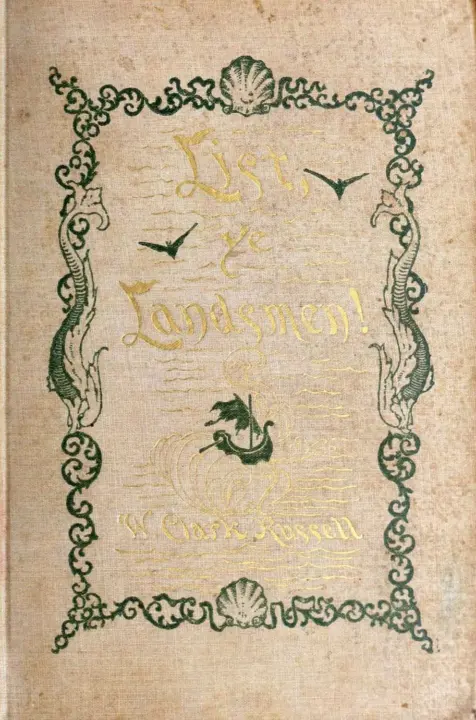
List, Ye Landsmen! A Romance of Incident
William Clark Russell

THE CLASSIC COLLECTION · 1889
"William Dampier" by W. Clark Russell is a historical account written in the late 19th century. The book explores the life and adventures of the famous 17th-century explorer, pirate, and natural historian, William Dampier. It delves into Dampier's experiences on the seas, connecting his narrative to the broader context of navigation and piracy during that era. The opening of the narrative introduces readers to the world of 17th-century buccaneers, characterizing them as a rugged and "savage" community engaged in hunting and piracy. It discusses the challenges faced by early mariners and the art of navigation at that time, illustrating the difficulties they encountered aboard unwieldy ships without modern instruments. This section sets the stage for focusing on Dampier himself, shedding light on how he differed from his contemporaries by possessing qualities of courage and seamanship, while also hinting at the romanticized yet brutal life of piracy and exploration that defined his voyages.
Introduction adapted from the source catalogue; source summaries may be automatically generated.
Free to read · English · 57,549 words · No account needed
MAKE TIME FOR A GOOD BOOK
On by default. Untick to stop anonymous reading totals. Each page counts after 10 seconds in view. How this works.
Anonymous counting is on unless you have switched it off.
Whilst he was at Acheen some of the people rebelled against the choice that had been made of a queen. Dampier, with others, hastened to take shelter in the ships in the road, fearing that if the rebels obtained the upper hand they would imprison him. He had indeed good cause to dread the effects of a prison upon his constitution, shaken and almost shattered as it was by long illness. There were two vessels at anchor, one of them fresh from England and short of provisions. He in consequence boarded the other, whose stores were tolerably plentiful, but she was so crowded with cargo that he could not find space to swing his hammock in; and as repose was absolutely essential to him, he carried his bed into the boat that had brought him off and lay in her for three or four days, fed by the people of the ship. He could obtain no rest. There happened a total eclipse of the moon, at which he gazed from the bottom of his boat, but he says: “I was so little curious that I remembered not so much as what Day of the Month it was, and I kept no journal of this Voyage as I did of my other; but only kept an account of several particular Remarks and Observations as they occurred to me.” When the disturbance ashore was quieted he returned to his lodging, and learning that the natives regarded the water of their river as charged with medicinal virtues, he determined to bathe in it, and after a few baths was so much benefited that he was able to get about again. In May, 1689, he took charge of a sloop that had been purchased by one Captain Tyler; but when the craft was loaded, the owner changed his mind and gave the command to a man named Minchin, who offered Dampier the post of mate. “I was forced to submit,” he says bitterly, “and accepted a Mate's employ under Captain Minchin.” They sailed in the middle of September for Malacca, at which place some of the people left Minchin to join another vessel that had been in company, so that Dampier and the captain were the only two white sailors on board. Shortly after starting they carried away their foreyard and brought up off a small island owned by the Dutch. Dampier called upon the governor to request his permission to cut down a tree. Our hero, as an old Campeché man, was not likely to be at a loss; and leaving the tree ready to be carried to the ship, he returned to the fort, dined with the governor, and then went aboard. Shortly afterwards his captain, together with a passenger and his wife, came ashore. The fare of the fort was exceedingly meagre, and the governor, to entertain his guests, sent a boat to catch a dish of fish. The fish, on being cooked, was served in dishes of solid silver, and eaten from plates of the same metal; whilst in the centre of the table was placed a great silver bowl full of punch. It was to prove but little better than a Barmecide's feast. The governor, his guests, and several officers attached to the fort seated themselves, but as they were about to begin a soldier outside roared, “The Malays!” The governor, starting from his chair, leapt out of one of the windows, the officers followed, and all was consternation and uproar. “Every one of them,” says Dampier, “took the nearest way, some out of the Windows, others out of the Doors, leaving the three Guests by themselves, who soon followed with all the haste they could make, without knowing the meaning of this sudden consternation of the Governor and his people.” All being in the fort, the door was bolted, and several volleys fired to let the Malays know that the Dutch were in readiness for them. The alarm was real enough. A large Malay canoe, filled with men armed to the teeth, had been noticed skulking under the island close to the shore. The captain and the passengers hastened on board, the vessel's guns were loaded and primed for service, and a bright look-out kept all night. Dampier, however, was not very much frightened. It rained heavily, and he knew from experience that the Malays seldom or never made any attack in wet weather. Next morning nothing was to be seen of the enemy, and having rigged up the foreyard, Dampier and his companions set sail for Acheen. Here he was seized with a fever, which confined him to his bed for a fortnight. On regaining his health he returned to the vessel with orders to take charge of her, and on New Year's Day, 1690, sailed for Fort St. George with a cargo of pepper and other produce. His description of Madras as it then showed, now two hundred years ago, is interesting. “I was much pleased,” he says, “with the beautiful prospect this Place makes off at Sea. For it stands in a plain Sandy spot of Ground, close by the shore, the Sea sometimes washing its Walls; which are of Stone and high, with Half-Moons and Flankers and a great many Guns mounted on the Battlements: so that what with the Walls and fine buildings within the Fort, the large town of Maderas without it, the Pyramids of the English Tombs, Houses, and Gardens adjacent, and the variety of fine Trees scatter'd up and down, it makes as agreeable a Landskip as I have anywhere seen.” He tells us that he stayed at this place for some months, where he met with a Mr. Moody, who had purchased what Dampier calls a painted prince named Jeoly. Then in July he sailed with a Captain Howel for Sumatra.
Your reading position is saved on this browser. Take it to another device with a library code. Reading pages adapt to text, rather than matching a printed edition.
William Clark Russell

William Clark Russell
William Clark Russell

William Clark Russell
BEHIND THE BOOK
This eBook is for the use of anyone anywhere in the United States and most other parts of the world at no cost and with almost no restrictions whatsoever. You may copy it, give it away or re-use it under the terms of the Project Gutenberg License included with this eBook or online at www.gutenberg.org. If you are not located in the United States, you will have to check the laws of the country where you are located before using this eBook. Read the source licence.
The original source file, including credits and licence, is retained by this library. Request an original-format copy at no charge. Please include the book title and Project Gutenberg identifier #54284.
KEEP YOUR CURIOSITY GOING
Cécile Tormay

Moritz Busch
John L. Ransom
Frances Wright
Cécile Tormay

Mabel Potter Daggett