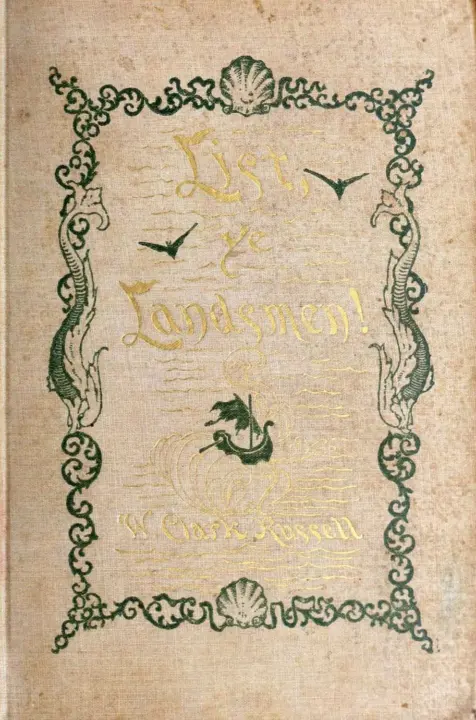
List, Ye Landsmen! A Romance of Incident
William Clark Russell

THE CLASSIC COLLECTION · 1889
"William Dampier" by W. Clark Russell is a historical account written in the late 19th century. The book explores the life and adventures of the famous 17th-century explorer, pirate, and natural historian, William Dampier. It delves into Dampier's experiences on the seas, connecting his narrative to the broader context of navigation and piracy during that era. The opening of the narrative introduces readers to the world of 17th-century buccaneers, characterizing them as a rugged and "savage" community engaged in hunting and piracy. It discusses the challenges faced by early mariners and the art of navigation at that time, illustrating the difficulties they encountered aboard unwieldy ships without modern instruments. This section sets the stage for focusing on Dampier himself, shedding light on how he differed from his contemporaries by possessing qualities of courage and seamanship, while also hinting at the romanticized yet brutal life of piracy and exploration that defined his voyages.
Introduction adapted from the source catalogue; source summaries may be automatically generated.
Free to read · English · 57,549 words · No account needed
MAKE TIME FOR A GOOD BOOK
On by default. Untick to stop anonymous reading totals. Each page counts after 10 seconds in view. How this works.
Anonymous counting is on unless you have switched it off.
Trifling as these incidents are, it is proper to relate them as examples of the life and experiences of Dampier during this period of his career. Unfortunately, until one opens his own books one does not know where to look for him. In whose troop he marched, in whose canoe he sat, in what special adventures he was concerned, whether he was favoured for his intelligence above the others by the commanders of the expedition, cannot be ascertained. When Ringrose wrote, Dampier was still a mere privateersman, a foremast hand, a man without individuality enough to arrest the attention of the sturdy, plain, and honest historian of the voyage in which they both took part. Indeed, there is no reason to suppose that Dampier at this time was regarded by his fellows as better than the humblest of the shaggy, sun-blackened men who, with fuzees on their shoulders and pistols in their girdles, tramped in little troops through the swamps and creeks and over the swelling lands of the Isthmus, or who in their deep and narrow canoes floated silent and grim upon the hot and creeping river in search of the unexpectant Don and his almost fabulous wealth.
Dampier introduces a curious story in connection with Panama and the South Seas in his first volume. He says that when he was on board Captain Coxon's ship, there being three or four privateers in company, they captured a despatch boat bound to Cartagena from Porto Bello. They opened many of the letters, and were struck by observing that several of the merchants who wrote from Old Spain exhorted their correspondents at Panama to bear in mind a certain prophecy that had been current in Madrid and other centres for some months past, the tenor of which was—That there would be English privateers that year in the West Indies, who would make such great discoveries as to open a door into the South Seas. This door, Dampier says, was the passage overland to Darien through the country of the Indians, a people who had quarrelled with the Spaniards and professed a friendship for the English. At all events, these Indians had been for some time inviting the privateers to march across their territory and fall upon the Spaniards in the South Seas. Hence when the letters came into their hands they grew disposed to entertain the Indians' proposal in good earnest, and finally made those attempts to which I have referred in quoting from the pages of Ringrose. The cause of the friendship between the English buccaneers and the Darien Indians is a story of some interest. About fifteen years before Dampier crossed the Isthmus a certain Captain Wright, who was cruising in those waters, met with a young Indian lad paddling about in a canoe. He took him aboard his ship, clothed him, and, with the idea of making an Englishman of him, gave him the name of John Gret. Some Mosquito Indians, however, begged the boy from Captain Wright, who gave him to them. They carried him into their own country, and by and by he married a wife from among them. Through the agency of this John Gret, who always preserved an affection for the English, a friendship was established between the buccaneers and the Indians. Presents were made on each side, and a certain secret signal was concerted whereby the Indians might recognise their English friends. It happened that there was a Frenchman among one of the buccaneering captain's crew. He was artful enough to commit this signal, whatever it was, to memory, and on his arrival at Petit Guavres he communicated what he knew to his countrymen there, and represented the facility with which the South Seas might be entered now that he had the secret of winning over the Indians to help him. On this one hundred and twenty Frenchmen formed themselves into a troop, with the buccaneer, whom Dampier calls Mr. la Sound, as their captain, and marched against Cheapo, an attempt that proved unsuccessful, though the simple Indians, believing them to be English, gave them all the assistance that was in their power. “From such small beginnings,” adds Dampier, “arose those great stirs that have been since made in the South Seas, viz.: from the Letters we took and from the Friendship contracted with these Indians by means of John Gret. Yet this Friendship had like to have been stifled in its Infancy; for within few months after an English trading Sloop came on this Coast from Jamaica, and John Gret, who by this time had advanced himself as a Grandee amongst these Indians, together with 5 or 6 more of that quality, went off to the Sloop in their long Gowns, as the custom is for such to wear among them. Being received aboard, they expected to find everything friendly, and John Gret talkt to them in English; but these English Men having no knowledge at all of what had happened, endeavoured to make them Slaves (as is commonly done), for upon carrying them to Jamaica they could have sold them for 10 or 12 Pound apiece. But John Gret and the rest perceiving this, leapt all overboard, and were by the others killed every one of them in the Water. The Indians on Shoar never came to the knowledge of it; if they had it would have endangered our Correspondence.”
Your reading position is saved on this browser. Take it to another device with a library code. Reading pages adapt to text, rather than matching a printed edition.
William Clark Russell
William Clark Russell
William Clark Russell

William Clark Russell
BEHIND THE BOOK
This eBook is for the use of anyone anywhere in the United States and most other parts of the world at no cost and with almost no restrictions whatsoever. You may copy it, give it away or re-use it under the terms of the Project Gutenberg License included with this eBook or online at www.gutenberg.org. If you are not located in the United States, you will have to check the laws of the country where you are located before using this eBook. Read the source licence.
The original source file, including credits and licence, is retained by this library. Request an original-format copy at no charge. Please include the book title and Project Gutenberg identifier #54284.
KEEP YOUR CURIOSITY GOING
Cécile Tormay

Moritz Busch
John L. Ransom
Frances Wright
Cécile Tormay

Mabel Potter Daggett