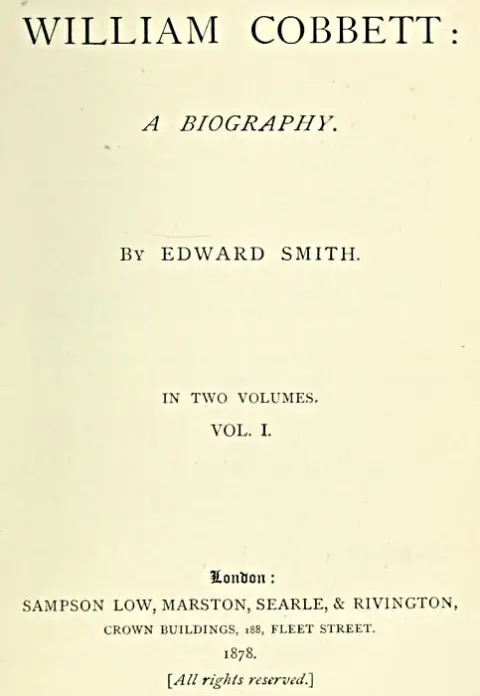
William Cobbett: A Biography in Two Volumes, Vol. 1
Edward Smith
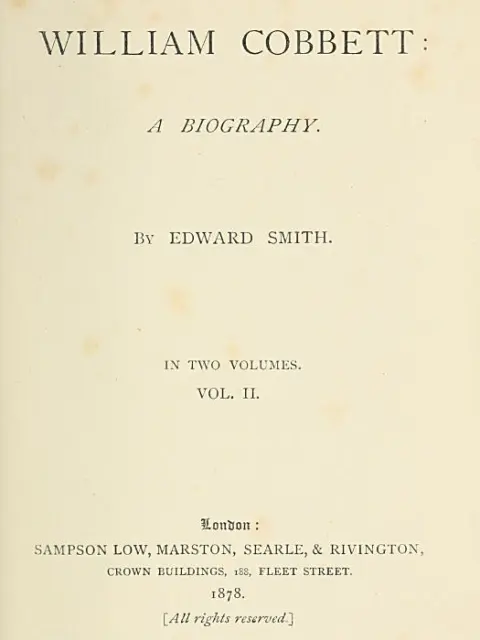
THE CLASSIC COLLECTION · 1878
"William Cobbett: A Biography in Two Volumes, Vol. 2" by Edward Smith is a historical account written in the late 19th century. The biography chronicles the life and work of William Cobbett, a political reformer and journalist, focusing on his influences and contributions during a time of significant social and political change in England. The text delves into Cobbett's efforts in advocating for the working class, his literary output, and his battles against political corruption and injustices. At the start of the biography, readers are introduced to Cobbett's life in Botley, where he expresses contentment with his family's pastoral lifestyle and the joys of gardening and fishing. Through letters, Cobbett shares his plans for a farming life while balancing his political ambitions, including efforts to address public disenfranchisement and reform parliamentary practices. The groundwork is laid for examining his growing prominence in political discourse, as he begins to align himself with reformers while navigating the complexities of maintaining his integrity amidst public and personal challenges.
Introduction adapted from the source catalogue; source summaries may be automatically generated.
Free to read · English · 87,523 words · No account needed
MAKE TIME FOR A GOOD BOOK
On by default. Untick to stop anonymous reading totals. Each page counts after 10 seconds in view. How this works.
Anonymous counting is on unless you have switched it off.
72. COBBETT’S LEGACY TO LABOURERS; or, what is the right which the lords, baronets, and squires, have to possess the lands, or to make the laws? In six letters, addressed to the working people of the whole kingdom. With a dedication to Sir Robert Peel. London, 1835. 16mo. p. 141.
73. COBBETT’S LEGACY TO PEEL; or, an inquiry with respect to what the right honourable baronet will now do with the House of Commons, with Ireland, with the English Church and the Dissenters, with the swarms of pensioners, &c., with the crown lands and the army, with the currency and the debt. In six letters. London, 1835. 18mo.
74. COBBETT’S LEGACY TO PARSONS; or, have the clergy of the established church an equitable right to the tithes, or to any other thing called church property, greater than the dissenters have to the same? And, ought there, or ought there not, to be a separation of the Church from the State? In six letters, addressed to the church-parsons in general, including the cathedral and college clergy and the bishops. With a dedication to Blomfield, Bishop of London. London, 1835. 16mo. pp. 192.
Abbot (Charles, 1st Baron Colchester)--his conferences, “after church,” with Mr. Perceval, ii. 49, 110.
Abercrombie (Rev. James), of Philadelphia, i. 194.
Adam (William)--C.’s counsel on first Government prosecution, i. 307.
Adams (John), President of U. S.--C. supports his administration, i. 187.
Addington (Henry, 1st Viscount Sidmouth) becomes Premier, i. 271;
C.’s letters to him on the peace, 279;
his incapacity as a statesman, 302;
bestows a sinecure upon his son, 327;
other references, ii. 170, 178.
Adet (Pierre A.), French envoy to America, i. 181.
Agricultural interest--its troubles, ii. 153, 154, 259.
America--The War of Independence, i. 16;
Raynal and other writers invoke interest in Europe concerning the
country, 96;
current political condition in the United States, 121;
rise of the two great parties, 122;
treaty with England, 127, 138;
flogging abolished in the States, ii. 133;
the war of 1812 and its effects, 198;
C.’s writings again attract notice in America, 200.
André (Major)--exhumation of his remains, ii. 218.
Andrews’s “British Journalism” quoted, ii. 117.
Anti-Cobbett literature, i. 136, 172, 174, 177, 189, 303; ii. 43, 46, 47, 48, 55, 56, 110, 123, 171, 217, 226, 243, 260.
Anti-Gallicanism in London, i. 287.
Anti-Jacobinism, i. 131, 241, 252, 263.
Astley (Sir J.), ii. 65.
Attwood (Thomas), M.P. for Birmingham, ii. 286.
Bache (Benjamin F.)--his Philadelphia newspaper, i. 139, &c.;
notice of his family, 151;
his editorial virulence, 204.
Bagshaw (Richard), newsman, ii. 59, 76, 114, 126.
Baker (Rev. Richard), the “Botley parson,” ii. 74, 150, 151.
Bamford (Samuel)--his “Recollections” quoted, ii. 156.
Beevor (Sir Thomas) supports C.’s candidature for parliament, ii. 252.
Beloe (Rev. Wm.), i. 237, 251, 289.
Benbow (Wm.) a sufferer under the Press Laws, ii. 206.
Bentham (Jeremy) quoted, i. 197, 306;
contributes to the London Porcupine, 276.
Berkeley (Admiral Sir George), i. 23.
Bibliography, ii. 305.
Birkbeck (Morris)--his emigration scheme, ii. 205.
Blagdon (F. W.)--his Weekly Political Register, ii. 47.
Blount (Wm.), Governor of Tennessee, i. 207.
Your reading position is saved on this browser. Take it to another device with a library code. Reading pages adapt to text, rather than matching a printed edition.
BEHIND THE BOOK
This eBook is for the use of anyone anywhere in the United States and most other parts of the world at no cost and with almost no restrictions whatsoever. You may copy it, give it away or re-use it under the terms of the Project Gutenberg License included with this eBook or online at www.gutenberg.org. If you are not located in the United States, you will have to check the laws of the country where you are located before using this eBook. Read the source licence.
The original source file, including credits and licence, is retained by this library. Request an original-format copy at no charge. Please include the book title and Project Gutenberg identifier #49845.
KEEP YOUR CURIOSITY GOING
Cécile Tormay

Moritz Busch
John L. Ransom
Frances Wright
Cécile Tormay

Mabel Potter Daggett