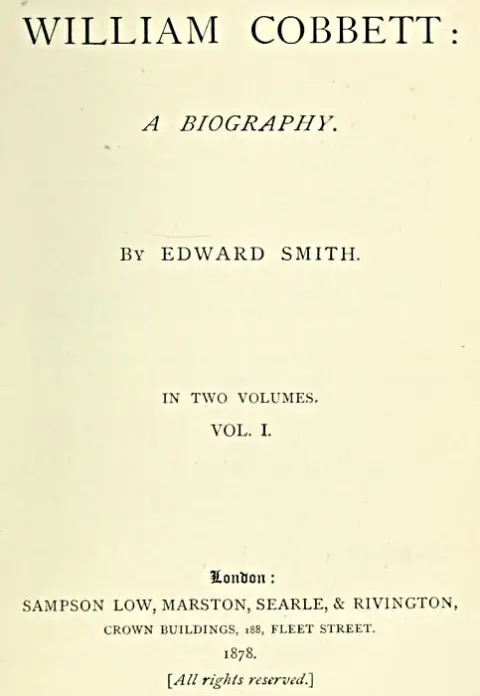
William Cobbett: A Biography in Two Volumes, Vol. 1
Edward Smith
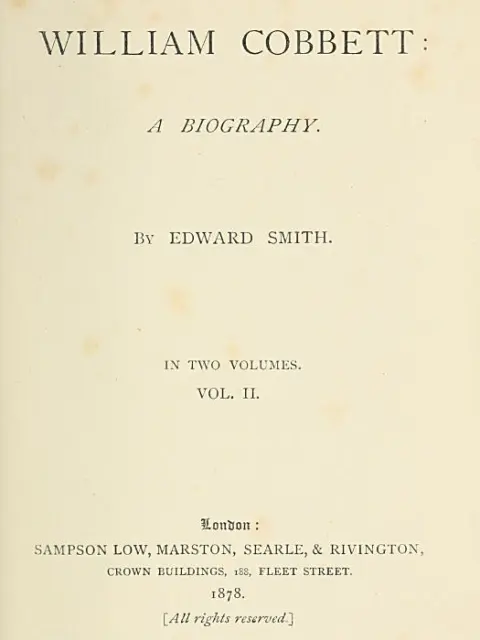
THE CLASSIC COLLECTION · 1878
"William Cobbett: A Biography in Two Volumes, Vol. 2" by Edward Smith is a historical account written in the late 19th century. The biography chronicles the life and work of William Cobbett, a political reformer and journalist, focusing on his influences and contributions during a time of significant social and political change in England. The text delves into Cobbett's efforts in advocating for the working class, his literary output, and his battles against political corruption and injustices. At the start of the biography, readers are introduced to Cobbett's life in Botley, where he expresses contentment with his family's pastoral lifestyle and the joys of gardening and fishing. Through letters, Cobbett shares his plans for a farming life while balancing his political ambitions, including efforts to address public disenfranchisement and reform parliamentary practices. The groundwork is laid for examining his growing prominence in political discourse, as he begins to align himself with reformers while navigating the complexities of maintaining his integrity amidst public and personal challenges.
Introduction adapted from the source catalogue; source summaries may be automatically generated.
Free to read · English · 87,523 words · No account needed
MAKE TIME FOR A GOOD BOOK
On by default. Untick to stop anonymous reading totals. Each page counts after 10 seconds in view. How this works.
Anonymous counting is on unless you have switched it off.
The whole story is graphically told by Cobbett, in the “History of the Regency and Reign of George IV.,” and his cotemporary articles will be found in the Registers of 1820.
[16] Among the anti-Cobbett literature of this period which has not utterly perished, may be named,--
“The Political Death of Mr. William Cobbett” (Edinburgh, 1820), a short collection of slanders, intermingled with just sufficient truth to float it.
“The Book of Wonders” (London, 1821), an occasional publication. The second number was a verbatim report of the trial in Wright v. Cobbett, illustrated with notes.
“Cobbett’s Gridiron: written to warn Farmers of their Danger, and to put Landowners, Mortgagees, Lenders, Borrowers, the Labouring, and indeed all Classes of the Community on their Guard” (London, 1822).
“The True Patriot,” No. 1, May 15, 1824,--should have been entitled “The Truthful Hypocrite.”
“Cobbett’s Reflections on Religion,” and “Cobbett’s Reflections on Politics” (Sunderland, circa 1820-1), were “loyal” selections from his early writings.
“The Gridiron; or, Cook’s Weekly Register.” First number, March 23, 1822. Here are specimens of it:--
[“Our present intention is, principally, to exterminate Cobbett from the political world. The time required to effect this, of course, cannot be distinctly defined.…
“In our immediate attacks upon Cobbett, we request our readers to excuse the coarseness of the language adopted.”
“Farmers’ wives.--It is now but a few years since that an old shameless, wicked fellow rose up from his bed to pray for your husbands’ destruction. This wicked fellow’s name is no other than Cobbett,” &c.]
No. 2 speaks of the increasing demand for the first number. No. 3 is reduced to sixpence, for the purpose of affording a more general circulation. No. 4, ?????
All this anonymous rubbish did more good than harm, as obvious hypocrisy always will, under similar circumstances. A more respectable opponent was Henry White, a well-known Whig writer of the day. People said he was jealous of Cobbett. He was a very able man, and had himself been well abused by the Times and other papers, on account of his strict partisanship. After many years of animadversion, he produced “A Calm Appeal to the Friends of Freedom and Reform, on the Double Dealings of Mr. Cobbett, and the baneful tendency of his Writings. With a vindication of the Whigs, and the Patriots of Westminster and the Borough of Southwark, against his Scurrilous and Malignant Aspersions. By Henry White, late editor of the Independent Whig, the Charles James Fox, the Independent Observer, the Sunday Times, the Public Cause, &c., &c.” (London, 1823). Referring to his own party, White says, “What virtue, what wisdom, what real patriotism there is in the country, he knows they possess.”
Your reading position is saved on this browser. Take it to another device with a library code. Reading pages adapt to text, rather than matching a printed edition.
BEHIND THE BOOK
This eBook is for the use of anyone anywhere in the United States and most other parts of the world at no cost and with almost no restrictions whatsoever. You may copy it, give it away or re-use it under the terms of the Project Gutenberg License included with this eBook or online at www.gutenberg.org. If you are not located in the United States, you will have to check the laws of the country where you are located before using this eBook. Read the source licence.
The original source file, including credits and licence, is retained by this library. Request an original-format copy at no charge. Please include the book title and Project Gutenberg identifier #49845.
KEEP YOUR CURIOSITY GOING
Cécile Tormay

Moritz Busch
John L. Ransom
Frances Wright
Cécile Tormay

Mabel Potter Daggett