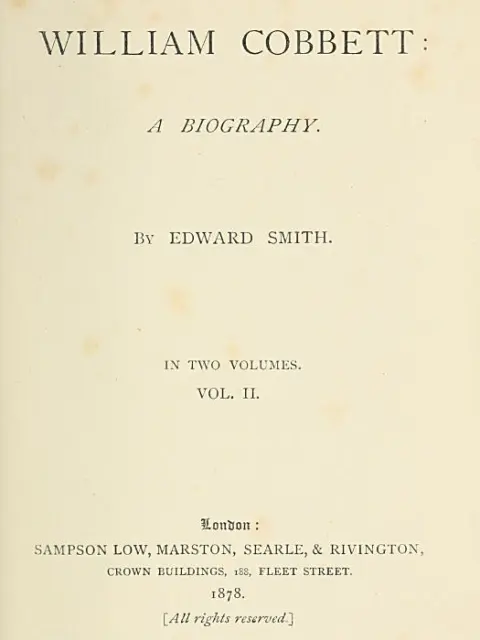
William Cobbett: A Biography in Two Volumes, Vol. 2
Edward Smith
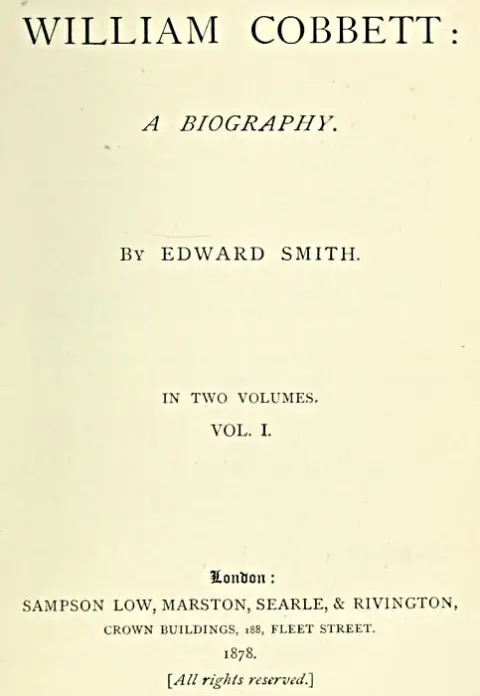
THE CLASSIC COLLECTION · 1878
"William Cobbett: A Biography in Two Volumes, Vol. 1" by Edward Smith is a historical biography written in the late 19th century. This work delves into the life of William Cobbett, an influential figure known for his political writings and reforms in England, exploring his early life, upbringing, and the formative experiences that shaped his views and career. The opening of the biography introduces William Cobbett, born in 1762 in Farnham, Surrey, and reflects on his humble beginnings as a farmer's son. Smith vividly characterizes Cobbett's early life, detailing the agricultural landscape of Farnham and the influence of his family, particularly his hardworking father and grandfather, on his formative years. Cobbett recalls his childhood struggles and joys, establishing a strong sense of pride derived from his rural upbringing, experiences with hard work, and self-education, which ultimately set the stage for his future endeavors as a political writer and reformer. The narrative suggests a burgeoning intelligence and defiance in young Cobbett that would later manifest in his lifetime battles against public corruption and oppression.
Introduction adapted from the source catalogue; source summaries may be automatically generated.
Free to read · English · 78,845 words · No account needed
MAKE TIME FOR A GOOD BOOK
On by default. Untick to stop anonymous reading totals. Each page counts after 10 seconds in view. How this works.
Anonymous counting is on unless you have switched it off.
In such manner the merry, sturdy, little life went on. At tying hop-poles, or scaring birds, almost as soon as he could barely stand, a trifling share was given to the family efforts; whilst the vigorous, healthy senses were already open to the keenest enjoyment of nature, and to the unexpected moments of fun which enter into the days of boyhood. Look at this, for example (written at nearly seventy years of age).
“When I was a very little boy, I was, in the barley-sowing season, going along by the side of a field, near Waverley Abbey; the primroses and blue-bells bespangling the banks on both sides of me; a thousand linnets singing in a spreading oak over my head; while the jingle of the traces, and the whistling of the plough-boys saluted my ear from over the hedge; and, as it were to snatch me from the enchantment, the hounds, at that instant, having started a hare in the hanger on the other side of the field, came up scampering over it in full cry, taking me after them many a mile. I was not more than eight years old; but this particular scene has presented itself to my mind many times every year from that day to this. I always enjoy it over again, &c.”
Cobbett’s political writings, during his whole career, were largely illustrated by the incidents and occurrences of his life. This was the line taken by his own peculiar egotism, and we are indebted to it for numerous pictures similar to the above. Of this particular period there is only space here for the following capital story:--
“When I was a boy, a huntsman named George Bradley, who was huntsman to Mr. Smither, of Hale, very wantonly gave me a cut with his whip, because I jumped in amongst the dogs, pulled a hare from them, and got her scut, upon a little common, called Seal Common, near Waverley Abbey. I was only about eight years old; but my mind was so strongly imbued with the principles of natural justice, that I did not rest satisfied with the mere calling of names, of which, however, I gave Mr. George Bradley a plenty. I sought to inflict a just punishment upon him; and, as I had not the means of proceeding by force, I proceeded by cunning in the manner that I am presently going to describe. I had not then read the Bible, much less had I read GROTIUS and PUFFENDORF; I, therefore, did not know that God and man had declared, that it was laudable to combat tyranny by either force or fraud; but, though I did not know what tyranny meant, reason and a sense of justice taught me that Bradley had been guilty of tyranny towards me; and the native resources of my mind, together with my resolution, made me inflict justice on him in the following manner:--Hounds (hare-hounds at least) will follow the trail of a red herring as eagerly as that of a hare, and rather more so, the scent being stronger and more unbroken. I waited till Bradley and his pack were trailing for a hare in the neighbourhood of that same Seal Common. They were pretty sure to find in the space of half an hour, and the hare was pretty sure to go up the common and over the hill to the south. I placed myself ready with a red herring at the end of a string, in a dry field, and near a hard path, along which, or near to which, I was pretty sure the hare would go. I waited a long while; the sun was getting high, the scent bad; but, by and by, I heard the view-halloo and full cry. I squatted down in the fern, and my heart bounded with the prospect of inflicting justice, when I saw my lady come skipping by, going off towards Pepperharrow; that is to say, to the south. In a moment, I clapped down my herring, went off at a right angle towards the west, climbed up a steep bank very soon, where the horsemen, such as they were, could not follow; then on I went over the roughest part of the common that I could find, till I got to the pales of Moor Park, over which I went, there being holes at the bottom for the letting in of the hares. That part of the park was covered with short heath; and I gave some twirls about to amuse Mr. Bradley for half-an-hour. Then off I went, and down a hanger at last, to the bottom of which no horseman could get without riding round a quarter of a mile. At the bottom of the hanger was an alder moor, in a swamp. There my herring ceased to perform its service. The river is pretty rapid, I tossed it in, that it might go back to the sea, and relate to its brethren the exploits of the land. I washed my hands in the water of the moor; and took a turn, and stood at the top of the hanger to witness the winding up of the day’s sport, which terminated a little before dusk in one of the dark days of November. After overrunning the scent a hundred times, after an hour’s puzzling in the dry field, after all the doubles and all the turns that the sea-borne hare had given them, down came the whole posse to the swamp; the huntsman went round a mill-head not far off, and tried the other side of the river: ‘No! d-- her, where can she be?’ And thus, amidst conjectures, disputations, mutual blamings, and swearings a plenty, they concluded, some of them half-leg deep in dirt, and going soaking home at the end of a drizzling day.”
Your reading position is saved on this browser. Take it to another device with a library code. Reading pages adapt to text, rather than matching a printed edition.
BEHIND THE BOOK
This eBook is for the use of anyone anywhere in the United States and most other parts of the world at no cost and with almost no restrictions whatsoever. You may copy it, give it away or re-use it under the terms of the Project Gutenberg License included with this eBook or online at www.gutenberg.org. If you are not located in the United States, you will have to check the laws of the country where you are located before using this eBook. Read the source licence.
The original source file, including credits and licence, is retained by this library. Request an original-format copy at no charge. Please include the book title and Project Gutenberg identifier #49844.
KEEP YOUR CURIOSITY GOING
Cécile Tormay

Moritz Busch
John L. Ransom
Frances Wright
Cécile Tormay

Mabel Potter Daggett