
Home Life in All Lands—Book III—Animal Friends and Helpers
Charles Morris
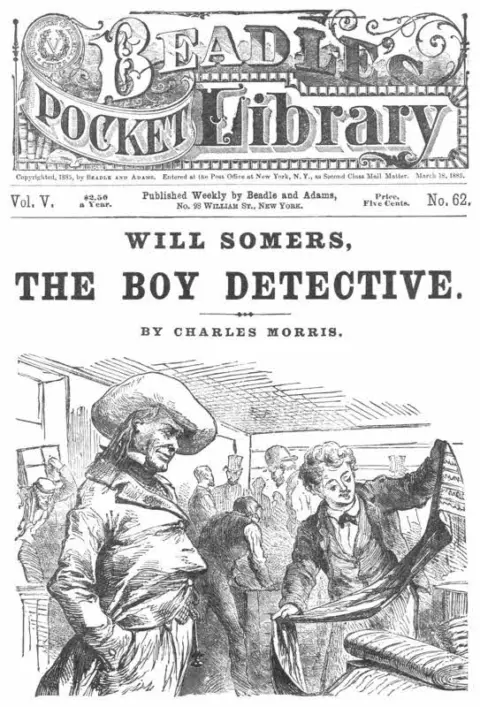
THE CLASSIC COLLECTION · 1885
"Will Somers, the Boy Detective" by Charles Morris is a fictional novel likely written in the late 19th century. The story centers around a sixteen-year-old boy named Will Somers, who, despite his ragged appearance, exhibits sharp wits and boldness as he seeks employment in a dry-goods store owned by Mr. Leonard. As he settles into his new job, he shows determination to prove his worth and navigate the challenges of the adult world, hinting at an adventurous and perhaps mischievous journey ahead. The opening of the book introduces us to Will, a confident and charismatic young boy who is in search of work. He engages Mr. Leonard, a merchant who is skeptical at first but intrigued by Will's audacity. Throughout their witty exchange, we learn about Will's rough upbringing, his experiences, and aspirations for a better life. As Will begins his job, he encounters challenges from other employees while showcasing his unique blend of street smarts and resilience. The initial chapters set the stage for a narrative filled with humor, adventure, and potential intrigue, as hints of deeper mysteries and relationships are woven into the storyline.
Introduction adapted from the source catalogue; source summaries may be automatically generated.
Free to read · English · 38,986 words · No account needed
MAKE TIME FOR A GOOD BOOK
On by default. Untick to stop anonymous reading totals. Each page counts after 10 seconds in view. How this works.
Anonymous counting is on unless you have switched it off.
He kissed her again, clasping her still closer.
“And what a place this is,” she said, looking round the cell. “I would have been here before, John, but I was hindered. I thought, indeed, the first few days, that you would not stay here.”
“How could I help myself, Jennie? No bird would stay in its cage if the
door was open.”
“You could open the door with a word. You know you could,” she said, looking tenderly but eagerly into his face. “You are innocent. Why will you not clear yourself?”
“It looks as if I were guilty,” he replied, leading her to the only chair the cell afforded. “The law and the public seem to think so.”
“It is your own fault, John. You are incomprehensible. Why are you so silent? I cannot guess a reason. You must clear yourself.”
“And convict others?”
“If they are guilty, yes.”
“There are things that cannot be told, Jennie, and reasons why I should not convict even the guilty. I hope you will not press this matter further. I have not taken my course without excellent reasons. If you knew all, you would counsel me to do as I have done. Let that suffice.”
Jennie was silent for a little, thinking. She clasped his hand with a warm pressure. His gladdened eyes were fixed eagerly upon her face.
“Let it be so,” she said, at length. “For the present, at least, we
will forget it.”
The conversation changed. Seated upon the floor at her feet, and looking lovingly up into her eyes, their talk grew of softer themes. Their voices fell, mellowed by love. Hours, it seemed to them, they conversed in that sweet love gossip so hard to translate, so weak and meaningless when put into words.
Looks, tones, hand-pressures, form the soul of lovers’ talk, and these no pen can write down. The words spoken are dreadfully prosy to outsiders; all the poetry lies in the language of lips and eyes.
“Your friends have all visited you, then?” she at length asked.
“Not all. Nearly all,” he replied. “Their kindness has helped me
greatly.”
“Could they do less, and be friends?” she quickly replied. “I do not think much of those who have failed to come.”
“I do not blame them. They might have been away, or unable to come. And my very equivocal position is a very good reason for their absence.”
“It is no reason at all,” she broke out. “They are no friends of yours to desert you in your extremity.”
“Well, well, Jennie, there are only three or four.”
“Let me know their names?”
Your reading position is saved on this browser. Take it to another device with a library code. Reading pages adapt to text, rather than matching a printed edition.
Charles Morris
Charles Morris
Charles Morris
Charles Morris & Thomas, Sir Malory
BEHIND THE BOOK
This eBook is for the use of anyone anywhere in the United States and most other parts of the world at no cost and with almost no restrictions whatsoever. You may copy it, give it away or re-use it under the terms of the Project Gutenberg License included with this eBook or online at www.gutenberg.org. If you are not located in the United States, you will have to check the laws of the country where you are located before using this eBook. Read the source licence.
The original source file, including credits and licence, is retained by this library. Request an original-format copy at no charge. Please include the book title and Project Gutenberg identifier #60978.
KEEP YOUR CURIOSITY GOING
Coulson Kernahan

Maurice Baring
Frances Wright
Cécile Tormay

Frederic Jesup Stimson

W. H. P. (William Henry Pope) Jarvis