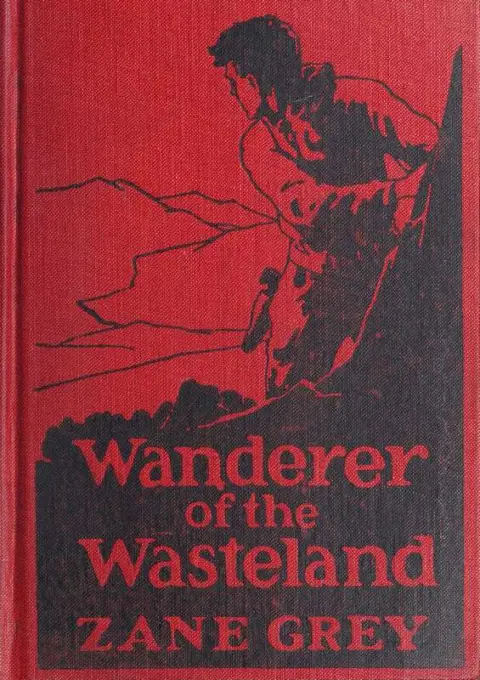
Wanderer of the Wasteland
Zane Grey
THE CLASSIC COLLECTION · 1916
"Wildfire" by Zane Grey is a novel written during the early 20th century, capturing the spirit of the American West. The story revolves around the character Lucy Bostil, a strong-willed young woman who is deeply connected to the desert landscape around her home, Bostil's Ford. The narrative explores themes of love, ambition, and rivalry amidst the backdrop of horse racing and the desire for freedom, setting the stage for Lucy's impending adventures and conflicts, particularly concerning her father's prized racehorse, the Sage King. The opening of the novel introduces Lucy Bostil as she grapples with her feelings of longing and restlessness on her eighteenth birthday while riding a forbidden horse out on the sage. The text paints a vivid picture of Lucy's admiration for the natural beauty surrounding her and her love for horses, contrasting it with the constraints of civilization and her father’s expectations. As she encounters various characters, including her father John Bostil and the rival Joel Creech, the stage is set for action and conflict. The dynamics of competition, particularly a contentious race between Bostil's Sage King and Creech's Blue Roan, establish tension within the community, making it clear that Lucy's future is intricately tied to these rivalries and her own aspirations for independence.
Introduction adapted from the source catalogue; source summaries may be automatically generated.
Free to read · English · 100,370 words · No account needed
MAKE TIME FOR A GOOD BOOK
On by default. Untick to stop anonymous reading totals. Each page counts after 10 seconds in view. How this works.
Anonymous counting is on unless you have switched it off.
This, then, was the great canyon, which had seemed like a hunter's fable rather than truth. Slone's sight dimmed, blurring the spectacle, and he found that his eyes had filled with tears. He wiped them away and looked again and again, until he was confounded by the vastness and the grandeur and the vague sadness of the scene. Nothing he had ever looked at had affected him like this canyon, although the Stewarts had tried to prepare him for it.
It was the horse-hunter's passion that reminded him of his pursuit. The deer trail led down through a break in the wall. Only a few rods of it could be seen. This trail was passable, even though choked with snow. But the depth beyond this wall seemed to fascinate Slone and hold him back, used as he was to desert trails. Then the clean mark of Wildfire's hoof brought back the old thrill.
"This place fits you, Wildfire," muttered Slone, dismounting.
He started down, leading Nagger. The mustang followed. Slone kept to the wall side of the trail, fearing the horses might slip. The snow held firmly at first and Slone had no trouble. The gap in the rim-rock widened to a slope thickly grown over with cedars and pinyons and manzanita. This growth made the descent more laborious, yet afforded means at least for Slone to go down with less danger. There was no stopping. Once started, the horses had to keep on. Slone saw the impossibility of ever climbing out while that snow was there. The trail zigzagged down and down. Very soon the yellow wall hung tremendously over him, straight up. The snow became thinner and softer. The horses began to slip. They slid on their haunches. Fortunately the slope grew less steep, and Slone could see below where it reached out to comparatively level ground. Still, a mishap might yet occur. Slone kept as close to Nagger as possible, helping him whenever he could do it. The mustang slipped, rolled over, and then slipped past Slone, went down the slope to bring up in a cedar. Slone worked down to him and extricated him. Then the huge Nagger began to slide. Snow and loose rock slid with him, and so did Slone. The little avalanche stopped of its own accord, and then Slone dragged Nagger on down and down, presently to come to the end of the steep descent. Slone looked up to see that he had made short work of a thousand-foot slope. Here cedars and pinyons grew thickly enough to make a forest. The snow thinned out to patches, and then failed. But the going remained bad for a while as the horses sank deep in a soft red earth. This eventually grew more solid and finally dry. Slone worked out of the cedars to what appeared a grassy plateau inclosed by the great green-and-white slope with its yellow wall over hanging, and distant mesas and cliffs. Here his view was restricted. He was down on the first bench of the great canyon. And there was the deer trail, a well-worn path keeping to the edge of the slope. Slone came to a deep cut in the earth, and the trail headed it, where it began at the last descent of the slope. It was the source of a canyon. He could look down to see the bare, worn rock, and a hundred yards from where he stood the earth was washed from its rims and it began to show depth and something of that ragged outline which told of violence of flood. The trail headed many canyons like this, all running down across this bench, disappearing, dropping invisibly. The trail swung to the left under the great slope, and then presently it climbed to a higher bench. Here were brush and grass and huge patches of sage, so pungent that it stung Slone's nostrils. Then he went down again, this time to come to a clear brook lined by willows. Here the horses drank long and Slone refreshed himself. The sun had grown hot. There was fragrance of flowers he could not see and a low murmur of a waterfall that was likewise invisible. For most of the time his view was shut off, but occasionally he reached a point where through some break he saw towers gleaming red in the sun. A strange place, a place of silence, and smoky veils in the distance. Time passed swiftly. Toward the waning of the afternoon he began to climb to what appeared to be a saddle of land, connecting the canyon wall on the left with a great plateau, gold-rimmed and pine-fringed, rising more and more in his way as he advanced. At sunset Slone was more shut in than for several hours. He could tell the time was sunset by the golden light on the cliff wall again overhanging him. The slope was gradual up to this pass to the saddle, and upon coming to a spring, and the first pine-trees, he decided to halt for a camp. The mustang was almost exhausted.
Your reading position is saved on this browser. Take it to another device with a library code. Reading pages adapt to text, rather than matching a printed edition.
Zane Grey
Zane Grey
Zane Grey
Zane Grey
BEHIND THE BOOK
This eBook is for the use of anyone anywhere in the United States and most other parts of the world at no cost and with almost no restrictions whatsoever. You may copy it, give it away or re-use it under the terms of the Project Gutenberg License included with this eBook or online at www.gutenberg.org. If you are not located in the United States, you will have to check the laws of the country where you are located before using this eBook. Read the source licence.
The original source file, including credits and licence, is retained by this library. Request an original-format copy at no charge. Please include the book title and Project Gutenberg identifier #2066.
KEEP YOUR CURIOSITY GOING
Coulson Kernahan

Maurice Baring
Frances Wright
Cécile Tormay

Frederic Jesup Stimson

W. H. P. (William Henry Pope) Jarvis