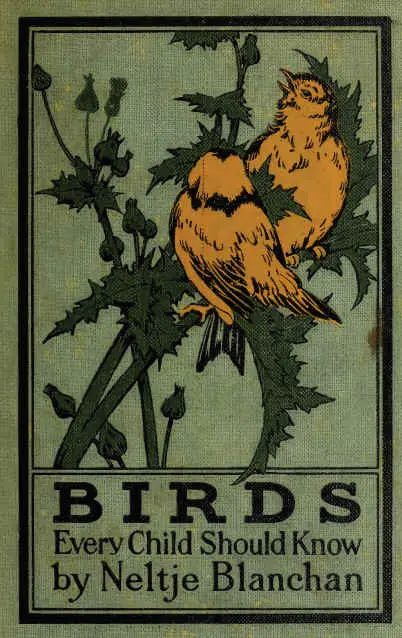
Birds Every Child Should Know
Neltje Blanchan
THE CLASSIC COLLECTION · 1901
"WILD FLOWERS" by Neltje Blanchan is a scientific publication written during the late 19th century. The work aims to explore the intricate relationships between various wild flower species and their insect pollinators, emphasizing the importance of these connections in the natural world. The opening of the book begins with a preface in which Blanchan establishes the overarching theme: flowers are not just beautiful entities within nature, but sentient beings that engage actively with their surroundings. She discusses the evolutionary traits that flowers possess to attract or repel insects, underscoring their vital role in species perpetuation. The text also hints at a more comprehensive study of over 500 species classified by color, offering readers insights into the fascinating adaptations of these plants. This introduction sets the foundation for understanding how flowers have evolved alongside insects, reflecting the delicate interdependence of life within ecosystems.
Introduction adapted from the source catalogue; source summaries may be automatically generated.
Free to read · English · 159,238 words · No account needed
MAKE TIME FOR A GOOD BOOK
On by default. Untick to stop anonymous reading totals. Each page counts after 10 seconds in view. How this works.
Anonymous counting is on unless you have switched it off.
On account of the smallness of its flowers and their scantiness, the Indian tobacco is perhaps the least attractive of the lobelias, none of which has so inflated a seed vessel, the distinguishing characteristic of this common plant.
CHICORY; SUCCORY; BLUE SAILORS; BUNK
(Cichorium Intybus) Chicory family
Flower-head - Bright, deep azure to gray blue, rarely pinkish or white, 1 to 1 1/2 in. broad, set close to stem, often in small clusters for nearly the entire length; each head a composite of ray flowers only, 5-toothed at upper edge, and set in a flat green receptacle. Stem: Rigid, branching, to 3 ft. high. Leaves: Lower ones spreading on ground, 3 to 6 in. long, spatulate, with deeply cut or irregular edges, narrowed into petioles, from a deep tap-root; upper leaves of stem and branches minute, bract-like. Preferred Habitat - Roadsides, waste places, fields. Flowering Season - July-October. Distribuition - Common in Eastern United States and Canada, south to the Carolinas; also sparingly westward to Nebraska.
At least the dried and ground root of this European invader is known to hosts of people who buy it undisguised or not, according as they count it an improvement to their coffee or a disagreeable adulterant. So great is the demand for chicory that, notwithstanding its cheapness, it is often in its turn adulterated with roasted wheat, rye, acorns, and carrots. Forced and blanched in a warm, dark place, the bitter leaves find a ready market as a salad known as "barbe de Capucin" by the fanciful French. Endive and dandelion, the chicory's relatives, appear on the table too, in spring, where people have learned the possibilities of salads, as they certainly have in Europe.
>From the depth to which the tap-root penetrates, it is not unlikely the succory derived its name from the Latin succurrere = to run under. The Arabic name chicourey testifies to the almost universal influence of Arabian physicians and writers in Europe after the Conquest. As chicoree, achicoria, chicoria, cicorea, chicorie, cichorei, cikorie, tsikorei, and cicorie the plant is known respectively to the French, Spanish, Portuguese, Italians, Germans, Dutch, Swedes, Russians, and Danes.
On cloudy days or in the morning only throughout midsummer the "peasant posy" opens its "dear blue eyes"
"Where tired feet
Toil to and fro;
Where flaunting Sin
May see thy heavenly hue,
Or weary Sorrow look from thee
Toward a tenderer blue!"
- Margaret Deland.
In his "Humble Bee" Emerson, too, sees only beauty in the "Succory to match the sky;" but, mirabile dictu, Vergil, rarely caught in a prosaic, practical mood, wrote, "And spreading succ'ry chokes the rising field."
IRON-WEED; FLAT TOP
(Vernonia Noveboracensis) Thistle family.
Your reading position is saved on this browser. Take it to another device with a library code. Reading pages adapt to text, rather than matching a printed edition.
BEHIND THE BOOK
This eBook is for the use of anyone anywhere in the United States and most other parts of the world at no cost and with almost no restrictions whatsoever. You may copy it, give it away or re-use it under the terms of the Project Gutenberg License included with this eBook or online at www.gutenberg.org. If you are not located in the United States, you will have to check the laws of the country where you are located before using this eBook. Read the source licence.
The original source file, including credits and licence, is retained by this library. Request an original-format copy at no charge. Please include the book title and Project Gutenberg identifier #3003.
KEEP YOUR CURIOSITY GOING

John Muir

Asa Gray
Asa Gray

Florence Nightingale
Elizabeth Robins Pennell
Denison Olmsted