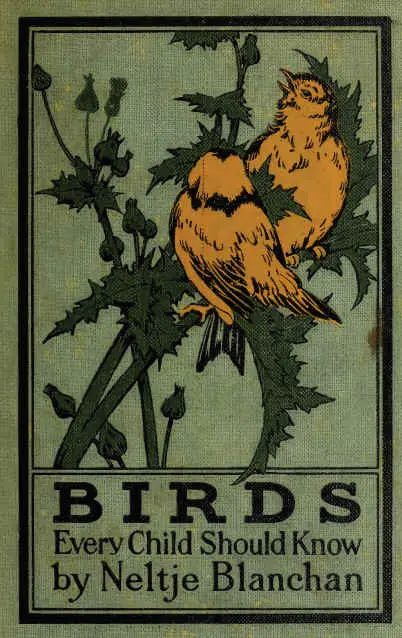
Birds Every Child Should Know
Neltje Blanchan
THE CLASSIC COLLECTION · 1901
"WILD FLOWERS" by Neltje Blanchan is a scientific publication written during the late 19th century. The work aims to explore the intricate relationships between various wild flower species and their insect pollinators, emphasizing the importance of these connections in the natural world. The opening of the book begins with a preface in which Blanchan establishes the overarching theme: flowers are not just beautiful entities within nature, but sentient beings that engage actively with their surroundings. She discusses the evolutionary traits that flowers possess to attract or repel insects, underscoring their vital role in species perpetuation. The text also hints at a more comprehensive study of over 500 species classified by color, offering readers insights into the fascinating adaptations of these plants. This introduction sets the foundation for understanding how flowers have evolved alongside insects, reflecting the delicate interdependence of life within ecosystems.
Introduction adapted from the source catalogue; source summaries may be automatically generated.
Free to read · English · 159,238 words · No account needed
MAKE TIME FOR A GOOD BOOK
On by default. Untick to stop anonymous reading totals. Each page counts after 10 seconds in view. How this works.
Anonymous counting is on unless you have switched it off.
The unusually beautiful, spreading, recurved, branching panicle of bloom borne by the EARLY, PLUME, or SHARP-TOOTHED GOLDENROD or YELLOW-TOP (S. juncea), so often dried for winter decoration, may wave four feet high, but usually not over two, at the summit of a smooth, rigid stem. Toward the top, narrow, elliptical, uncut leaves are seated on the stalk; below, much larger leaves, their sharp teeth slanting forward, taper into a broad petiole, whose edges may be cut like fringe. In dry, rocky soil this is, perhaps, the first and last goldenrod to bloom, having been found as early as June, and sometimes lasting into November. Range, from North Carolina and Missouri very far north.
West of the Mississippi how beautiful are the dry prairies in autumn with the MISSOURI GOLDENROD (S. Missouriensis), its short, broad, spreading panicle waving at the summit of a smooth, slender stem from two to five feet tall. Its firm, rather thick leaves are lance-shaped, triple-nerved, entire, very rough-margined, or perhaps the lowest ones with a few scattered teeth.
Perhaps the commonest of all the lovely clan east of the Mississippi, or throughout a range extending from Arizona and Florida northward to British Columbia and New Brunswick, is the CANADA GOLDENROD or YELLOW-WEED (S. Canadensis). Surely everyone must be familiar with the large, spreading, dense-flowered panicle, with recurved sprays, that crowns a rough, hairy stem sometimes eight feet tall, or again only two feet. Its lance-shaped, acutely pointed, triple-nerved leaves are rough, and the lower ones saw-edged. From August to November one cannot fail to find it blooming in dry soil.
Most brilliantly colored of its tribe is the low-growing GRAY or FIELD GOLDENROD or DYER'S WEED (S. nemoralis). The rich, deep yellow of its little spreading, recurved, and usually one-sided panicles is admirably set off by the ashy gray, or often cottony, stem, and the hoary, grayish-green leaves in the open, sterile places where they arise from July to November. Quebec and the Northwest Territory to the Gulf States.
No longer classed as a true Solidago, but the type of a distinct genus, the LANCE-LEAVED, BUSHY, or FRAGRANT GOLDENROD (Euthamia graminifolia; formerly S. lanceolata) lifts its flat-topped, tansy-like, fragrant clusters of flower-heads from two to four feet above moist ground. From July to September it transforms whole riverbanks, low fields, and roadsides into a veritable El Dorado. Its numerous leaves are very narrow, lance-shaped, triple or five nerved, uncut, sometimes with a few resinous dots. Range, from New Brunswick to the Gulf, and westward to Nebraska.
"Along the roadside, like the flowers of gold That tawny Incas for their gardens wrought, Heavy with sunshine droops the goldenrod."
Your reading position is saved on this browser. Take it to another device with a library code. Reading pages adapt to text, rather than matching a printed edition.
BEHIND THE BOOK
This eBook is for the use of anyone anywhere in the United States and most other parts of the world at no cost and with almost no restrictions whatsoever. You may copy it, give it away or re-use it under the terms of the Project Gutenberg License included with this eBook or online at www.gutenberg.org. If you are not located in the United States, you will have to check the laws of the country where you are located before using this eBook. Read the source licence.
The original source file, including credits and licence, is retained by this library. Request an original-format copy at no charge. Please include the book title and Project Gutenberg identifier #3003.
KEEP YOUR CURIOSITY GOING

John Muir

Asa Gray
Asa Gray

Florence Nightingale
Elizabeth Robins Pennell
Denison Olmsted