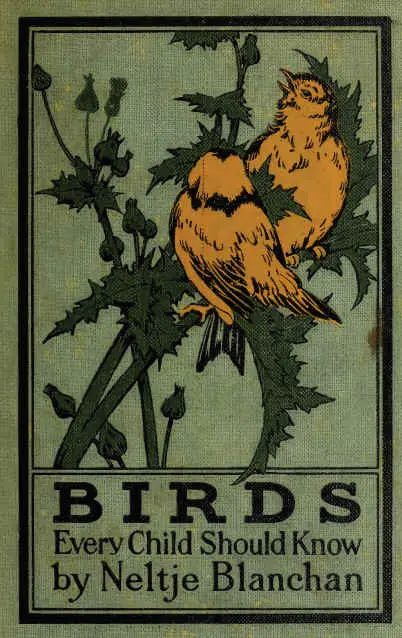
Birds Every Child Should Know
Neltje Blanchan
THE CLASSIC COLLECTION · 1901
"WILD FLOWERS" by Neltje Blanchan is a scientific publication written during the late 19th century. The work aims to explore the intricate relationships between various wild flower species and their insect pollinators, emphasizing the importance of these connections in the natural world. The opening of the book begins with a preface in which Blanchan establishes the overarching theme: flowers are not just beautiful entities within nature, but sentient beings that engage actively with their surroundings. She discusses the evolutionary traits that flowers possess to attract or repel insects, underscoring their vital role in species perpetuation. The text also hints at a more comprehensive study of over 500 species classified by color, offering readers insights into the fascinating adaptations of these plants. This introduction sets the foundation for understanding how flowers have evolved alongside insects, reflecting the delicate interdependence of life within ecosystems.
Introduction adapted from the source catalogue; source summaries may be automatically generated.
Free to read · English · 159,238 words · No account needed
MAKE TIME FOR A GOOD BOOK
On by default. Untick to stop anonymous reading totals. Each page counts after 10 seconds in view. How this works.
Anonymous counting is on unless you have switched it off.
There was a time, not many years ago, when this now common and often troublesome weed was imported from India and tenderly cultivated in flower gardens. In the Orient it and allied species are grown for their fiber, which is utilized for cordage and cloth; but the equally valuable plant now running wild here has yet to furnish American men with a profitable industry. Although the blossom is next of kin to the veiny Chinese bell-flower, or striped abutilon, so common in greenhouses, its appearance is quite different.
ST. ANDREW'S CROSS
(Ascyrum hypericoides; A. Crux-Andreae of Gray) St.
John's-wort family
Flowers - Yellow, 1/2 to 3/4 in. across, terminal and from the leaf axils. Calyx of 4 sepals in 2 pairs; 4 narrow, oblong petals; stamens numerous; 2 styles. Stem: Much branched and spreading from base, 5 to 10 in. high, leafy. Leaves: Opposite, oblong, small, seated on stem. Preferred Habitat - Dry, sandy soil; pine barrens. Flowering Season - July-August. Distribution - Nantucket Island (Mass.), westward to Illinois, south to Florida and Texas.
Because the four pale yellow petals of this flower approach each other in pairs, suggesting a cross with equals arms, the plant was given its name by Linnaeus in 1753. ST. PETER'S-WORT (A. stans), a similar plant, found in the same localities, in bloom at the same time, has larger flowers in small clusters at the tips only of its upright branches.
COMMON ST. JOHN'S-WORT
(Hypericum perforatum) St. John's-wort family
Flowers - Bright yellow, 1 in. across or less, several or many in terminal clusters. Calyx of 5 lance-shaped sepals; 5 petals dotted with black; numerous stamens in 3 sets 3 styles. Stem: to 2 ft. high, erect, much branched. Leaves: Small, opposite, oblong, more or less black-dotted. Preferred Habitat - Fields, waste lands, roadsides. Flowering Season - June-September. Distribution - Throughout our area, except the extreme North; Europe, and Asia.
"Gathered upon a Friday, in the hour of Jupiter when he comes to his operation, so gathered, or borne, or hung upon the neck, it mightily helps to drive away all phantastical spirits." These are the blossoms which have been hung in the windows of European peasants for ages on St. John's eve, to avert the evil eye and the spells of the spirits of darkness. "Devil chaser" its Italian name signifies. To cure demoniacs, to ward off destruction by lightning, to reveal the presence of witches, and to expose their nefarious practices, are some of the virtues ascribed to this plant, which superstitious farmers have spared from the scythe and encouraged to grow near their houses until it has become, even in this land of liberty, a troublesome weed at times. "The flower gets its name," says F. Schuyler Mathews, "from the superstition that on St. John's day, the 24th of June, the dew which fell on the plant the evening before was efficacious in preserving the eyes from disease. So the plant was collected, dipped in oil, and thus transformed into a balm for every wound." Here it is a naturalized, not a native, immigrant. A blooming plant, usually with many sterile shoots about its base, has an unkempt, untidy look; the seed capsules and the brown petals of withered flowers remaining among the bright yellow buds through a long season. No nectar is secreted by the St. John's-worts, therefore only pollen collectors visit them regularly, and occasionally cross-fertilize the blossoms, which are best adapted, however, to pollinate themselves.
Your reading position is saved on this browser. Take it to another device with a library code. Reading pages adapt to text, rather than matching a printed edition.
BEHIND THE BOOK
This eBook is for the use of anyone anywhere in the United States and most other parts of the world at no cost and with almost no restrictions whatsoever. You may copy it, give it away or re-use it under the terms of the Project Gutenberg License included with this eBook or online at www.gutenberg.org. If you are not located in the United States, you will have to check the laws of the country where you are located before using this eBook. Read the source licence.
The original source file, including credits and licence, is retained by this library. Request an original-format copy at no charge. Please include the book title and Project Gutenberg identifier #3003.
KEEP YOUR CURIOSITY GOING

John Muir

Asa Gray
Asa Gray

Florence Nightingale
Elizabeth Robins Pennell
Denison Olmsted