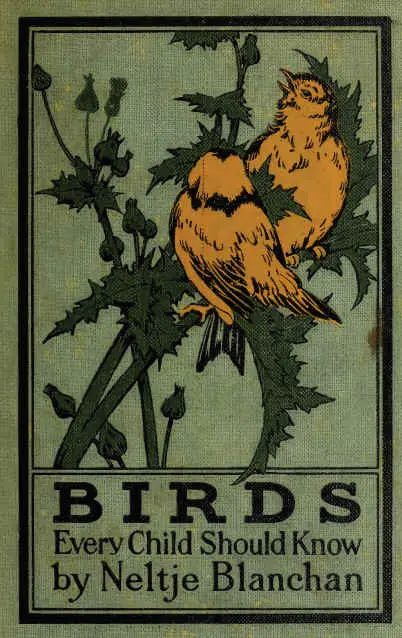
Birds Every Child Should Know
Neltje Blanchan
THE CLASSIC COLLECTION · 1901
"WILD FLOWERS" by Neltje Blanchan is a scientific publication written during the late 19th century. The work aims to explore the intricate relationships between various wild flower species and their insect pollinators, emphasizing the importance of these connections in the natural world. The opening of the book begins with a preface in which Blanchan establishes the overarching theme: flowers are not just beautiful entities within nature, but sentient beings that engage actively with their surroundings. She discusses the evolutionary traits that flowers possess to attract or repel insects, underscoring their vital role in species perpetuation. The text also hints at a more comprehensive study of over 500 species classified by color, offering readers insights into the fascinating adaptations of these plants. This introduction sets the foundation for understanding how flowers have evolved alongside insects, reflecting the delicate interdependence of life within ecosystems.
Introduction adapted from the source catalogue; source summaries may be automatically generated.
Free to read · English · 159,238 words · No account needed
MAKE TIME FOR A GOOD BOOK
On by default. Untick to stop anonymous reading totals. Each page counts after 10 seconds in view. How this works.
Anonymous counting is on unless you have switched it off.
Flowers - Very small, white, few, solitary, nodding on short, curved peduncles from the leaf axils. Calyx 2-bracted, 4-cleft; corolla a short 4-cleft bell; 8 short stamens, each anther sac opening by a slit to the middle; 1 pistil, the ovary 4-celled. Stem: Creeping along the ground, the slender, leafy, hairy branches 3 to 12 in. long. Leaves: Evergreen, alternate, 2-ranked, oval, very small, dark and glossy above, coated with stiff, rusty hairs underneath, the edges curled. Fruit: A snow-white, round or oval, mealy, aromatic berry; ripe August-September. Preferred Habitat - Cool bogs; low, moist, mossy woods. Flowering Season - May-June. Distribution - North Carolina and Michigan northward to the British Possessions.
Allied on the one hand to the cranberry, so often found with it in the cool northern peat bogs, and on the other to the delicious blueberries, this "snow-born" berry, which appears on no dining table, nevertheless furnishes many a good meal to hungry birds and fagged pedestrians. Both the pretty foliage and the fruit have the refreshing flavor of sweet birch.
PYXIE; FLOWERING MOSS; PINE-BARREN BEAUTY
(Pyxidanthera barbulata) Diapensia family
Flowers - Abundant, white, or sometimes pink, about 1/4 in. across, 5-parted, solitary, seated at tips of branches. Stem: Prostrate, creeping, much branched, the main branches often 1 ft. long, very leafy, growing in mat-like patches. Leaves: Moss-like, very narrow, pointed, seated on stem, and overlapping like scales, on upper part of branches. Preferred Habitat - Dry sandy soil; pine barrens. Flowering Season - March-May. Distribution - New Jersey, south to North Carolina.
Curiously enough, this creeping, tufted, mat-like little plant is botanically known as a shrub, yet it is lower than many mosses, and would seem to the untrained eye to be certainly of their kin. In earliest spring, when Lenten penitents, jaded with the winter's frivolities in the large cities, seek the salubrious pine lands of southern New Jersey and beyond, they are amazed and delighted to find the abundant little evergreen mounds of pyxie already starred with blossoms. The dense mossy cushions, plentifully sprinkled with pink buds and white flowers, are so beautiful, one cannot resist taking a few tuffets home to naturalize in the rock garden. Planted in a mixture of clear sand and leaf-mould, with exposure to the morning sun, pyxie will smile up at us from under our very windows, spring after spring, with increased charms; whereas the arbutus, that untamable wildling, carried home from the pinewoods at the same time, soon sulks itself to death.
STARFLOWER; CHICKWEED-WINTERGREEN; STAR ANEMONE
(Trientalis Americana) Primrose family
Your reading position is saved on this browser. Take it to another device with a library code. Reading pages adapt to text, rather than matching a printed edition.
BEHIND THE BOOK
This eBook is for the use of anyone anywhere in the United States and most other parts of the world at no cost and with almost no restrictions whatsoever. You may copy it, give it away or re-use it under the terms of the Project Gutenberg License included with this eBook or online at www.gutenberg.org. If you are not located in the United States, you will have to check the laws of the country where you are located before using this eBook. Read the source licence.
The original source file, including credits and licence, is retained by this library. Request an original-format copy at no charge. Please include the book title and Project Gutenberg identifier #3003.
KEEP YOUR CURIOSITY GOING

John Muir

Asa Gray
Asa Gray

Florence Nightingale
Elizabeth Robins Pennell
Denison Olmsted