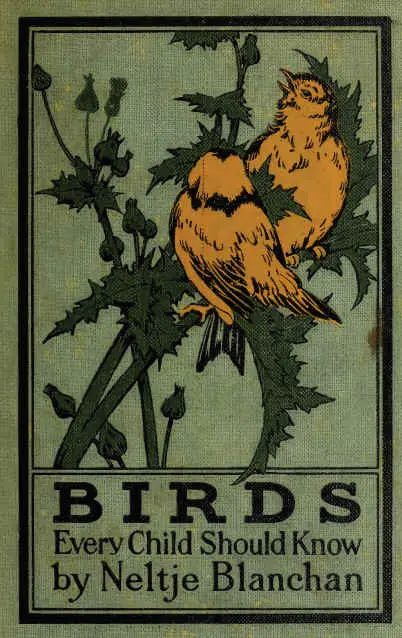
Birds Every Child Should Know
Neltje Blanchan
THE CLASSIC COLLECTION · 1901
"WILD FLOWERS" by Neltje Blanchan is a scientific publication written during the late 19th century. The work aims to explore the intricate relationships between various wild flower species and their insect pollinators, emphasizing the importance of these connections in the natural world. The opening of the book begins with a preface in which Blanchan establishes the overarching theme: flowers are not just beautiful entities within nature, but sentient beings that engage actively with their surroundings. She discusses the evolutionary traits that flowers possess to attract or repel insects, underscoring their vital role in species perpetuation. The text also hints at a more comprehensive study of over 500 species classified by color, offering readers insights into the fascinating adaptations of these plants. This introduction sets the foundation for understanding how flowers have evolved alongside insects, reflecting the delicate interdependence of life within ecosystems.
Introduction adapted from the source catalogue; source summaries may be automatically generated.
Free to read · English · 159,238 words · No account needed
MAKE TIME FOR A GOOD BOOK
On by default. Untick to stop anonymous reading totals. Each page counts after 10 seconds in view. How this works.
Anonymous counting is on unless you have switched it off.
Flowers - Pure white, over 1 in. across, on long, slender pedicels, in spreading or drooping racemes, with silky, reddish bracts, early falling, among them. Calyx persistent, 5-parted; 5 long, narrow, tapering petals, 3 or 4 times the length of calyx; numerous stamens inserted on calyx throat; 2 to 5 styles, hairy at base. Stem: A large shrub or tree, usually much less than 25 ft. high, rarely twice that height, wood very hard and heavy. Leaves: Alternate, oval, tapering at tip, finely saw-edged, smooth (like the pear tree's), often hairy when young. Fruit. Round, crimson, sweet, edible, seedy berries, ripe in June and July. Preferred Habitat - Woodland borders, pasture thickets, dry soil. Flowering Season - March-May. Distribution - Newfoundland to the Gulf of Mexico, westward over a thousand miles.
Silvery-white chandeliers, hanging from the edges of the woods, light Flora's path in earliest spring, before the trees and shrubbery about them have begun to put forth foliage, much less flowers. Little plants that hug the earth for protection while rude winds rush through the forest and across the hillsides, are already starring her way with fragile, dainty blossoms; but what other shrub, except the serviceberry's twin sister the shadbush, or perhaps the spicebush, has the temerity to burst into bloom while March gusts howl through the naked forests? Little female bees of the Andrena tribe, already at work collecting pollen and nectar for generations yet unborn, buzz their gratitude about the beautiful feathery clusters that lean away from the crowded thicket with a wild, irregular grace. Nesting birds have abundant cause for gratitude also, for the attractive, sweet berries, that ripen providentially early; but, of course, the bees which transfer pollen from flower to flower, and the birds which drop the seeds far and wide, are not the receivers of wholly disinterested favors.
The SHADBUSH or SWAMP SUGAR-PEAR (A. Botryapium), because it was formerly accounted a mere variety (oblongifolia) of the preceding species, still shares with it its popular names; but swamps, river banks, brook sides, and moist thickets are its habitat. Consequently both its inflorescence and pale green, glossy foliage are covered with a sort of whitish cotton, absorbent when young, to prevent the pores from clogging with vapors arising from its damp retreats. Late in the season, when streams narrow or dry up altogether, and the air becomes drier, as the sun rises higher in the heavens, the foliage is usually quite smooth. It will be noticed that, lovely as the shadbush is, its smaller flowers have shorter pedicels than the serviceberry's; consequently its feathery sprays, which are flung outward to the sunshine in April and May, lack something of the grace for which its sister stands preeminent. Under cultivation both species assume conventional form, and lose the wild irregularities of growth that charm us in Nature's garden. Indians believed, what is an obvious fact, that when this bush whitens the swampy river banks, shad are swimming up the stream from the sea to spawn. Then, too, the nighthawk, returning from its winter visit south, booms forth its curious whirring, vibrating, jarring sound as it drops through the air at unseen heights, a dismal, weird noise which the red man thought proceeded from the shad spirits come to warn the schools of fish of their impending fate.
Your reading position is saved on this browser. Take it to another device with a library code. Reading pages adapt to text, rather than matching a printed edition.
BEHIND THE BOOK
This eBook is for the use of anyone anywhere in the United States and most other parts of the world at no cost and with almost no restrictions whatsoever. You may copy it, give it away or re-use it under the terms of the Project Gutenberg License included with this eBook or online at www.gutenberg.org. If you are not located in the United States, you will have to check the laws of the country where you are located before using this eBook. Read the source licence.
The original source file, including credits and licence, is retained by this library. Request an original-format copy at no charge. Please include the book title and Project Gutenberg identifier #3003.
KEEP YOUR CURIOSITY GOING

John Muir

Asa Gray
Asa Gray

Florence Nightingale
Elizabeth Robins Pennell
Denison Olmsted