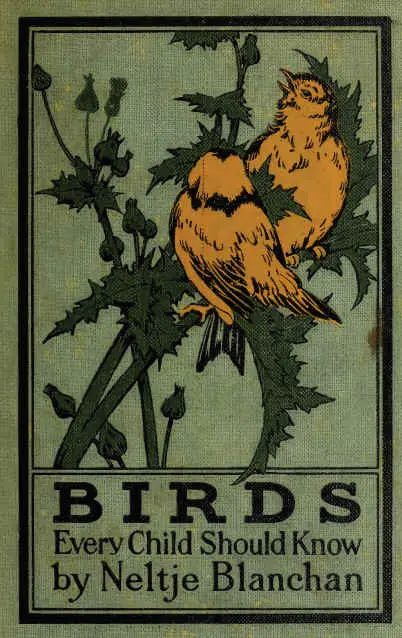
Birds Every Child Should Know
Neltje Blanchan
THE CLASSIC COLLECTION · 1901
"WILD FLOWERS" by Neltje Blanchan is a scientific publication written during the late 19th century. The work aims to explore the intricate relationships between various wild flower species and their insect pollinators, emphasizing the importance of these connections in the natural world. The opening of the book begins with a preface in which Blanchan establishes the overarching theme: flowers are not just beautiful entities within nature, but sentient beings that engage actively with their surroundings. She discusses the evolutionary traits that flowers possess to attract or repel insects, underscoring their vital role in species perpetuation. The text also hints at a more comprehensive study of over 500 species classified by color, offering readers insights into the fascinating adaptations of these plants. This introduction sets the foundation for understanding how flowers have evolved alongside insects, reflecting the delicate interdependence of life within ecosystems.
Introduction adapted from the source catalogue; source summaries may be automatically generated.
Free to read · English · 159,238 words · No account needed
MAKE TIME FOR A GOOD BOOK
On by default. Untick to stop anonymous reading totals. Each page counts after 10 seconds in view. How this works.
Anonymous counting is on unless you have switched it off.
A larger-flowered species, the PRAIRIE WHITE-FRINGED ORCHIS (H. lepicophea), found in bloom in June and July, on moist, open ground from western New York to Minnesota and Arkansas, differs from the preceding chiefly in having larger and greenish-white flowers, the lip cleft into wedge-shaped segments deeply fringed. The hawk-moth removes on its tongue one, but not often both, of the pollinia attached to disks on either side of the entrance to the spur.
NODDING LADIES' TRESSES or TRACES (Gyrostachys cernua; Spiranthes cernua of Gray) Orchid family
Flowers - Small, white or yellowish, without a spur, fragrant, nodding or spreading in 3 rows on a cylindrical, slightly twisted spike 4 or 5 in. long. Side sepals free, the upper ones arching, and united with petals; the oblong, spreading lip crinkle-edged, and bearing minute, hairy callosities at bases Stem: 6 in. to 2 ft. tall, with several pointed, wrapping bracts. Leaves: From or near the base, linear, almost grass-like. Preferred Habitat - Low meadows, ditches, and swamps. Flowering Season - July-October. Distribution - Nova Scotia to the Gulf of Mexico, and westward to the Mississippi.
This last orchid of the season, and perhaps the commonest of its interesting tribe in the eastern United States, at least, bears flowers that, however insignificant in size, are marvelous pieces of mechanism, to which such men as Charles Darwin and Asa Gray have devoted hours of study and, these two men particularly, much correspondence.
Just as a woodpecker begins at the bottom of a tree and taps his way upward, so a bee begins at the lower and older flowers on a spike and works up to the younger ones; a fact on which this little orchid, like many another plant that arranges its b1ossoms in long racemes, depends. Let us not note for the present what happens in the older flowers, but begin our observations, with the help of a powerful lens, when the bee has alighted on the spreading lip of a newly opened blossom toward the top of the spire. As nectar is already secreted for her in its receptacle, she thrusts her tongue through the channel provided to guide it aright, and by the slight contact with the furrowed rostellum, it splits, and releases a boat-shaped disk standing vertically on its stern in the passage. Within the boat is an extremely sticky cement that hardens almost instantly on exposure to the air. The splitting of the rostellum, curiously enough, never happens without insect aid; but if a bristle or needle be passed over it ever so lightly, a stream of sticky, milky fluid exudes, hardens, and the boat-shaped disk, with pollen masses attached, may be withdrawn on the bristle just as the bee removes them with her tongue. Each pollinium consists of two leaves of pollen united for about half their length in the middle with elastic threads. As the pollinia are attached parallel to the disk, they stick parallel on the bee's tongue, yet she may fold up her proboscis under her head, if she choose, without inconvenience from the pollen masses, or without danger of loosening them. Now, having finished sucking the newly opened flowers at the top of the spike, away she flies to an older flower at the bottom of another one. Here a marvelous thing has happened. The passage which, when the flower first expanded, scarcely permitted a bristle to pass, has now widened through the automatic downward movement of the column in order to expose the stigmatic surfaces to contact with the pollen masses brought by the bee. Without the bee's help this orchid, with a host of other flowers, must disappear from the face of the earth. So very many species which have lost the power to fertilize themselves now depend absolutely on these little pollen carriers, it is safe to say that, should the bees perish, one half our flora would be exterminated with them. On the slight downward movement of the column in the ladies' tresses, then, as well as on the bee's ministrations, the fertilization of the flower absolutely depends. "If the stigma of the lowest flower has already been fully fertilized," says Darwin, "little or no pollen will be left on its dried surface; but on the next succeeding flower, of which the stigma is adhesive, large sheets of pollen will be left. Then as soon as the bee arrives near the summit of the spike she will withdraw fresh pollinia, will fly to the lower flowers on another plant, and fertilize them; and thus, as she goes her rounds and adds to her store of honey, she continually fertilizes fresh flowers and perpetuates the race of autumnal spiranthes, which will yield honey to future generations of bees."
Your reading position is saved on this browser. Take it to another device with a library code. Reading pages adapt to text, rather than matching a printed edition.
BEHIND THE BOOK
This eBook is for the use of anyone anywhere in the United States and most other parts of the world at no cost and with almost no restrictions whatsoever. You may copy it, give it away or re-use it under the terms of the Project Gutenberg License included with this eBook or online at www.gutenberg.org. If you are not located in the United States, you will have to check the laws of the country where you are located before using this eBook. Read the source licence.
The original source file, including credits and licence, is retained by this library. Request an original-format copy at no charge. Please include the book title and Project Gutenberg identifier #3003.
KEEP YOUR CURIOSITY GOING

John Muir

Asa Gray
Asa Gray

Florence Nightingale
Elizabeth Robins Pennell
Denison Olmsted