THE CLASSIC COLLECTION✦Quinneys’CLASSIC FREE BOOKS
Quinneys’
Horace Annesley Vachell
THE CLASSIC COLLECTION · 1920
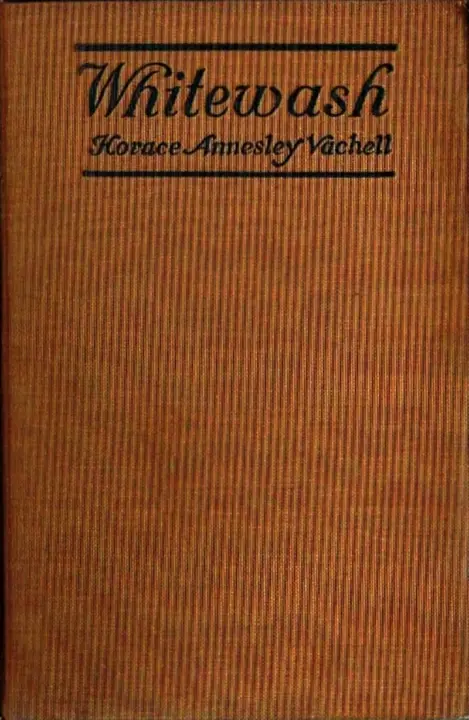
"Whitewash" by Horace Annesley Vachell is a novel written in the early 20th century. The story revolves around Lady Selina Chandos, the strong-willed widow of a squire as she manages her estate and navigates the complexities of her relationships with tenants and local gentry. The initial chapters introduce us to Lady Selina, her family dynamics, and the socio-political tensions in her community concerning her decisions as a landowner. The opening of "Whitewash" presents Lady Selina at her manor, reflecting on her responsibilities post her husband's death. While preparing for a local fête, she engages in discussions about an eviction notice she feels compelled to issue to her long-time tenant, Ephraim Exton, due to his negligence in maintaining his property. This scene establishes her character as someone who is both benevolent yet firm in her management of the estate. Lady Selina's interactions with her children, Brian and Cicely, as well as the village clergyman, Mr. Goodrich, reveal the communal expectations of her position, foreshadowing tensions that may arise as new ideas challenge traditional practices. The narrative hints at the underlying social pressures and moral dilemmas she encounters in a changing world.
Introduction adapted from the source catalogue; source summaries may be automatically generated.
Free to read · English · 89,679 words · No account needed
MAKE TIME FOR A GOOD BOOK
On by default. Untick to stop anonymous reading totals. Each page counts after 10 seconds in view. How this works.
Anonymous counting is on unless you have switched it off.
“I can’t imagine,” said Cicely.
Tiddy observed thoughtfully:
“She might have said a good deal.”
The ancient chuckled.
“‘Granfer,’ she says, ‘a man o’ your gert age ought to go to bed wi’ a candlestick.’”
Cicely threw back her head and laughed. Tiddy wanted more detail.
“And what did you reply to that, Mr. Burble?”
“Ah-h-h! I was too flambergasted, miss, for common speech, but a very notable answer blowed into my yed just one fornit arter. I can’t go to bed wi’ a candlestick, acause I ain’t got none, nary one.”
He hobbled on, still chuckling.
“They’re quite wonderful,” said Tiddy. “Prehistoric. How long will it
last?”
Cicely frowned, anticipating criticism.
“I suppose you would like to see everything cut to pattern, with the colour out of the pattern, a drab monotony of millions doing and saying the same thing; no distinctions, no differences—ugh?”
“Is that your own, Cis?”
Cicely had to admit that she was quoting from the Morning Post.
Tiddy laughed at her, as usual.
“You Tories are always so extreme. Changes needn’t be violent, but they may be violent if you swells don’t climb down the pole a bit and get nearer facts as they are. That’s all. What a very horrid smell!”
Under the stronger beams of a May sun odours of pig were wafted on the
breeze.
“I don’t mind the smell of pigs.”
“Does your mother ever notice it?”
“I don’t know.”
“If she kept away from her village I should understand, but she
doesn’t.”
Cicely was sharp enough to explain.
“That’s it. If she kept away . . .! Then she might notice. She has smelt these smells for thirty years. She says that a smell you can smell is not dangerous. Brian thinks just as she does.”
“France may take some dust out of his eyes.”
Retrenchment, expenses cut to the irreducible Saltaire minimum, was inscribed upon gates, fences, and buildings. Cicely had an illuminating word to say about the gates:
“Father said that he liked a gate that you could put a young horse at without running much risk of breaking your neck.”
“What a humane man!”
Cicely added pensively:
“When hounds run across Wilverley I look before I leap.”
“Ah! Then you do see the difference between Wilverley and Upworthy?”
Your reading position is saved on this browser. Take it to another device with a library code. Reading pages adapt to text, rather than matching a printed edition.
Horace Annesley Vachell
Horace Annesley Vachell
Horace Annesley Vachell
Horace Annesley Vachell
BEHIND THE BOOK
This eBook is for the use of anyone anywhere in the United States and most other parts of the world at no cost and with almost no restrictions whatsoever. You may copy it, give it away or re-use it under the terms of the Project Gutenberg License included with this eBook or online at www.gutenberg.org. If you are not located in the United States, you will have to check the laws of the country where you are located before using this eBook. Read the source licence.
The original source file, including credits and licence, is retained by this library. Request an original-format copy at no charge. Please include the book title and Project Gutenberg identifier #56827.
KEEP YOUR CURIOSITY GOING
Coulson Kernahan

Maurice Baring
Frances Wright
Cécile Tormay

Frederic Jesup Stimson

W. H. P. (William Henry Pope) Jarvis