THE CLASSIC COLLECTION✦Quinneys’CLASSIC FREE BOOKS
Quinneys’
Horace Annesley Vachell
THE CLASSIC COLLECTION · 1920
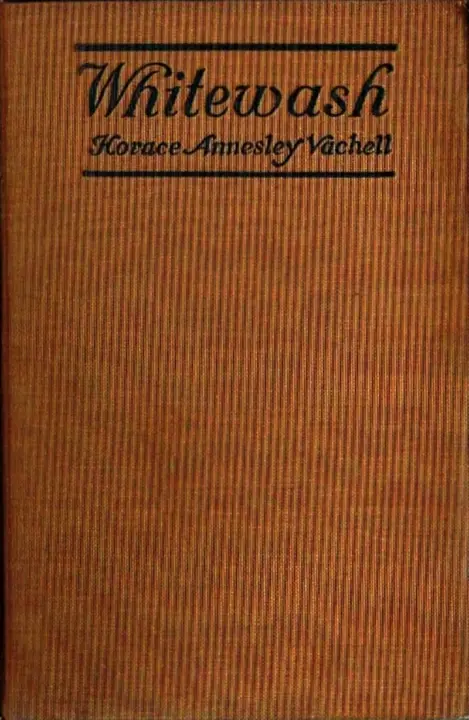
"Whitewash" by Horace Annesley Vachell is a novel written in the early 20th century. The story revolves around Lady Selina Chandos, the strong-willed widow of a squire as she manages her estate and navigates the complexities of her relationships with tenants and local gentry. The initial chapters introduce us to Lady Selina, her family dynamics, and the socio-political tensions in her community concerning her decisions as a landowner. The opening of "Whitewash" presents Lady Selina at her manor, reflecting on her responsibilities post her husband's death. While preparing for a local fête, she engages in discussions about an eviction notice she feels compelled to issue to her long-time tenant, Ephraim Exton, due to his negligence in maintaining his property. This scene establishes her character as someone who is both benevolent yet firm in her management of the estate. Lady Selina's interactions with her children, Brian and Cicely, as well as the village clergyman, Mr. Goodrich, reveal the communal expectations of her position, foreshadowing tensions that may arise as new ideas challenge traditional practices. The narrative hints at the underlying social pressures and moral dilemmas she encounters in a changing world.
Introduction adapted from the source catalogue; source summaries may be automatically generated.
Free to read · English · 89,679 words · No account needed
MAKE TIME FOR A GOOD BOOK
On by default. Untick to stop anonymous reading totals. Each page counts after 10 seconds in view. How this works.
Anonymous counting is on unless you have switched it off.
To ask herself questions when another could answer them was not Miss
Tiddle’s failing. The situation began to interest her. She said
casually:
“I thought you were in France, Mr. Grimshaw.”
Grimshaw looked up. She had no reason to complain of lack of penetration in his glance. And his next words confirmed her first impression that he was quite out of the ordinary. Wilverley, for instance, would have looked puzzled, taking for granted he had met this sparkling stranger before and forgotten her. Grimshaw said sharply:
“You know me, but I have never met you; never.”
She laughed, a delightful tinkle of sound which brought a smile to his
lips.
“Are you sure of that?”
“Absolutely.”
“Well, you happen to be right. We have never met. All the same, I know
you.”
“How?”
Mischievously, she continued:
“There are such things as photographs.”
“There are. It happens that I have not been photographed for about ten years. I hate photographs.”
“Then you have no idea who I am?”
“None.”
Tiddy reflected that Cicely, evidently, had not taken undue pains to describe her best friend to another friend. However . . .!
“I am Arabella Tiddle.”
Grimshaw remained perfectly calm.
“My name is—a—unfamiliar?”
“Not—unfamiliar. I have seen your surname on—on——”
“Hoardings. And in advertisements. Tiddle’s Family Pellets. I am Sir Nathaniel Tiddle’s daughter.”
Grimshaw bowed, saying politely:
“I am delighted to make your acquaintance. This is much better than a
formal introduction.”
Was he pulling her leg?
“Miss Chandos never mentioned my name to you?”
“No.”
Tiddy experienced a tiny, triumphant thrill. She had brought out Cicely’s name plumply, and designedly so, the artful baggage! And Grimshaw had winced—winced! True, he recovered himself, swiftly, but a glimpse had been vouchsafed her, all that she wanted at the moment.
“I am her school-friend. We worked together at Wilverley Court as V.A.D.’s. I am on my way to the Manor now.”
“Not yet.”
She was delighted. Wilverley, much as she liked and esteemed that honest fellow, was incapable of subtleties of speech. The “not yet” was immensely revealing. He could pull legs, she decided. That was a greater accomplishment than setting them. She began to hope that the recalcitrant tyre would not budge too easily. Grimshaw was hard at work on it.
The tyre yielded suddenly. To test him, and to test, also, her own powers of attraction, she said quickly:
“Thanks ever so much. I can repair the inner tube.”
“The tyre will not go on again too easily. Where is your repairing
stuff?”
Your reading position is saved on this browser. Take it to another device with a library code. Reading pages adapt to text, rather than matching a printed edition.
Horace Annesley Vachell
Horace Annesley Vachell
Horace Annesley Vachell
Horace Annesley Vachell
BEHIND THE BOOK
This eBook is for the use of anyone anywhere in the United States and most other parts of the world at no cost and with almost no restrictions whatsoever. You may copy it, give it away or re-use it under the terms of the Project Gutenberg License included with this eBook or online at www.gutenberg.org. If you are not located in the United States, you will have to check the laws of the country where you are located before using this eBook. Read the source licence.
The original source file, including credits and licence, is retained by this library. Request an original-format copy at no charge. Please include the book title and Project Gutenberg identifier #56827.
KEEP YOUR CURIOSITY GOING
Coulson Kernahan

Maurice Baring
Frances Wright
Cécile Tormay

Frederic Jesup Stimson

W. H. P. (William Henry Pope) Jarvis