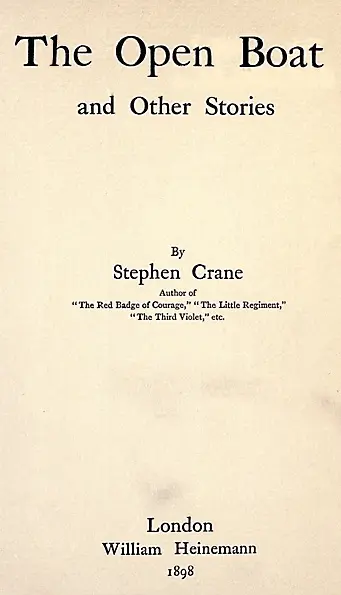
The Open Boat and Other Stories
Stephen Crane
THE CLASSIC COLLECTION · 1900
"Whilomville Stories" by Stephen Crane is a collection of short stories written in the late 19th century. The stories revolve around the lives of children in a small town called Whilomville, exploring their adventures, friendships, and the complexities of childhood. The main characters include Jimmie Trescott and Cora, known as the angel child, as they navigate their experiences with innocence, mischief, and social dynamics among their peers. The opening of "Whilomville Stories" introduces readers to the quaint town of Whilomville during summer, when city visitors arrive, marking a pivotal time for the local children. Among them is the Trescott family, who host guests, including their daughter, Cora, who quickly becomes the center of attention among the local children due to her commanding personality and her father's indulgence. The stories detail their playful yet tumultuous adventures, such as a chaotic birthday celebration, a fateful trip to the candy shop, and the ensuing fallout when their impulsive choices lead to unforeseen consequences, setting the tone for the humorous yet poignant reflections on childhood.
Introduction adapted from the source catalogue; source summaries may be automatically generated.
Free to read · English · 39,242 words · No account needed
MAKE TIME FOR A GOOD BOOK
On by default. Untick to stop anonymous reading totals. Each page counts after 10 seconds in view. How this works.
Anonymous counting is on unless you have switched it off.
"Huh?" said the Phelps boy.
"Guilty or not guilty?" demanded the chief, peremptorily. "Guilty or not guilty? Don't you understand?"
Homer Phelps looked profoundly puzzled. "Guilty or not guilty?" he
asked, slowly and weakly.
The chief made a swift gesture, and turned in despair to the others. "Oh, he don't do it right! He does it all wrong!" He again faced the prisoner with an air of making a last attempt, "Now look-a-here, Homer, when I say, 'Guilty or not guilty?' you want to up an' say, 'Not Guilty.' Don't you see?"
"Not guilty," said Homer, at once.
"No, no, no. Wait till I ask you. Now wait." He called out, pompously, "Pards, if this prisoner before us is guilty, what shall be his fate?"
All those well-trained little infants with one voice sung out,
"Death!"
"Prisoner," continued the chief, "are you guilty or not guilty?"
"But look-a-here," argued Homer, "you said it wouldn't be nothin' that
would hurt. I--"
"Thunder an' lightnin'!" roared the wretched chief. "Keep your mouth shut, can't ye? What in the mischief--"
But there was an interruption from Jimmie Trescott, who shouldered a twin aside and stepped to the front. "Here," he said, very contemptuously, "let me be the prisoner. I'll show 'im how to do it."
"All right, Jim," cried the chief, delighted; "you be the prisoner, then. Now all you fellers with guns stand there in a row! Get out of the way, Homer!" He cleared his throat, and addressed Jimmie. "Prisoner, are you guilty or not guilty?"
"Not guilty," answered Jimmie, firmly. Standing there before his judge--unarmed, slim, quiet, modest--he was ideal.
The chief beamed upon him, and looked aside to cast a triumphant and withering glance upon Homer Phelps. He said: "There! That's the way to do it."
The twins and Dan Earl also much admired Jimmie.
"That's all right so far, anyhow," said the satisfied chief. "An' now we'll--now we'll--we'll perceed with the execution."
"That ain't right," said the new prisoner, suddenly. "That ain't the next thing. You've got to have a trial first. You've got to fetch up a lot of people first who'll say I done it."
"That's so," said the chief. "I didn't think. Here, Reeves, you be first witness. Did the prisoner do it?"
The twin gulped for a moment in his anxiety to make the proper reply.
He was at the point where the roads forked. Finally he hazarded,
"Yes."
"There," said the chief, "that's one of 'em. Now, Dan, you be a
witness. Did he do it?"
Dan Earl, having before him the twin's example, did not hesitate.
"Yes," he said.
"Well, then, pards, what shall be his fate?"
Your reading position is saved on this browser. Take it to another device with a library code. Reading pages adapt to text, rather than matching a printed edition.
Stephen Crane
Stephen Crane
Stephen Crane
Stephen Crane
BEHIND THE BOOK
This eBook is for the use of anyone anywhere in the United States and most other parts of the world at no cost and with almost no restrictions whatsoever. You may copy it, give it away or re-use it under the terms of the Project Gutenberg License included with this eBook or online at www.gutenberg.org. If you are not located in the United States, you will have to check the laws of the country where you are located before using this eBook. Read the source licence.
The original source file, including credits and licence, is retained by this library. Request an original-format copy at no charge. Please include the book title and Project Gutenberg identifier #39644.
KEEP YOUR CURIOSITY GOING
Coulson Kernahan

Maurice Baring
Frances Wright
Cécile Tormay

Frederic Jesup Stimson

W. H. P. (William Henry Pope) Jarvis