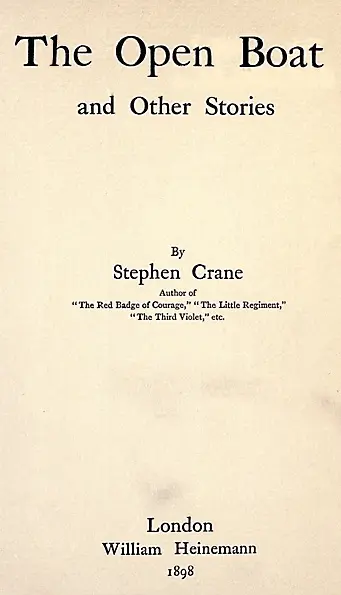
The Open Boat and Other Stories
Stephen Crane
THE CLASSIC COLLECTION · 1900
"Whilomville Stories" by Stephen Crane is a collection of short stories written in the late 19th century. The stories revolve around the lives of children in a small town called Whilomville, exploring their adventures, friendships, and the complexities of childhood. The main characters include Jimmie Trescott and Cora, known as the angel child, as they navigate their experiences with innocence, mischief, and social dynamics among their peers. The opening of "Whilomville Stories" introduces readers to the quaint town of Whilomville during summer, when city visitors arrive, marking a pivotal time for the local children. Among them is the Trescott family, who host guests, including their daughter, Cora, who quickly becomes the center of attention among the local children due to her commanding personality and her father's indulgence. The stories detail their playful yet tumultuous adventures, such as a chaotic birthday celebration, a fateful trip to the candy shop, and the ensuing fallout when their impulsive choices lead to unforeseen consequences, setting the tone for the humorous yet poignant reflections on childhood.
Introduction adapted from the source catalogue; source summaries may be automatically generated.
Free to read · English · 39,242 words · No account needed
MAKE TIME FOR A GOOD BOOK
On by default. Untick to stop anonymous reading totals. Each page counts after 10 seconds in view. How this works.
Anonymous counting is on unless you have switched it off.
On the following Sunday morning Jimmie presented himself at the door of the basement of the Big Progressive church. He was conspicuously washed, notably raimented, prominently polished. And, incidentally, he was very uncomfortable because of all these virtues.
A number of acquaintances greeted him contemptuously. "Hello, Jimmie! What you doin' here? Thought you was a Presbyterian?"
Jimmie cast down his eyes and made no reply. He was too cowed by the change. However, Homer Phelps, who was a regular patron of the Big Progressive Sunday-school, suddenly appeared and said, "Hello, Jim!" Jimmie seized upon him. Homer Phelps was amenable to Trescott laws, tribal if you like, but iron-bound, almost compulsory.
"Hello, Homer!" said Jimmie, and his manner was so good that Homer felt a great thrill in being able to show his superior a new condition of life.
"You 'ain't never come here afore, have you?" he demanded, with a new
arrogance.
"No, I 'ain't," said Jimmie. Then they stared at each other and
manoeuvred.
"You don't know my teacher," said Homer.
"No, I don't know her" admitted Jimmie, but in a way which
contended, modestly, that he knew countless other Sunday-school
teachers.
"Better join our class," said Homer, sagely. "She wears spectacles; don't see very well. Sometimes we do almost what we like."
"All right," said Jimmie, glad to place himself in the hands of his friends. In due time they entered the Sunday-school room, where a man with benevolent whiskers stood on a platform and said, "We will now sing No. 33--'Pull for the Shore, Sailor, Pull for the Shore.'" And as the obedient throng burst into melody the man on the platform indicated the time with a fat, white, and graceful hand. He was an ideal Sunday-school superintendent--one who had never felt hunger or thirst or the wound of the challenge of dishonor; a man, indeed, with beautiful flat hands who waved them in greasy victorious beneficence over a crowd of children.
Jimmie, walking carefully on his toes, followed Homer Phelps. He felt that the kingly superintendent might cry out and blast him to ashes before he could reach a chair. It was a desperate journey. But at last he heard Homer muttering to a young lady, who looked at him through glasses which greatly magnified her eyes. "A new boy," she said, in an oily and deeply religious voice.
"Yes'm," said Jimmie, trembling. The five other boys of the class scanned him keenly and derided his condition.
"We will proceed to the lesson," said the young lady. Then she cried sternly, like a sergeant, "The seventh chapter of Jeremiah!"
Your reading position is saved on this browser. Take it to another device with a library code. Reading pages adapt to text, rather than matching a printed edition.
Stephen Crane

Stephen Crane
Stephen Crane
Stephen Crane
BEHIND THE BOOK
This eBook is for the use of anyone anywhere in the United States and most other parts of the world at no cost and with almost no restrictions whatsoever. You may copy it, give it away or re-use it under the terms of the Project Gutenberg License included with this eBook or online at www.gutenberg.org. If you are not located in the United States, you will have to check the laws of the country where you are located before using this eBook. Read the source licence.
The original source file, including credits and licence, is retained by this library. Request an original-format copy at no charge. Please include the book title and Project Gutenberg identifier #39644.
KEEP YOUR CURIOSITY GOING
Coulson Kernahan

Maurice Baring
Frances Wright
Cécile Tormay

Frederic Jesup Stimson

W. H. P. (William Henry Pope) Jarvis