
Last letters from the living dead man
David Patterson (Spirit) Hatch
THE CLASSIC COLLECTION · 1919
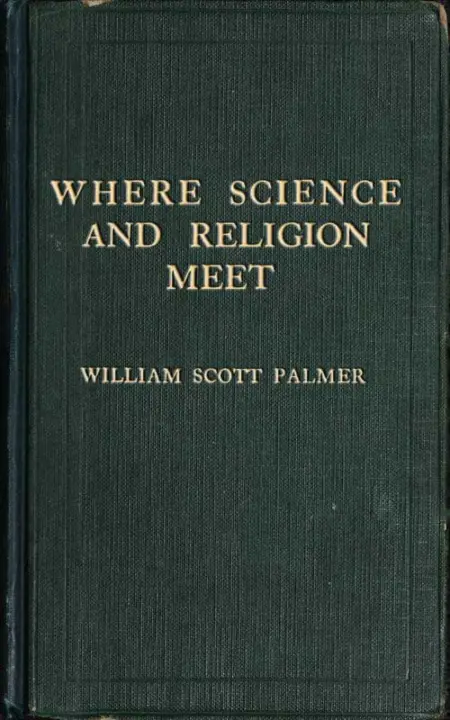
"Where Science and Religion Meet" by William Scott Palmer is a philosophical treatise exploring the relationship between scientific understanding and religious belief, likely written in the early 20th century. The work delves into fundamental existential questions about life, consciousness, and the universe, seeking to find connections between the empirical world and spiritual inquiry, suggesting that both science and religion can coexist and inform each other. The opening of the book presents a profound exploration of the human desire to understand life and the universe, emphasizing the contrast between our everyday experiences and the deeper mysteries they conceal. Palmer reflects on the junction between the living and the non-living, using the process of photosynthesis as an example of the remarkable complexity of life that often goes unnoticed. He challenges the reader to reconsider the foundations of their knowledge, insisting that scientific inquiry, though essential, must also embrace philosophical and spiritual dimensions to fully grasp the essence of existence and life itself. The beginning sets the stage for a thoughtful examination of how humanity can bridge the realms of science and faith in the quest for understanding and meaning.
Introduction adapted from the source catalogue; source summaries may be automatically generated.
Free to read · English · 44,179 words · No account needed
MAKE TIME FOR A GOOD BOOK
On by default. Untick to stop anonymous reading totals. Each page counts after 10 seconds in view. How this works.
Anonymous counting is on unless you have switched it off.
There are other societies besides those of men. Some are far more completely organized. The bees and the ants have carried social organization to a state of harmony and of adjustment to ends which is as strongly marked in its contrast with any that human societies present, as is the triumphant surgery of the solitary wasp by contrast with the blunders of an untrained man. In 'the civility of these little citizens' society is carried to a completeness corresponding with that of the life of the creatures who are its parts. In an ant-hill or a hive we have before us, some may say, a model of what a society should be. Perfect co-operation, complete subordination of individual to social ends, the highest possible working efficiency of each and all—it sounds well, and no one can deny that for bees and ants it works well. Would it work equally well for men?
The answer we give to this question will depend on two things. It will depend first on whether we think that men are or are not competent to advance, and are aided to advance, as beings not only spiritual in essential character and purpose, but self-creative and so able to reach both an efficiency beyond all constraint by institutions and machines, and an enlargement of community-life which shall embrace society upon society in all their diverse modes. Secondly, it will depend on whether we are or are not willing to organize any society by what used to be called biological methods, that is by the methods of the arena—of the 'gladiators' show.' If we decide on the gladiators' show and a social efficiency with no further outlook than a highly superior human ant-hill's, we pronounce ourselves believers that in principle the ant-hill manner of life with its isolation of society from society will work for men. We may be wrong even in a short view or a narrow view of man's capacities and existence; we are certainly wrong if spiritual progress lies before him as a glorious prospect not only for this man or society of men here, or another there, but for all men as members of an all-containing community made one only by an all-containing principle. In face of the promise and adventure of life we are as certainly wrong in giving consent to the ant-hill principle for society as we should be if we consented to exchange our own pregnant incompleteness for the perfection of the ant. Yet we of the modern civilized nations of Europe and America have been far too much influenced of late years, not only by our animal inheritance and the passions that we share with 'ape and tiger,' but by what is now a powerful tradition and in the last century was a new force—the mechanistic conception of social life. Our reasoning about society, our social science, even our social practices, have by this tradition been made not only more materialistic—many of us know that—but more plausibly mechanistic. It has seemed to us that we have science and nature both on our side, in trusting less to the initiative of life and more to its organization of circumscribed institutions and ordered means. We have taken a biological hypothesis far too seriously. And no doubt we have done this in great part because it has enabled us to leave uncriticized, or even to justify, habitual ways of acting and thinking which have about them still the taint of the pit from which we have been digged. These ways of ours were laid down for us in the long effort of each man to keep his footing on earth for himself and for the few he recognized as his own; but we have made them both more difficult and more dangerous by loading ourselves with a burden of perverted or artificial needs which not only call for perverted or artificial means to satisfy them, but set us in opposition to other men from whom we wrest their satisfaction. Those ways and this burden are proper to a creature who in very truth is seeking so to encumber life as to prevent its carrying him on, so to contract his own life as to prevent its intermingling with the lives of others. In short they are proper to one who is arresting life in himself as it has been arrested in the tiger or the ant. It will be arrested at a higher point—that is all; and it will be consciously arrested by the conscious building up of an obstacle far more serious than death. Therefore it is no mere failure; it is sin—sin against the true nature of human life.
Your reading position is saved on this browser. Take it to another device with a library code. Reading pages adapt to text, rather than matching a printed edition.
BEHIND THE BOOK
This eBook is for the use of anyone anywhere in the United States and most other parts of the world at no cost and with almost no restrictions whatsoever. You may copy it, give it away or re-use it under the terms of the Project Gutenberg License included with this eBook or online at www.gutenberg.org. If you are not located in the United States, you will have to check the laws of the country where you are located before using this eBook. Read the source licence.
The original source file, including credits and licence, is retained by this library. Request an original-format copy at no charge. Please include the book title and Project Gutenberg identifier #52245.
KEEP YOUR CURIOSITY GOING
David Patterson (Spirit) Hatch

David Patterson (Spirit) Hatch

David Patterson (Spirit) Hatch
Coulson Kernahan

Ralph Waldo Emerson
Frances Wright