
The Writing of News A Handbook with Chapters on Newspaper Correspondence and Copy Reading
Charles G. (Charles Griffith) Ross
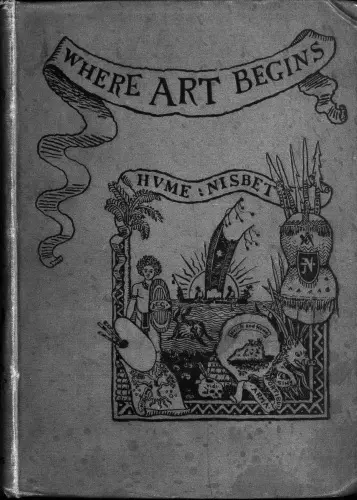
THE CLASSIC COLLECTION · 1892
"Where Art Begins" by Hume Nisbet is a treatise on the principles of art, specifically focusing on painting and photography, written in the late 19th century. The author shares insights from his experience as an artist and art teacher, discussing the relationship between practical techniques and the emotional resonance of art. Through a blend of theoretical reflections and practical guidance, the work aims to inspire both art students and enthusiasts to appreciate the profound influence of art on humanity and personal expression. The opening portion introduces Nisbet's contemplations on the nature and significance of art, framing it as a deeply emotional and universal experience that goes beyond mere aesthetics. He reflects on the journey of life through art, addressing its ingrained connection to human emotions and society. He articulates the transformative power of art in fostering charity and understanding. Additionally, he touches on the historical context of photography and painting, illustrating a personal narrative of his artistic development and early experiences with photography—a convergence point for technical skill and emotional expression.
Introduction adapted from the source catalogue; source summaries may be automatically generated.
Free to read · English · 93,334 words · No account needed
MAKE TIME FOR A GOOD BOOK
On by default. Untick to stop anonymous reading totals. Each page counts after 10 seconds in view. How this works.
Anonymous counting is on unless you have switched it off.
A good land, where we can cast aside the trammels of cities and get out to see it; where we can forget our brothers in iniquity, our brothers in sorrow and starvation, depths which charity cannot cure, or investigation eradicate, which rise up like black waves against our stemming and threaten in the future to engulf us all.
A good land, where we can abnegate desire, learn to be poor as Christ was poor in order to correct poverty; where we can conquer ourselves, lay down the most clinging habit, for the sake of mankind, and by example teach others at the lower level to be content with God's air, and God's light, and go out to get them; where we can live with less comfort, fewer tastes, and greater simplicity.
A good land, where the great social problem is solved and self-abolished for cause, and men, proud of being poor, as now they grow arrogant in wealth, join hands as little children, forgetting that bat-ghoul philosophy, taking the gifts which God has given to them as the foretaste of better things in store.
A good land here; but what is there to come, where Art begins?
Abbey, 157
A B C of art, 115
Aberdonian clipper, 146
Academies, 96
Actions of nature, 28
Adoration in art, 255
Age of romance, 281
Agnosticism, 306-9
Aikenhead (Major), 97
Aissouas, the, 107
'Ally Sloper's Half Holiday,' 166, 167
Alma-Tadema, his work, 80, 193, 194, 273
Almanack, Comic, 166
Anatomy, 95
Ancient Egypt, style of, 299-301
'Ansidei Madonna,' its value, 231
Apocalypse, Albert Dürer's, 156
Ark, dimensions of, 135
Art, realism in, 34;
fashion in, 90;
instinct of, 98;
lessons in, 102;
savage, 102, 214-16;
Eastern, 105;
false, 107;
true aim of, 108, 252;
A B C of, 115;
uses of, 117-18;
practical, 157;
individualism in, 160;
influence of Turner on illustrative, 163;
sacred, 250;
sacrifices of, 252;
imagination in, 254;
adoration in, 255;
soul in, 255;
comic, 260;
Dutch, 268;
dignity in, 268, 293;
symbol of, 291
Art course, time of, 116
Artist and butterfly, 291
Artists as readers, 273
Assyria, styles of, 60
Astronomy, artistic, 276
Atheism, 307
Australian experience, 108-12
Backgrounds, old style, 7
Barnard (F.), 157
Bayeux Tapestry, the, 139
Beauty, 209, 257;
spirit of, 289
Bell, his 'Mary Queen of Scots,' 45
Bellini (Giovanni), 238
Bewick, 159, 160, 173
Black and gold marble, 189
'Black and White,' 165
Blake (William), 35, 89
Blemishes in marbles, 195
Blunders of science, 278
Boats, Egyptian, 136
Body colour, 92
Bolton, 171
Book, an illustrated, 152, 172-5
---- plates, 276
Books on painting, 83
Boots and feet, 200, 201, 203
Botany, artistic, 284
Botticelli (Sandro F.), 240
Bough (Sam), 82
Breydenbach's Travels, 155
Bronzino (Angelo), 240
Brushes, 69
Buddha, 298
Burnett on painting, 127, 129
Burns (Robert), 211
Byron (Lord), 89
Cameron (Hugh), 47, 48
Canvas, preparing a, 179
Carlyle (Thomas), 20, 87, 101
Cassell & Co., 155, 169
Centre line, the, 225
Chalmers (George Paul), 82, 239, 246, 292
Champs and champing, 183, 184
Chatto (W. A.), 150, 152
Chatto & Windus, 166
Chemistry of colour, 92
Chevreul, his book, 115
China collecting, 273
Classification of light, 129
Coleridge, 89, 217
Colour, body, 92;
chemistry of, 92
---- perception, 269
Colours, blending of, 59;
the primaries, 58
Combing, 181, 182
Comfort in ornament, 224
Comic Almanack, 166
---- art, 260
Consistency in ornament, 225
Constable (John), 86, 160
Your reading position is saved on this browser. Take it to another device with a library code. Reading pages adapt to text, rather than matching a printed edition.
BEHIND THE BOOK
This eBook is for the use of anyone anywhere in the United States and most other parts of the world at no cost and with almost no restrictions whatsoever. You may copy it, give it away or re-use it under the terms of the Project Gutenberg License included with this eBook or online at www.gutenberg.org. If you are not located in the United States, you will have to check the laws of the country where you are located before using this eBook. Read the source licence.
The original source file, including credits and licence, is retained by this library. Request an original-format copy at no charge. Please include the book title and Project Gutenberg identifier #45504.
KEEP YOUR CURIOSITY GOING
Charles G. (Charles Griffith) Ross
Hannah Webster Foster

Emily Lawless
Edwin Hamlin Carr

Charles De Lano Hine
Andrew Ure