THE CLASSIC COLLECTION✦An outlaw’s diary: the CommuneCLASSIC FREE BOOKS
An outlaw’s diary: the Commune
Cécile Tormay
THE CLASSIC COLLECTION · 1923
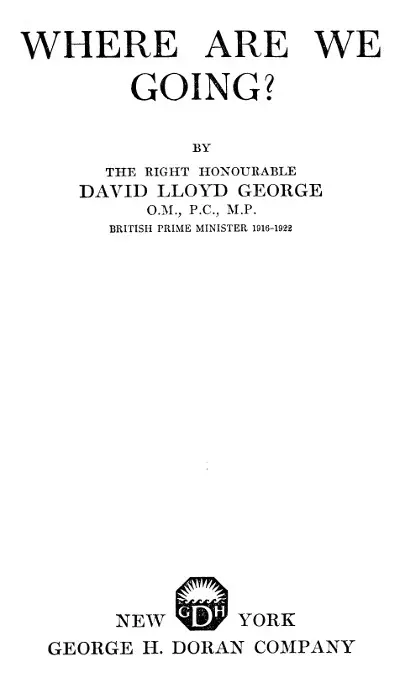
"Where Are We Going?" by David Lloyd George is a political treatise reflecting on the European geopolitical situation written in the early 20th century, specifically shortly after the end of World War I. The book addresses the changing dynamics of nations, the fragility of peace in the post-war era, and the potential for future conflicts if underlying issues are not addressed. The work appears to emphasize the importance of justice and good relations among nations as a means to prevent war. The opening of this treatise introduces the immense transformations Europe underwent after World War I, juxtaposing the pre-war confident systems with the post-war hesitance and chaos. Lloyd George describes a Europe marred by new nations rising while old empires crumble, with lingering tensions that threaten to ignite further conflicts despite the hope for lasting peace. He warns that, although many experiences from the Great War should educate nations against future wars, the persistent fears, suspicions, and military posturing among nations indicate that humanity may not have grasped the lessons learned. This critical reflection sets the tone for the rest of the work, which promises to explore the complexities of international relations and the pressing need for a cooperative global framework to ensure peace.
Introduction adapted from the source catalogue; source summaries may be automatically generated.
Free to read · English · 68,739 words · No account needed
MAKE TIME FOR A GOOD BOOK
On by default. Untick to stop anonymous reading totals. Each page counts after 10 seconds in view. How this works.
Anonymous counting is on unless you have switched it off.
Note: Images of the original pages are available through
Internet Archive. See
https://archive.org/details/wherearewegoing00lloy
by
The Right Honourable
New York
George H. Doran Company
Copyright, 1923,
by George H. Doran Company
Printed in the United States of America
The chapters collected in this book represent a running comment on the European situation during the past ten months. Although in the haze that covers the Continent it is difficult always to see clearly what is happening, and still more difficult to forecast what is likely to occur, I have not deemed it necessary to revise any of the estimates I made from time to time in these periodic reviews on the position. In the period covered by them peace has gone back perceptibly and unmistakably. Of the years immediately after the end of the Great War it may be said that up to the present year each showed a distinct improvement over its predecessor. The temper of the warring nations showed a gradual healing and improvement, and East and West there was a return to reason and calm in their attitude towards each other. In the Cannes discussions of January 1922 the atmosphere of hostility which poisoned the Spa discussions in 1920 had largely disappeared, and the applause which greeted Herr Rathenau's fine speech at Genoa in April 1922 was cordial and general. The electric messages from Paris failed to provoke a thunderstorm, and one of the speakers, at the last meeting of the Assembly, drawing an illustration from the weather outside, said the Conference had broken up under blue skies and a serene firmament.
That was in May 1922. Those words, when used, met with cheering approval: if used to-day they would be greeted with scoffing laughter. The present year has been one of growing gloom and menace. The international temper is distinctly worse all round. A peace has been patched up with the Turkish Empire. No one believes it can endure long. The only question is, How long? There may be other patched-up treaties between struggling nations before the year is out. There is only one prediction concerning them which can at this stage be safely made--they will leave European peace in a more precarious plight than ever. A peace wrung by triumphant force out of helplessness is never a good peace. That is why I view with apprehension the character of the settlement which may soon be wrung out of German despair in the Ruhr and imposed on Greek impotence in the Adriatic. The Fiume settlement may turn out to be more satisfactory in spite of threatening omens. The Jugo-Slavs are a formidable military proposition to be tackled by any Power. The War proved them to be about the best fighting material in Europe. They are also fairly well equipped with modern weapons, and if unhappily the need arose their deficiencies in this respect would soon be supplied from the workshops of Czecho-Slovakia and elsewhere. I am, therefore, still hopeful that Fiume may be remitted for settlement to diplomatists and not to gunmen. International right in these turbulent days seems to depend, not on justice, but on a reckoning of chances. The Slavs are ready to defend their rights and can do so. There is, therefore, some talk of conferences and even arbitration in their case. Germany and Greece cannot put up a fight. Unconditional surrender is, therefore, their lot. All the same, this is not only a wrong but a miscalculation. Unjust concessions, extracted by violence, are not settlements; they are only postponements. Unfortunately, the decisions at the next great hearing of the cause are just as likely to be provisional--and so the quarrel will go on to the final catastrophe unless humanity one day sees the light and has the courage to follow it. But that day must not be too distant, otherwise it will come too late to save civilisation. The last conflict between great nations has exposed the devastating possibilities of modern science. Henceforth progress in the destructiveness of the apparatus of war has been, and will continue to be, so rapid that a conflict to-morrow would spread ten times the desolation caused by the Great War of 1914-18. There is a concentration of much scientific and mechanical skill on strengthening the machinery of devastation. Incredible progress--if progress be the word--has been made within the last three or four years in perfecting and increasing the shattering power of this kind of devilry. What will it be like five, ten, twenty years hence!
Your reading position is saved on this browser. Take it to another device with a library code. Reading pages adapt to text, rather than matching a printed edition.
BEHIND THE BOOK
This eBook is for the use of anyone anywhere in the United States and most other parts of the world at no cost and with almost no restrictions whatsoever. You may copy it, give it away or re-use it under the terms of the Project Gutenberg License included with this eBook or online at www.gutenberg.org. If you are not located in the United States, you will have to check the laws of the country where you are located before using this eBook. Read the source licence.
The original source file, including credits and licence, is retained by this library. Request an original-format copy at no charge. Please include the book title and Project Gutenberg identifier #60262.
KEEP YOUR CURIOSITY GOING
Cécile Tormay

Moritz Busch
John L. Ransom
Frances Wright
Cécile Tormay

Mabel Potter Daggett