THE CLASSIC COLLECTION✦Building the pacific railwayCLASSIC FREE BOOKS
Building the pacific railway
Edwin L. (Edwin Legrand) Sabin
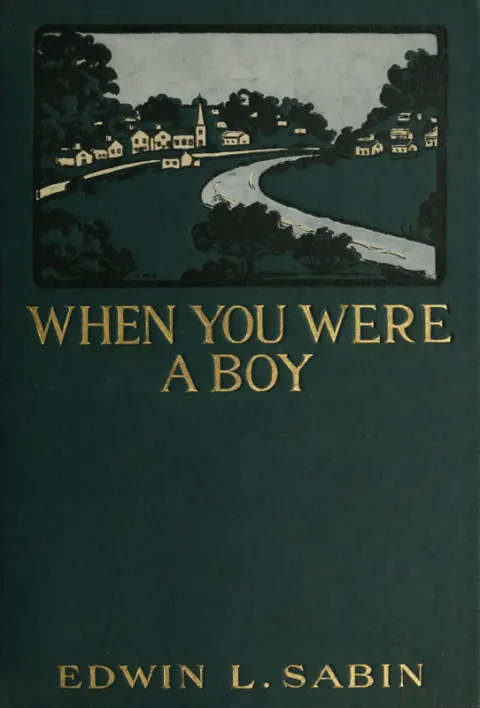
THE CLASSIC COLLECTION · 1905
"When You Were a Boy" by Edwin L. Sabin is a nostalgic children's narrative written in the early 20th century. The text is likely a novel or a collection of intertwined stories centered around the experiences of boys during childhood, exploring themes of innocence, adventure, and the simplicity of pastimes like baseball and the circus. The main character, addressed as "you," engages with a cast of friends, including relatable figures such as Fat Day, Hen Schmidt, and Billy Lunt, who embody the essence of youthful camaraderie and imaginative play. The opening portion of the work introduces the reader to a lively scene where the main character joins friends in forming a baseball team, the North Stars. The camaraderie is palpable as they organize their lineup, discuss their uniforms, and anticipate an upcoming match against the Second-street kids. The sense of competition, childhood rivalry, and the spirit of playfulness is highlighted as the boys navigate the trials of their baseball game, culminating in moments filled with excitement and disappointment. The narrative captures the essence of boyhood adventures, from the thrill of playing sports to the simplicity of the friendships formed during these formative years.
Introduction adapted from the source catalogue; source summaries may be automatically generated.
Free to read · English · 42,358 words · No account needed
MAKE TIME FOR A GOOD BOOK
On by default. Untick to stop anonymous reading totals. Each page counts after 10 seconds in view. How this works.
Anonymous counting is on unless you have switched it off.
The dishes are large.
“Piggie!” upbraids Lucy, when, having been solicited, you accept a second. Nevertheless, she does not refuse a spoonful from it, now and then.
Last come the candies, amidst which are fascinating motto-wafers, always the source of much mirth and amusement.
All the company exchange mottoes. You and Lucy limit your operations chiefly to one another. For instance, you present her with a pink motto, shaped like a four-leaf clover, which says;
“Are you fickle-minded?”
“You are too stout!” replies Lucy, with a circular disk in cream color.
“Forget me not,” you entreat—the words being done in red upon a white
diamond.
“All in life is dear,” answers Lucy, rather vaguely, with a greenish
hexagon.
“Are you in earnest?” you query—a pink heart.
“Ask pa’s consent,” suggests Lucy, unmaidenly as the encouragement may appear, with an indented square.
You have to trade around among various friends before you can effectually respond. Sly Mary Webster supplies you with “Say now!” of which you immediately avail yourself.
“Will you marry me?” asks Lucy, dared thereto by companions, while those in the secret whoop and shriek at her boldness.
“Of course I will,” you assure her, providentially possessing the very reply, on a yellow oval.
“That’s what!” comments Lucy.
The remark deserves better, but the best that you can do is a “With all my heart,” on a pink star.
The festivities of the evening are over. It is time to go home. Most of the mottoes have eventually been eaten, and the rest of them have been stuffed, along with other sweets, into greedy pockets. Already some of the girls have been called for by kinspeople, and some of the boys have scrambled through the hall, and noisily fled into the street. You encounter Lucy at the foot of the stairs, and hastily thrust into her hand a motto that you have been saving—a fine shamrock in yellow, which says for you:
“May I see you home to-night?”
There is a motto-wafer with a mitten on it; has Lucy one, and will she be moved to give it to you, as a mischievous rebuff? No; lacking ready answer, she only giggles and attempts to pass on.
“But may I? I ain’t foolin’—truly I ain’t!” you beseech, husky in the stress of the moment.
“I don’t care,” calls back Lucy, half-way up the flight.
Your reading position is saved on this browser. Take it to another device with a library code. Reading pages adapt to text, rather than matching a printed edition.
Edwin L. (Edwin Legrand) Sabin

Edwin L. (Edwin Legrand) Sabin

Edwin L. (Edwin Legrand) Sabin

Edwin L. (Edwin Legrand) Sabin
BEHIND THE BOOK
This eBook is for the use of anyone anywhere in the United States and most other parts of the world at no cost and with almost no restrictions whatsoever. You may copy it, give it away or re-use it under the terms of the Project Gutenberg License included with this eBook or online at www.gutenberg.org. If you are not located in the United States, you will have to check the laws of the country where you are located before using this eBook. Read the source licence.
The original source file, including credits and licence, is retained by this library. Request an original-format copy at no charge. Please include the book title and Project Gutenberg identifier #58165.
KEEP YOUR CURIOSITY GOING
Coulson Kernahan

Maurice Baring
Frances Wright
Cécile Tormay

Frederic Jesup Stimson

W. H. P. (William Henry Pope) Jarvis