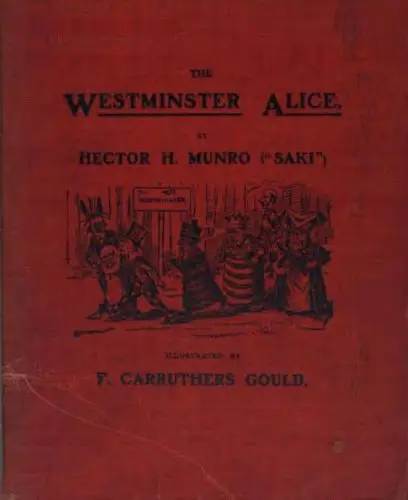
The Westminster Alice
Saki
THE CLASSIC COLLECTION · 1914
"When William Came" by Saki is a novel published in November 1913. Set in a future London under German occupation after Britain's defeat in war, it chronicles life under Kaiser Wilhelm II's rule. This work of invasion literature explores the dramatic changes brought by foreign conquest, from altered legal systems to enforced police registration. Written amid rising European tensions, the novel serves as both a warning and an argument for military preparedness, painting a bitter portrait of a subjugated England.
Introduction adapted from the source catalogue; source summaries may be automatically generated.
Free to read · English · 50,040 words · No account needed
MAKE TIME FOR A GOOD BOOK
On by default. Untick to stop anonymous reading totals. Each page counts after 10 seconds in view. How this works.
Anonymous counting is on unless you have switched it off.
"In any case," said Cicely, "as regards the hunting, there is no Civil War or national war raging just now, and there is no immediate likelihood of one. A good many hunting seasons will have to come and go before we can think of a war of independence as even a distant possibility, and in the meantime hunting and horse-breeding and country sports generally are the things most likely to keep Englishmen together on the land. That is why so many men who hate the German occupation are trying to keep field sports alive, and in the right hands. However, I won't go on arguing. You and I always think things out for ourselves and decide for ourselves, which is much the best way in the long run."
Cicely slipped away to her writing-room to make final arrangements over the telephone for the all-important supper-party, leaving Yeovil to turn over in his mind the suggestion that she had thrown out. It was an obvious lure, a lure to draw him away from the fret and fury that possessed him so inconveniently, but its obvious nature did not detract from its effectiveness. Yeovil had pleasant recollections of the East Wessex, a cheery little hunt that afforded good sport in an unpretentious manner, a joyous thread of life running through a rather sleepy countryside, like a merry brook careering through a placid valley. For a man coming slowly and yet eagerly back to the activities of life from the weariness of a long fever, the prospect of a leisurely season with the East Wessex was singularly attractive, and side by side with its attractiveness there was a tempting argument in favour of yielding to its attractions. Among the small squires and yeoman farmers, doctors, country tradesmen, auctioneers and so forth who would gather at the covert-side and at the hunt breakfasts, there might be a local nucleus of revolt against the enslavement of the land, a discouraged and leaderless band waiting for some one to mould their resistance into effective shape and keep their loyalty to the old dynasty and the old national cause steadily burning. Yeovil could see himself taking up that position, stimulating the spirit of hostility to the fait accompli, organising stubborn opposition to every Germanising influence that was brought into play, schooling the youth of the countryside to look steadily Delhiward. That was the bait that Yeovil threw out to his conscience, while slowly considering the other bait that was appealing so strongly to his senses. The dry warm scent of the stable, the nip of the morning air, the pleasant squelch-squelch of the saddle leather, the moist earthy fragrance of the autumn woods and wet fallows, the cold white mists of winter days, the whimper of hounds and the hot restless pushing of the pack through ditch and hedgerow and undergrowth, the birds that flew up and clucked and chattered as you passed, the hearty greeting and pleasant gossip in farmhouse kitchens and market-day bar-parlours--all these remembered delights of the chase marshalled themselves in the brain, and made a cumulative appeal that came with special intensity to a man who was a little tired of his wanderings, more than a little drawn away from the jarring centres of life. The hot London sunshine baking the soot- grimed walls and the ugly incessant hoot and grunt of the motor traffic gave an added charm to the vision of hill and hollow and copse that flickered in Yeovil's mind. Slowly, with a sensuous lingering over detail, his imagination carried him down to a small, sleepy, yet withal pleasantly bustling market town, and placed him unerringly in a wide straw-littered yard, half-full of men and quarter-full of horses, with a bob-tailed sheep-dog or two trying not to get in everybody's way, but insisting on being in the thick of things. The horses gradually detached themselves from the crowd of unimportant men and came one by one into momentary prominence, to be discussed and appraised for their good points and bad points, and finally to be bid for. And always there was one horse that detached itself conspicuously from the rest, the ideal hunter, or at any rate, Yeovil's ideal of the ideal hunter. Mentally it was put through its paces before him, its pedigree and brief history recounted to him; mentally he saw a stable lad put it over a jump or two, with credit to all concerned, and inevitably he saw himself outbidding less discerning rivals and securing the desired piece of horseflesh, to be the chief glory and mainstay of his hunting stable, to carry him well and truly and cleverly through many a joyous long-to-be-remembered run. That scene had been one of the recurring half-waking dreams of his long days of weakness in the far-away Finnish nursing-home, a dream sometimes of tantalising mockery, sometimes of pleasure in the foretaste of a joy to come. And now it need scarcely be a dream any longer, he had only to go down at the right moment and take an actual part in his oft-rehearsed vision. Everything would be there, exactly as his imagination had placed it, even down to the bob-tailed sheep-dogs; the horse of his imagining would be there waiting for him, or if not absolutely the ideal animal, something very like it. He might even go beyond the limits of his dream and pick up a couple of desirable animals--there would probably be fewer purchasers for good class hunters in these days than of yore. And with the coming of this reflection his dream faded suddenly and his mind came back with a throb of pain to the things he had for the moment forgotten, the weary, hateful things that were symbolised for him by the standard that floated yellow and black over the frontage of Buckingham Palace.
Your reading position is saved on this browser. Take it to another device with a library code. Reading pages adapt to text, rather than matching a printed edition.
BEHIND THE BOOK
This eBook is for the use of anyone anywhere in the United States and most other parts of the world at no cost and with almost no restrictions whatsoever. You may copy it, give it away or re-use it under the terms of the Project Gutenberg License included with this eBook or online at www.gutenberg.org. If you are not located in the United States, you will have to check the laws of the country where you are located before using this eBook. Read the source licence.
The original source file, including credits and licence, is retained by this library. Request an original-format copy at no charge. Please include the book title and Project Gutenberg identifier #14540.
KEEP YOUR CURIOSITY GOING
Coulson Kernahan

Maurice Baring
Frances Wright
Cécile Tormay

Frederic Jesup Stimson

W. H. P. (William Henry Pope) Jarvis