
Memoirs of Bertha von Suttner: The Records of an Eventful Life (Vol. 2 of 2)
Bertha von Suttner
THE CLASSIC COLLECTION · 1914
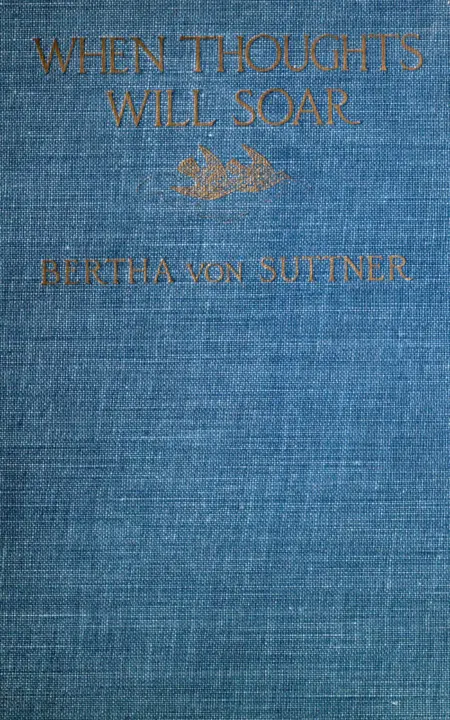
"When Thoughts Will Soar: A Romance of the Immediate Future" by Baroness Bertha von Suttner is a novel written in the early 20th century. The story centers around Franka Garlett, a young woman who grapples with loss and the complexities of her uncertain future following the death of her father. As she navigates her new life among strangers, she confronts societal expectations, the pursuit of love, and her inherited legacy. The opening of the novel introduces readers to Mr. John A. Toker, an affluent American contemplating a grand plan sparked by developments in aeronautics and the implications of technology on society, which foreshadows key themes of the book. Following this, we meet Franka, who mourns the untimely death of her father, a professor, and struggles with loneliness in their modest home. Her past is steeped in academic pursuits and deep emotional bonds, but the realization of her plight prompts her search for work to sustain herself. The narrative then depicts her encounters with various individuals, including Baron Ludwig Malhof, whose unsettling intentions lead Franka to assert her independence and morals amid an array of societal challenges. This sets the stage for Franka's journey towards self-identity, resistance against oppressive norms, and her quest for love and belonging amidst the changing world around her.
Introduction adapted from the source catalogue; source summaries may be automatically generated.
Free to read · English · 114,957 words · No account needed
MAKE TIME FOR A GOOD BOOK
On by default. Untick to stop anonymous reading totals. Each page counts after 10 seconds in view. How this works.
Anonymous counting is on unless you have switched it off.
“Probably prettier than ever—she is a ravishing creature....”
“What fire, Baron Malhof!”
“Yes, I confess, Fräulein Garlett was my last flame.... Oh, not a very creditable story, as far as I was concerned. I tried to—well, never mind what I tried—but she gave me a pretty rebuff. As to emancipation, as you keep saying, Countess, nothing of that could be seen in her. A virtuous maiden of the old-fashioned model....”
“Excuse me, but in order to resist you....”
“One need not be so very virtuous—were you going to say, Madam? That is true, but the circumstances under which I was repulsed, and the way in which she did it, certainly indicated the much-praised ‘fundamental principles.’”
“Don’t you approve of them?”
“I never have, most gracious Countess.”
“I know, I know; you have the reputation of having been a genuine Don Juan. However, as far as Franka is concerned, she seems to have kept her head. In spite of this adventurous life—this gallivanting about and making speeches, nothing discreditable has ever been charged against her.”
“So much the worse for her.”
“What do you mean?”
“Well, if one hears nothing bad about a young woman, it means that nothing pleasant has happened to her.”
“You are a terrible man! Albertine, we ought never to have trusted
ourselves to his escort!”
The old maid did not understand the joke. “Why not?” she asked earnestly. “He is certainly a very respectable gentleman. But do you know, Baron Malhof, I should like to give you one piece of advice: you ought not to comb your back hair over your bald spot. Excuse my frankness; but it is not at all becoming to you.”
The baron nervously and awkwardly moved his hand over the place to which such invidious attention had been called. “Good Heavens! One does the best one can....”
“Oh, you, with your everlasting frankness,” exclaimed the countess
reprovingly.
Coriolan went on reading his newspaper. “Here among the names of the Rose comedians stands that of a Herr Helmer; wasn’t that fool Jew, who was Eduard’s last secretary, named Helmer?”
“Yes, that was his name,” replied Countess Adele. “But he wasn’t a Jew.”
“Well, his maternal grandmother was Jewish, and that is pretty much the
same thing.”
“So was our common ancestor Adam,” said Malhof angrily. “Especially here, in this free and democratic Switzerland, you should not assume that tone. Here one must not brag too much of race and rank.”
Your reading position is saved on this browser. Take it to another device with a library code. Reading pages adapt to text, rather than matching a printed edition.
Bertha von Suttner
Bertha von Suttner
BEHIND THE BOOK
This eBook is for the use of anyone anywhere in the United States and most other parts of the world at no cost and with almost no restrictions whatsoever. You may copy it, give it away or re-use it under the terms of the Project Gutenberg License included with this eBook or online at www.gutenberg.org. If you are not located in the United States, you will have to check the laws of the country where you are located before using this eBook. Read the source licence.
The original source file, including credits and licence, is retained by this library. Request an original-format copy at no charge. Please include the book title and Project Gutenberg identifier #63599.
KEEP YOUR CURIOSITY GOING
Coulson Kernahan

Maurice Baring
Frances Wright
Cécile Tormay

Frederic Jesup Stimson

W. H. P. (William Henry Pope) Jarvis