
Memoirs of Bertha von Suttner: The Records of an Eventful Life (Vol. 2 of 2)
Bertha von Suttner
THE CLASSIC COLLECTION · 1914
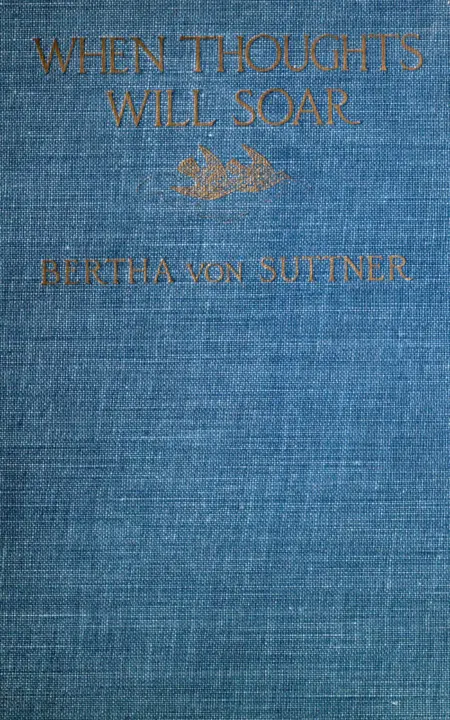
"When Thoughts Will Soar: A Romance of the Immediate Future" by Baroness Bertha von Suttner is a novel written in the early 20th century. The story centers around Franka Garlett, a young woman who grapples with loss and the complexities of her uncertain future following the death of her father. As she navigates her new life among strangers, she confronts societal expectations, the pursuit of love, and her inherited legacy. The opening of the novel introduces readers to Mr. John A. Toker, an affluent American contemplating a grand plan sparked by developments in aeronautics and the implications of technology on society, which foreshadows key themes of the book. Following this, we meet Franka, who mourns the untimely death of her father, a professor, and struggles with loneliness in their modest home. Her past is steeped in academic pursuits and deep emotional bonds, but the realization of her plight prompts her search for work to sustain herself. The narrative then depicts her encounters with various individuals, including Baron Ludwig Malhof, whose unsettling intentions lead Franka to assert her independence and morals amid an array of societal challenges. This sets the stage for Franka's journey towards self-identity, resistance against oppressive norms, and her quest for love and belonging amidst the changing world around her.
Introduction adapted from the source catalogue; source summaries may be automatically generated.
Free to read · English · 114,957 words · No account needed
MAKE TIME FOR A GOOD BOOK
On by default. Untick to stop anonymous reading totals. Each page counts after 10 seconds in view. How this works.
Anonymous counting is on unless you have switched it off.
Rinotti jotted down on a sheet of paper notes wherein swarmed a profusion of references to movements of troops, blockades of boundaries, communiqués, airship works, and the like. In the same breath he scribbled on another sheet of paper detached words and sentences like “Splendid creature,” “lovely one,” “You must be mine,” “devouring fire,” and other ingredients of a glowing billet doux which that very evening he proposed to slip into Annette’s hands at the Rose-Festival.
In the mean time Victor Adolph was expecting the promised visit. He was sitting on his balcony and lying back comfortably in a rocking-chair, with a book in his hand and a cigarette between his lips. He was not alone. His constant attendant, General von Orell, adjutant, tutor, compagnon de plaisir, paternal friend, and master of ceremonies, all in one person, was resting in a second rocking-chair, also engaged in smoking and reading. Only he was puffing a strong imported cigar and was reading a military aëronautical journal.
Victor Adolph glanced up from his reading: “Why, he is a real poet, this Helmer.... You ought to read ‘Schwingen,’ Orell, since you are so much interested in aviation, as I see from the title-picture of your journal.”
The general politely laid his journal aside, as his prince was pleased
to address him.
“Never read poems, Your Royal Highness.”
“I know that, you are too ‘matter-of-fact’ for such things.”
“Too what?” The general did not understand the English expression used
by the prince.
“Too sober, too cold-hearted, too skeptical, too....”
“Too prosaic. Granted. Dry common sense. Practical mind. I flatter
myself.”
“What news in your journal? Any great advance in the art of flying?”
“Yes, great supplies of explosives can be carried by airships.”
“Really? What a blessing.... Will not Signor Rinotti be here shortly?”
Orell glanced at his watch:—
“Quarter of an hour.”
The general preferred not to say more words than were necessary.
“Have the violets been sent to the Rose-Palace?”
“Yes, Your Royal Highness. Pretty girl. But a bluestocking.... Shame!”
“Fräulein Garlett does not give the impression of being a bluestocking, but she is very clever.”
“Women should not be clever.”
The prince laughed. “You are fearfully vieux jeu, my dear Orell.”
“Fearfully what?”
“Old-fashioned.”
“I flatter myself; hate all modern follies. Modern technique, especially the technique of arms, also the modern mode of warfare interests me. Your Royal Highness is far too little interested in such things. Here are the experiences of the Russo-Japanese campaign....”
“I know them. There is some of that in Veresayef’s ‘Recollections of a Physician,’ and in Leonid Andreyef’s ‘Red Laughter.’”
“Your Royal Highness reads bad books with the rest.”
Your reading position is saved on this browser. Take it to another device with a library code. Reading pages adapt to text, rather than matching a printed edition.
Bertha von Suttner
Bertha von Suttner
BEHIND THE BOOK
This eBook is for the use of anyone anywhere in the United States and most other parts of the world at no cost and with almost no restrictions whatsoever. You may copy it, give it away or re-use it under the terms of the Project Gutenberg License included with this eBook or online at www.gutenberg.org. If you are not located in the United States, you will have to check the laws of the country where you are located before using this eBook. Read the source licence.
The original source file, including credits and licence, is retained by this library. Request an original-format copy at no charge. Please include the book title and Project Gutenberg identifier #63599.
KEEP YOUR CURIOSITY GOING
Coulson Kernahan

Maurice Baring
Frances Wright
Cécile Tormay

Frederic Jesup Stimson

W. H. P. (William Henry Pope) Jarvis