
In the Name of the People
Arthur W. Marchmont
THE CLASSIC COLLECTION · 1903
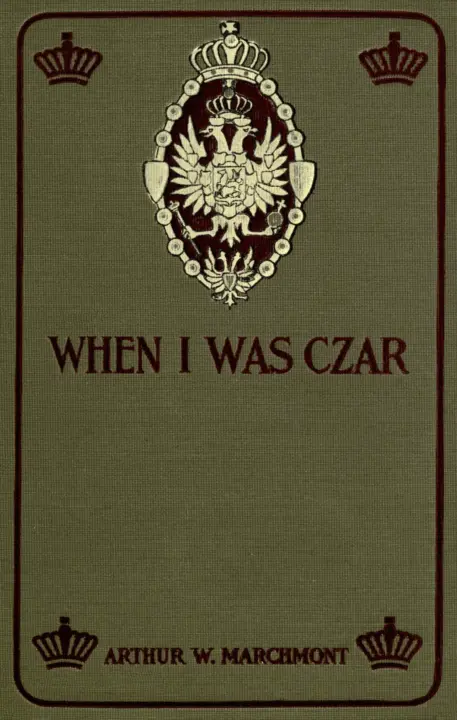
"When I Was Czar" by Arthur W. Marchmont is a romance novel written in the early 20th century. The story centers on the main character, Harper C. Denver, an American who, due to a chance resemblance to the Czar of Russia, is drawn into a complex web of intrigue and deception. As he navigates a series of unexpected events in the Russian Empire, themes of identity, allegiance, and romance unfold. The opening portion of the novel introduces Harper in St. Petersburg as he reminisces about his past connection with the Czar, which leads him to a grand adventure. He receives an invitation to the Czar's palace and soon finds himself facing a peculiar proposition from Prince Kalkov: to impersonate the Czar in order to thwart the schemes of a dangerous man named Boreski, who is entangled in a plot involving secret documents and a romance with the Duchess Stephanie. Feeling an obligation to repay the Czar for saving his life years ago, Harper is apprehensive yet eager to embrace this extraordinary challenge, setting the stage for the ensuing drama that intertwines with his growing attraction to a mysterious woman named Helga.
Introduction adapted from the source catalogue; source summaries may be automatically generated.
Free to read · English · 102,126 words · No account needed
MAKE TIME FOR A GOOD BOOK
On by default. Untick to stop anonymous reading totals. Each page counts after 10 seconds in view. How this works.
Anonymous counting is on unless you have switched it off.
But I had made up my mind. Her fear of “something happening” had given
me a cue.
“I am not going, mademoiselle, without the papers.”
“You will go, monsieur,” she replied, her face setting.
“Then I take the papers with me, mademoiselle.”
“On the contrary, monsieur, you will go without them.”
“We shall see;” and I sat down with an intentional deliberation.
“I have pledged myself for your personal safety. You must go.”
The purpose in her voice strengthened with every sentence.
“I will trust to my own right arm, mademoiselle. Without those papers, I do not leave the house, come what may.”
“You are dealing with a desperate woman, monsieur. You must go.”
“Then give me the papers to take with me.”
She came and stood opposite me, her eyes aflame, and her hands clenched.
“You shall go if we have to use force to take you away;” and she moved away and laid her finger on the bell.
“You will not do that, mademoiselle.”
“Why not?” she cried, turning round.
“Because the man who seeks to lay hands on me will touch nothing else
in this life.”
For a minute she stood silent in distracted hesitation.
The silence was broken by the sound of the carriage wheels.
“We will see,” she cried, and pressed the bell.
“As you please;” and I rose and stepped back against the wall and drew
my revolver.
At the sight of it she closed her eyes and threw up her hands with a cry of fear and anguish, and then clasped her hands to her head.
The servant came in then.
“Is the carriage there, Peter?”
“Yes, mademoiselle.”
“Very well.”
He went and closed the door.
“Your Majesty, I beg you for the love of God to go and save your life. Ah, do, do!” she cried distractedly.
“I am not the Emperor, mademoiselle; and without the papers I cannot
and will not go.”
She came nearer to me.
“I beg and entreat of you. If you are caught here, think what will
happen to me.”
“I have no discretion to think in such a case,” I answered firmly, although the sight of her suffering wrung my heart.
Almost before the words were out of my mouth she sprang forward in a wild attempt to seize my revolver. But I had been in too many tight corners in my life to be taken unawares, totally unexpected though the manœuvre was, and I wrenched my hand away and held her harmless with the other.
“This is worse than madness, mademoiselle!” I cried.
She gave up the contest then, and drawing away, fell into a lounge in
an attitude of despair.
Your reading position is saved on this browser. Take it to another device with a library code. Reading pages adapt to text, rather than matching a printed edition.
Arthur W. Marchmont
Arthur W. Marchmont
Arthur W. Marchmont
Arthur W. Marchmont
BEHIND THE BOOK
This eBook is for the use of anyone anywhere in the United States and most other parts of the world at no cost and with almost no restrictions whatsoever. You may copy it, give it away or re-use it under the terms of the Project Gutenberg License included with this eBook or online at www.gutenberg.org. If you are not located in the United States, you will have to check the laws of the country where you are located before using this eBook. Read the source licence.
The original source file, including credits and licence, is retained by this library. Request an original-format copy at no charge. Please include the book title and Project Gutenberg identifier #63320.
KEEP YOUR CURIOSITY GOING
Coulson Kernahan

Maurice Baring
Frances Wright
Cécile Tormay

Frederic Jesup Stimson

W. H. P. (William Henry Pope) Jarvis