
In the Name of the People
Arthur W. Marchmont
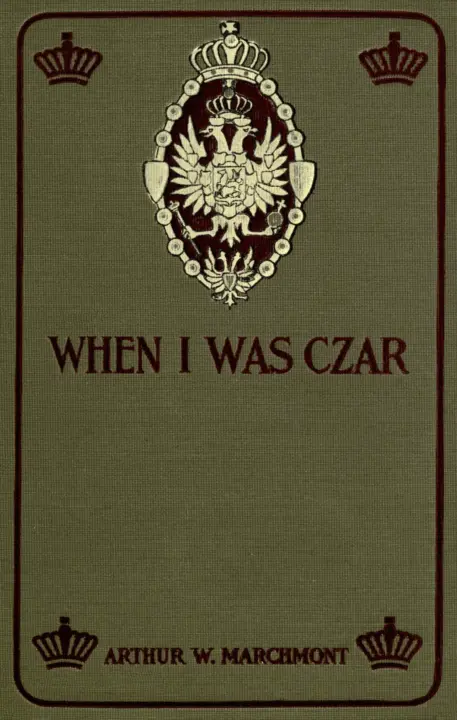
THE CLASSIC COLLECTION · 1903
"When I Was Czar" by Arthur W. Marchmont is a romance novel written in the early 20th century. The story centers on the main character, Harper C. Denver, an American who, due to a chance resemblance to the Czar of Russia, is drawn into a complex web of intrigue and deception. As he navigates a series of unexpected events in the Russian Empire, themes of identity, allegiance, and romance unfold. The opening portion of the novel introduces Harper in St. Petersburg as he reminisces about his past connection with the Czar, which leads him to a grand adventure. He receives an invitation to the Czar's palace and soon finds himself facing a peculiar proposition from Prince Kalkov: to impersonate the Czar in order to thwart the schemes of a dangerous man named Boreski, who is entangled in a plot involving secret documents and a romance with the Duchess Stephanie. Feeling an obligation to repay the Czar for saving his life years ago, Harper is apprehensive yet eager to embrace this extraordinary challenge, setting the stage for the ensuing drama that intertwines with his growing attraction to a mysterious woman named Helga.
Introduction adapted from the source catalogue; source summaries may be automatically generated.
Free to read · English · 102,126 words · No account needed
MAKE TIME FOR A GOOD BOOK
On by default. Untick to stop anonymous reading totals. Each page counts after 10 seconds in view. How this works.
Anonymous counting is on unless you have switched it off.
But I felt that Kalkov would only laugh at such a request from me, while of course I could not write a single word without the discrepancy of the handwriting being at once apparent.
I was loth to go back and admit my failure; but this I saw at length was the only resource. Every moment that I hesitated made the affair worse, so I put as bold a front on matters as I could and got up.
“This new admission of yours, M. Boreski,” I said with an assumption of dignity, “is so serious as to require consideration. Be good enough to have a carriage brought for me at once. The interview is at an end.”
He had risen with me and stood in indecision, when Helga interposed and took the lead in her own hands.
“You do not quite understand the position, I fear, monsieur,” she said
slowly.
“Do you mean I am not free to go--after your promise to me?”
“Oh no, no,” she cried, with one of her smiles. “I myself will order your carriage.” She rang the bell, and when the servant came she told him to order a carriage at once.
“I was sure of you, mademoiselle, and regret my hasty suspicion. You
will pardon it?”
“It was a natural inference--for one accustomed to treachery,” she replied, with soft sarcasm. “But we really are not traitors here. The way is open for you to leave--if you dare, monsieur?” And the challenge was in eyes, face, voice and manner alike.
“Dare? That is a strong word, mademoiselle.”
“Intentionally strong,” she retorted, with cutting deliberation. “Intentionally strong. I have been patient under injury, and have endured injustice, hoping, praying, and waiting for redress; living for the interview which I have had to-night--and had in vain. And now my patience is exhausted, and you have drained it to the dregs. Had there been a spark of just feeling left in your heart, a faint wan glimmer of desire to right the wrong done to mine and to me, and to wipe out the cruel stain of unmerited infamy, the name I mentioned to you to-night would have kindled the desire until, fanned by the remembrance of old and tried and dear friendship, it would have burned steadily with a bright avenging flame.” She spoke without passion in slow level accents.
I had not the faintest suspicion of her meaning.
“What name was that?” I asked, having even forgotten it.
The question drew a smile of contempt from her.
“I will not insult myself by repeating it.”
“The carriage is at the door, mademoiselle,” announced the servant.
“You can go, monsieur,” she said, when the man had left.
Your reading position is saved on this browser. Take it to another device with a library code. Reading pages adapt to text, rather than matching a printed edition.
Arthur W. Marchmont
Arthur W. Marchmont
Arthur W. Marchmont
Arthur W. Marchmont
BEHIND THE BOOK
This eBook is for the use of anyone anywhere in the United States and most other parts of the world at no cost and with almost no restrictions whatsoever. You may copy it, give it away or re-use it under the terms of the Project Gutenberg License included with this eBook or online at www.gutenberg.org. If you are not located in the United States, you will have to check the laws of the country where you are located before using this eBook. Read the source licence.
The original source file, including credits and licence, is retained by this library. Request an original-format copy at no charge. Please include the book title and Project Gutenberg identifier #63320.
KEEP YOUR CURIOSITY GOING
Coulson Kernahan

Maurice Baring
Frances Wright
Cécile Tormay

Frederic Jesup Stimson

W. H. P. (William Henry Pope) Jarvis