
Last letters from the living dead man
David Patterson (Spirit) Hatch
THE CLASSIC COLLECTION · 1919
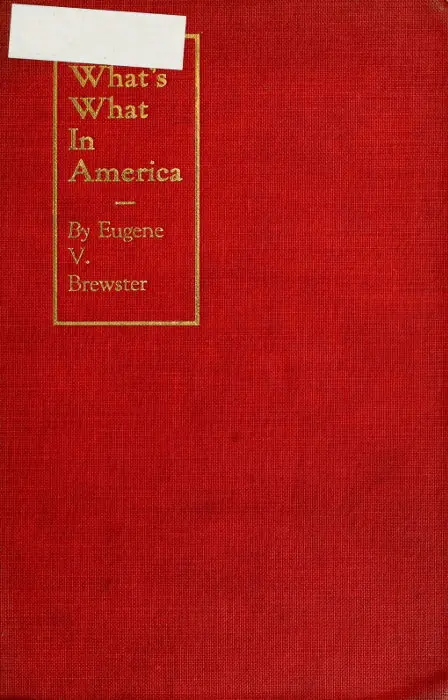
"What's What in America" by Eugene V. Brewster is a critical examination of societal trends and superstitions written in the early 20th century. The work discusses a variety of cultural phenomena viewed through Brewster's lens of skepticism, exploring the nature of credulity, self-deception, and the beliefs that take root in the American consciousness, including health fads and pseudosciences. At the start of the book, Brewster presents a preface outlining the complexities of American identity, highlighting the paradox of being a diverse yet unified society. He posits that Americans are drawn to various unorganized 'isms', such as Christian Science and phrenology, suggesting these credulities are indicative of a deeper social disarray. He introduces the themes of the book, indicating a series of essays that will dissect these ideologies, addressing the interplay of superstition, belief in the supernatural, and the sometimes absurd popularity of certain fads in the quest for understanding and meaning within the rapidly changing landscape of American life at the time.
Introduction adapted from the source catalogue; source summaries may be automatically generated.
Free to read · English · 46,415 words · No account needed
MAKE TIME FOR A GOOD BOOK
On by default. Untick to stop anonymous reading totals. Each page counts after 10 seconds in view. How this works.
Anonymous counting is on unless you have switched it off.
Again, in selecting the great men, should there not be some limit in number and some method of declaring different degrees of greatness, because otherwise the man who wrote "Home, Sweet Home" might find a place alongside Shakespeare. Again, should a conqueror be classed among the great? Still again, are philosophers like Schopenhauer, Ibsen, Bernard Shaw and Nietzsche to be numbered among the great, when most people say that their philosophy is wrong, destructive and immoral? No wonder, then, that nobody has yet been able to give a satisfactory definition of Greatness. Alexander accomplished wonders: he conquered the then known world and wept for other worlds to conquer; but perhaps he was not so deserving of his fellows as some poor shoemaker. And take Napoleon: he made all Europe run blood; yet he certainly did much good; are we to balance his account and determine if the good outweighed the bad? Dante and Milton are always numbered among the greatest men, yet some do say that these great poets did more harm than good by perpetuating the false doctrines of Hell and Paradise. Was Robespierre a great man?--no one questions that great good came from the French Revolution, yet who will urge a monument to Robespierre, the personification of that Revolution? His intentions were good, however bad may have been the method, but so were Cromwell's regardless of his fanaticism; yet public opinion curses the one and crowns the other. Some men seem to accomplish world-wonders without effort, while others struggle against tremendous odds: of the two, the latter, of course, are the greater, because, as Bryant says, "Difficulty is a nurse of greatness--a harsh nurse, who rocks her foster children roughly, but rocks them into strength. The mind, grappling with great aims and wrestling with mighty impediments, grows by a certain necessity to the stature of greatness." Some say that greatness is founded in human sympathy, and that the man who shows the biggest heart plus the greatest ability to do, is the greatest man. Others say that greatness consists in reforming the world along religious lines, and still others maintain that greatness is merely righteousness--"He is not great, who is no greatly good" (Shakespeare). Was Caesar great? Remember Campbell's line,--"What millions died that Caesar might be great." Beecher was doubtless right when he said, "Greatness lies not in being strong, but in the right use of strength," but men may differ as to what is the right use, for, suppose he uses it to defend his people against some other people, and for a cause which he believes in, as did Robert E. Lee? He thought he was right, many others thought he was right, and he displayed qualities truly great, yet Beecher would say that Lee was not a great man. No great man ever yet lived who was conceded so to be by everybody. We see many who are great, in a sense, and many that are good; but we seldom see a man who is both great and good; and, according to Franklin, a great man must be both. Leonardo da Vinci was great at many things,--"master of all the arts," and as virtuous as most men, yet many people place Caesar and Alexander in the list of great men and leave da Vinci out. Perhaps Colton was right when he said, "Subtract from the great men all that he owes to opportunity, all that he owes to chance, and all that he has gained by the wisdom of his friends and the folly of his enemies, and the giant will often be seen to be a pigmy." Shall we class Joan of Arc among the great? She was the victim of an illusion and she accomplished that which was bound to come. Shall we nominate Diogenes? He was what would now be called a tramp and lived in a tub. Shall we give Socrates a niche? He was also something of a tramp, and we may never know how much he really said of the many wise things which Plato attributed to him. Shall we declare Washington and Jefferson great, and not Tom Paine, when the latter knew more than the other two together, and gave them most of their ideas? No, we don't do that, because they say that Paine's religious views were bad. Shall Theodore Roosevelt go on the list? Shall we put Martin Luther on, and not Voltaire? And how about poor John Brown?--he did not accomplish much but he tried mighty hard and died in the attempt. Shall Booker T. Washington's name not go on the immortal list just because he is black? If not, how about Confucius who was yellow? Shall Jesus' name be written on the scroll and not Buddha's or Mohammed's? The fact is that it is next to impossible to name a complete list of the great men of history,--to say nothing of the greatest men. One of the toughest problems I ever attempted to solve was once given me by a young student, who asked me to write down the names of the twenty-five greatest men. I spent many evenings on it, and the answer was published in many newspapers. The chief difficulty came in the attempt to limit the list to just twenty-five--it is easy to make a list of about twenty-five, or about fifty, or about ten.
Your reading position is saved on this browser. Take it to another device with a library code. Reading pages adapt to text, rather than matching a printed edition.
BEHIND THE BOOK
This eBook is for the use of anyone anywhere in the United States and most other parts of the world at no cost and with almost no restrictions whatsoever. You may copy it, give it away or re-use it under the terms of the Project Gutenberg License included with this eBook or online at www.gutenberg.org. If you are not located in the United States, you will have to check the laws of the country where you are located before using this eBook. Read the source licence.
The original source file, including credits and licence, is retained by this library. Request an original-format copy at no charge. Please include the book title and Project Gutenberg identifier #54370.
KEEP YOUR CURIOSITY GOING
David Patterson (Spirit) Hatch

David Patterson (Spirit) Hatch

David Patterson (Spirit) Hatch
Cécile Tormay

Moritz Busch
John L. Ransom