
Last letters from the living dead man
David Patterson (Spirit) Hatch
THE CLASSIC COLLECTION · 1919
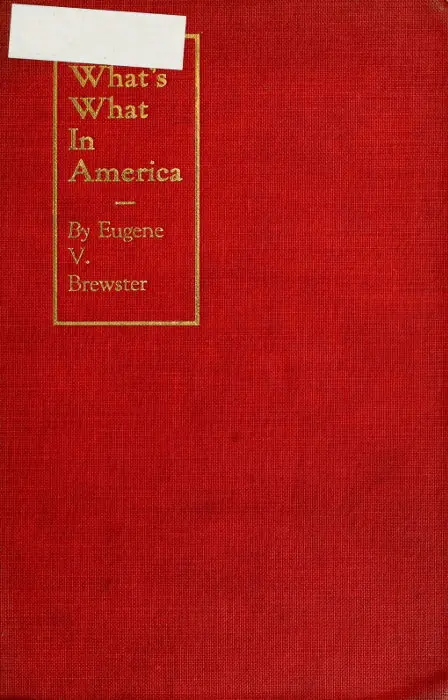
"What's What in America" by Eugene V. Brewster is a critical examination of societal trends and superstitions written in the early 20th century. The work discusses a variety of cultural phenomena viewed through Brewster's lens of skepticism, exploring the nature of credulity, self-deception, and the beliefs that take root in the American consciousness, including health fads and pseudosciences. At the start of the book, Brewster presents a preface outlining the complexities of American identity, highlighting the paradox of being a diverse yet unified society. He posits that Americans are drawn to various unorganized 'isms', such as Christian Science and phrenology, suggesting these credulities are indicative of a deeper social disarray. He introduces the themes of the book, indicating a series of essays that will dissect these ideologies, addressing the interplay of superstition, belief in the supernatural, and the sometimes absurd popularity of certain fads in the quest for understanding and meaning within the rapidly changing landscape of American life at the time.
Introduction adapted from the source catalogue; source summaries may be automatically generated.
Free to read · English · 46,415 words · No account needed
MAKE TIME FOR A GOOD BOOK
On by default. Untick to stop anonymous reading totals. Each page counts after 10 seconds in view. How this works.
Anonymous counting is on unless you have switched it off.
Physiognomy is not entirely a delusion. There is no "science" of Physiognomy, however, nor is it an exact art. The rules laid down by Adamantius were quite different from those of Aristotle, just as those of Baptist Porta and Robert Fludd were quite different from Levater's. Physiognomy is the art of knowing the humor, temperament or disposition of a person from observation of the lines of the face, and from the character of its members or features. While there is as yet no code of rules laid down by any author which constitutes a trustworthy guide, there in an apparent analogy between the mind and the countenance, which is discernible to keen observers. Probably every man and woman prides him or herself on the ability of translating expression, because we all imagine that we are good judges of human nature; yet, we have all erred in this regard, and often they were costly errors. Our instincts and intuitions, are perhaps the safest guides, after all, for there is but little reliance to be placed on the text books; and the common beliefs regarding the meaning of the features are anything but reliable. The best that can be done, for the present, is to assemble the predominating characteristics of the great men of history and compare these with their portraits.
It is generally conceded that the greatest authority on Physiognomy is Levater; yet, in my copy of his principal work, which, by the way, is the voluminous 15th London edition, he says: "I understand but little of physiognomy, and have been, and continue daily to be, mistaken in my judgment." Since no greater physiognomist ever lived, it seems fair to assume that there is no "science" of physiognomy, and no infallible system with which we can read the character and capabilities of a person by means of the features. Whether such a science will yet be discovered or devised, remains to be seen. However, it is possible, and even probable, that the features all have meanings, even if we do not know those meanings, and that the code finally adopted by Levater is fairly correct. This being true, the best we can say for Physiognomy is that it helps us to interpret character by showing us tendencies. That is, given a face the chin of which denotes firmness, and the mouth tenacity, we may be reasonably certain that the individual will have a strong tendency to do thus and so under certain conditions, provided those characteristics are not over-balanced and offset by other characteristics. That the tendency is not conclusive, is apparent: for the person may be born with a nose which, according to Physiognomy, denotes criminal propensities; yet, he may have overcome his immoral tendencies by means of education, religion or environment, while his nose remains unchanged. Again, he may have certain features which are said to denote generosity, for example, yet there may be various other features which denote love of power, acquisitiveness, vanity, etc., which would make it quite impossible to say that generosity would predominate, and to which tendency the subject would yield. Indeed, it is a grave question if all the accumulated knowledge of the ages on Physiognomy would not be misleading, even if every person knew the precise meaning of every section of the face; for, however skilful we might be, our judgment would constantly be taxed to the utmost to weigh and balance, to compare and distinguish, one indication with another, and then that other with still another, and with perhaps a whole group of others,--a task for a mathematician, psychologist and philosopher combined. Again, who may say that a large nose, which was esteemed so highly by Napoleon, or a strong jaw, which is generally understood to denote perseverance, may not be mere accidents of nature, for are not some born tongue-tied, cross-eyed or flat-footed, without design, meaning or tendency, so far as those physical conditions are concerned? And do not all persons develop one or more faculties, and neglect others, without causing any change in the bones of the face? One may conquer and conquer, like Alexander, until there are no more worlds to be conquered, and yet not acquire a conqueror's nose. If we treat Physiognomy as the science of interpreting expression by means of the muscular anatomy of the face, that is a different matter; but the real Physiognomy deals with bones as well as with muscles. If there is doubt as to whether the shape of the bones of the face are indicative of character, there is no doubt that the flesh and muscles of the face form what we call expression of the countenance, and that this can be interpreted with some degree of accuracy.
Your reading position is saved on this browser. Take it to another device with a library code. Reading pages adapt to text, rather than matching a printed edition.
BEHIND THE BOOK
This eBook is for the use of anyone anywhere in the United States and most other parts of the world at no cost and with almost no restrictions whatsoever. You may copy it, give it away or re-use it under the terms of the Project Gutenberg License included with this eBook or online at www.gutenberg.org. If you are not located in the United States, you will have to check the laws of the country where you are located before using this eBook. Read the source licence.
The original source file, including credits and licence, is retained by this library. Request an original-format copy at no charge. Please include the book title and Project Gutenberg identifier #54370.
KEEP YOUR CURIOSITY GOING
David Patterson (Spirit) Hatch

David Patterson (Spirit) Hatch

David Patterson (Spirit) Hatch
Cécile Tormay

Moritz Busch
John L. Ransom