
Last letters from the living dead man
David Patterson (Spirit) Hatch
THE CLASSIC COLLECTION · 1919
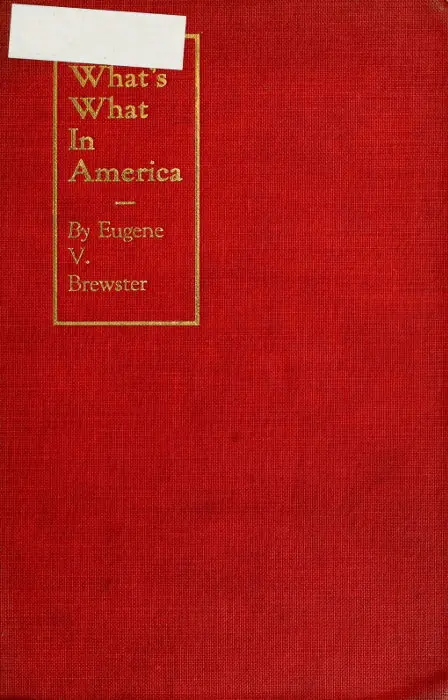
"What's What in America" by Eugene V. Brewster is a critical examination of societal trends and superstitions written in the early 20th century. The work discusses a variety of cultural phenomena viewed through Brewster's lens of skepticism, exploring the nature of credulity, self-deception, and the beliefs that take root in the American consciousness, including health fads and pseudosciences. At the start of the book, Brewster presents a preface outlining the complexities of American identity, highlighting the paradox of being a diverse yet unified society. He posits that Americans are drawn to various unorganized 'isms', such as Christian Science and phrenology, suggesting these credulities are indicative of a deeper social disarray. He introduces the themes of the book, indicating a series of essays that will dissect these ideologies, addressing the interplay of superstition, belief in the supernatural, and the sometimes absurd popularity of certain fads in the quest for understanding and meaning within the rapidly changing landscape of American life at the time.
Introduction adapted from the source catalogue; source summaries may be automatically generated.
Free to read · English · 46,415 words · No account needed
MAKE TIME FOR A GOOD BOOK
On by default. Untick to stop anonymous reading totals. Each page counts after 10 seconds in view. How this works.
Anonymous counting is on unless you have switched it off.
Dr. Still would have us believe that Osteopathy is something of a cure-all, and that its adoption makes the use of drugs unnecessary, but all Osteopaths do not make this claim. Dr. George V. Webster, D.O., says: "Osteopathy is not a cure-all. There are disorders that are incurable." This is encouraging, because we now know that if a disease is incurable Osteopathy cannot cure it! Dr. Webster says that "there are diseases needing surgical attention," that in some cases an anesthetic is necessary, that a parasite requires an antiseptic, and that a poison requires an antidote. Thus he has found that drugs have some uses, at least. In one place Dr. Webster says that Osteopathy is not a cure-all, and in another we find him saying, "The application of osteopathic principles to meet the problems of bodily disorder has demonstrated their efficiency in practically all diseases"! Dr. Still himself says, "You may say there are some failures. Yes, who would not expect it? Perhaps the Osteopath is not able to apply the knowledge he should have gained before being granted a diploma from his osteopathic school."
And thus, all through the Osteopath literature there is an inference that bone manipulation cures everything, although it admits that it has not always done so. This is the weak, fatally weak, spot in Osteopathy. It is the old story of the over-enthusiastic specialist who thinks that the sun rises and sets on his pet theory. Show a child a watch, and all it sees and understands is that it is wound up and that the hands move around. If the watch gets out of order the child tries to wind it up again--that is all it knows. It does not know that inside the case are hundreds of delicately arranged parts that are adjusted to a nicety. It does not know that some of these parts may be worn out from over-use, or are missing, or broken, or that they need cleaning. Likewise, when the Osteopath sees a body suffering from some disorder, he usually sees only the blood vessels and nerves, and he decides at once that one or more of them is being squeezed by a misadjustment of some bone or muscle. He looks on the spinal column as the backbone of the human structure, which is of course true, and surmises that if anything is wrong it must have originated in the spinal cord, which is not necessarily true. If it is indigestion, or a disease of the kidney, or what not, he thinks that by turning one of the keys on the spinal cord it will unlock the necessary drug and let it flow to the disordered part. He wears a pair of glasses on which is written the word "Osteopathy," and when he looks he sees nothing but Osteopathy. Now, as a matter of fact, he is right in many cases. He will cure when all the doctors in the world might not even relieve. He has a great truth. He holds the key that unlocks the door to many a mystery, and it is a key that should be in common use, by all doctors. Where the regular physician would perhaps drug his patient to death, the Osteopath might cure him with a few simple treatments. Take, for example, a headache. Now, a headache is a symptom, not a disease. It is a sign that something is going wrong. It is a sign that there is either too much blood in the head, or not enough, usually the former. In either case, it is probable that there is some abnormal pressure on some blood-vessel or nerve, and that if that pressure could be released the headache would disappear. Just examine a model of the spinal cord sometime and see what a complicated structure it is, with all the little nerves, blood vessels and muscles so intricately interwoven between its many parts. We are all prone to get in certain habits. We learn to read in a certain posture, and to write, and to lie down, and to walk, and to sit, and in the course of years it would be strange if one or more of our thousands of parts did not get into an abnormal position so as to compress or squeeze some of the delicately arranged nerves or blood channels, thus preventing freedom of passage. Such a condition might set up congestion and inflammation, and it is likely to affect seriously some distant organ. By readjusting the bones of the neck, shoulder, back or spinal cord, we relieve that pressure and thereby cure the disorder. There can be no doubt of all this, and every regular physician ought to know it and to practice it, but they don't and won't. Furthermore, they won't refer the patient to an Osteopath. Professional jealousy!
Your reading position is saved on this browser. Take it to another device with a library code. Reading pages adapt to text, rather than matching a printed edition.
BEHIND THE BOOK
This eBook is for the use of anyone anywhere in the United States and most other parts of the world at no cost and with almost no restrictions whatsoever. You may copy it, give it away or re-use it under the terms of the Project Gutenberg License included with this eBook or online at www.gutenberg.org. If you are not located in the United States, you will have to check the laws of the country where you are located before using this eBook. Read the source licence.
The original source file, including credits and licence, is retained by this library. Request an original-format copy at no charge. Please include the book title and Project Gutenberg identifier #54370.
KEEP YOUR CURIOSITY GOING
David Patterson (Spirit) Hatch

David Patterson (Spirit) Hatch

David Patterson (Spirit) Hatch
Cécile Tormay

Moritz Busch
John L. Ransom